

reduced with the multiplication of the different desirability function values d i (y i ) to
one overall desirability D:
D ¼
Y n
i¼1
d i y i
ð Þ
ð19Þ
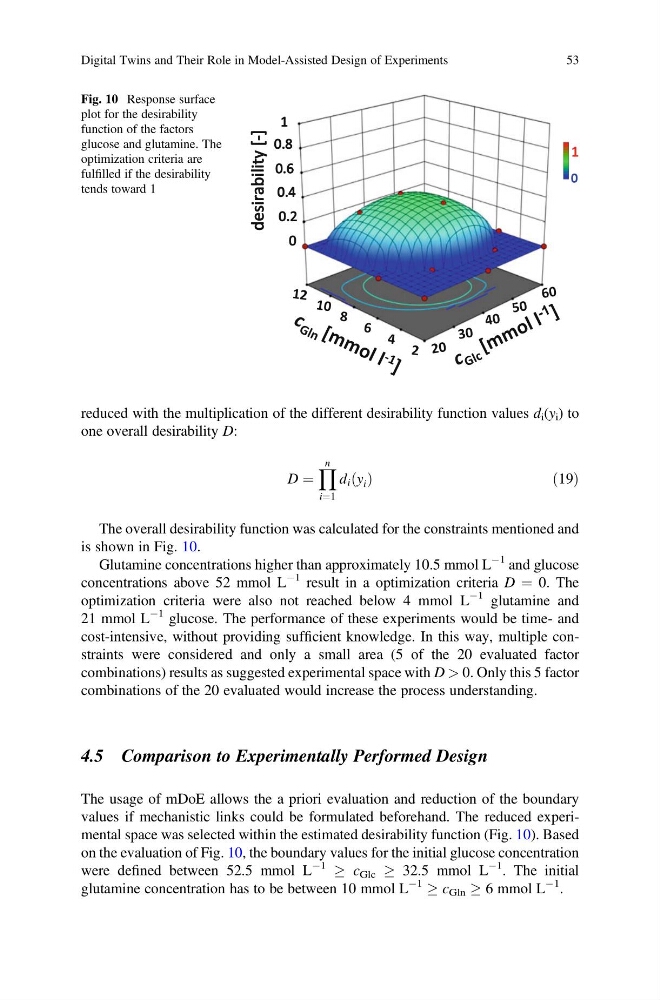
The overall desirability function was calculated for the constraints mentioned and
is shown in Fig. 10.
Glutamine concentrations higher than approximately 10.5 mmol L
À1 and glucose
concentrations above 52 mmol L
À1 result in a optimization criteria D ¼ 0. The
optimization criteria were also not reached below 4 mmol L
À1 glutamine and
21 mmol L
À1 glucose. The performance of these experiments would be time- and
cost-intensive, without providing sufficient knowledge. In this way, multiple constraints were considered and only a small area (5 of the 20 evaluated factor
combinations) results as suggested experimental space with D > 0. Only this 5 factor
combinations of the 20 evaluated would increase the process understanding.
4.5 Comparison to Experimentally Performed Design
The usage of mDoE allows the a priori evaluation and reduction of the boundary
values if mechanistic links could be formulated beforehand. The reduced experimental space was selected within the estimated desirability function (Fig. 10). Based
on the evaluation of Fig. 10, the boundary values for the initial glucose concentration
were defined between 52.5 mmol L
À1
! c Glc ! 32.5 mmol L
À1 . The initial
glutamine concentration has to be between 10 mmol L
À1
! c Gln ! 6 mmol L
À1 .
0 0
0.2
0.4
0.6
0.8
1
1
0
desirability [desirability [-]
Fig. 10 Response surface
plot for the desirability
function of the factors
glucose and glutamine. The
optimization criteria are
fulfilled if the desirability
tends toward 1
Digital Twins and Their Role in Model-Assisted Design of Experiments
53
one overall desirability D:
D ¼
Y n
i¼1
d i y i
ð Þ
ð19Þ
The overall desirability function was calculated for the constraints mentioned and
is shown in Fig. 10.
Glutamine concentrations higher than approximately 10.5 mmol L
À1 and glucose
concentrations above 52 mmol L
À1 result in a optimization criteria D ¼ 0. The
optimization criteria were also not reached below 4 mmol L
À1 glutamine and
21 mmol L
À1 glucose. The performance of these experiments would be time- and
cost-intensive, without providing sufficient knowledge. In this way, multiple constraints were considered and only a small area (5 of the 20 evaluated factor
combinations) results as suggested experimental space with D > 0. Only this 5 factor
combinations of the 20 evaluated would increase the process understanding.
4.5 Comparison to Experimentally Performed Design
The usage of mDoE allows the a priori evaluation and reduction of the boundary
values if mechanistic links could be formulated beforehand. The reduced experimental space was selected within the estimated desirability function (Fig. 10). Based
on the evaluation of Fig. 10, the boundary values for the initial glucose concentration
were defined between 52.5 mmol L
À1
! c Glc ! 32.5 mmol L
À1 . The initial
glutamine concentration has to be between 10 mmol L
À1
! c Gln ! 6 mmol L
À1 .
0 0
0.2
0.4
0.6
0.8
1
1
0
desirability [desirability [-]
Fig. 10 Response surface
plot for the desirability
function of the factors
glucose and glutamine. The
optimization criteria are
fulfilled if the desirability
tends toward 1
Digital Twins and Their Role in Model-Assisted Design of Experiments
53