

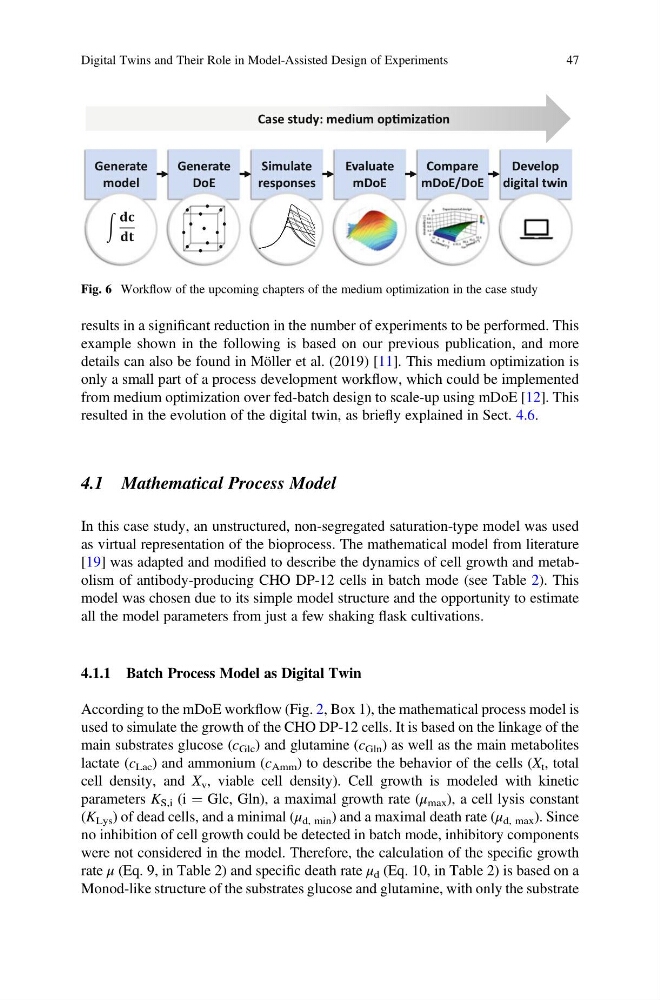
results in a significant reduction in the number of experiments to be performed. This
example shown in the following is based on our previous publication, and more
details can also be found in Möller et al. (2019) [11]. This medium optimization is
only a small part of a process development workflow, which could be implemented
from medium optimization over fed-batch design to scale-up using mDoE [12]. This
resulted in the evolution of the digital twin, as briefly explained in Sect. 4.6.
4.1 Mathematical Process Model
In this case study, an unstructured, non-segregated saturation-type model was used
as virtual representation of the bioprocess. The mathematical model from literature
[19] was adapted and modified to describe the dynamics of cell growth and metabolism of antibody-producing CHO DP-12 cells in batch mode (see Table 2). This
model was chosen due to its simple model structure and the opportunity to estimate
all the model parameters from just a few shaking flask cultivations.
4.1.1 Batch Process Model as Digital Twin
According to the mDoE workflow (Fig. 2, Box 1), the mathematical process model is
used to simulate the growth of the CHO DP-12 cells. It is based on the linkage of the
main substrates glucose (c Glc ) and glutamine (c Gln ) as well as the main metabolites
lactate (c Lac ) and ammonium (c Amm ) to describe the behavior of the cells (X t , total
cell density, and X v , viable cell density). Cell growth is modeled with kinetic
parameters K S,i (i ¼ Glc, Gln), a maximal growth rate (μ max ), a cell lysis constant
(K Lys ) of dead cells, and a minimal (μ d, min ) and a maximal death rate (μ d, max ). Since
no inhibition of cell growth could be detected in batch mode, inhibitory components
were not considered in the model. Therefore, the calculation of the specific growth
rate μ (Eq. 9, in Table 2) and specific death rate μ d (Eq. 10, in Table 2) is based on a
Monod-like structure of the substrates glucose and glutamine, with only the substrate
Generate
DoE
Evaluate
mDoE
Compare
mDoE/DoE
Develop
digital twin
Simulate
responses
Generate
model
Case study: medium opƟmizaƟon
Fig. 6 Workflow of the upcoming chapters of the medium optimization in the case study
Digital Twins and Their Role in Model-Assisted Design of Experiments
47
example shown in the following is based on our previous publication, and more
details can also be found in Möller et al. (2019) [11]. This medium optimization is
only a small part of a process development workflow, which could be implemented
from medium optimization over fed-batch design to scale-up using mDoE [12]. This
resulted in the evolution of the digital twin, as briefly explained in Sect. 4.6.
4.1 Mathematical Process Model
In this case study, an unstructured, non-segregated saturation-type model was used
as virtual representation of the bioprocess. The mathematical model from literature
[19] was adapted and modified to describe the dynamics of cell growth and metabolism of antibody-producing CHO DP-12 cells in batch mode (see Table 2). This
model was chosen due to its simple model structure and the opportunity to estimate
all the model parameters from just a few shaking flask cultivations.
4.1.1 Batch Process Model as Digital Twin
According to the mDoE workflow (Fig. 2, Box 1), the mathematical process model is
used to simulate the growth of the CHO DP-12 cells. It is based on the linkage of the
main substrates glucose (c Glc ) and glutamine (c Gln ) as well as the main metabolites
lactate (c Lac ) and ammonium (c Amm ) to describe the behavior of the cells (X t , total
cell density, and X v , viable cell density). Cell growth is modeled with kinetic
parameters K S,i (i ¼ Glc, Gln), a maximal growth rate (μ max ), a cell lysis constant
(K Lys ) of dead cells, and a minimal (μ d, min ) and a maximal death rate (μ d, max ). Since
no inhibition of cell growth could be detected in batch mode, inhibitory components
were not considered in the model. Therefore, the calculation of the specific growth
rate μ (Eq. 9, in Table 2) and specific death rate μ d (Eq. 10, in Table 2) is based on a
Monod-like structure of the substrates glucose and glutamine, with only the substrate
Generate
DoE
Evaluate
mDoE
Compare
mDoE/DoE
Develop
digital twin
Simulate
responses
Generate
model
Case study: medium opƟmizaƟon
Fig. 6 Workflow of the upcoming chapters of the medium optimization in the case study
Digital Twins and Their Role in Model-Assisted Design of Experiments
47