

3.1 Digital Twins in Model-Assisted Design of Experiments
As already discussed, the term “digital twin” is still not sufficiently defined and has
different meanings in different parts of industry. Historically, it is a computational
model of a machine tool or a mechanical manufacturing site, and it is used to handle
the increased complexity [8]. In the bioprocess industry, digital twins progressively
include multiple parts of the manufacturing steps and their interaction [9]. They are
intended to be a universal tool for the entire life cycle of a bioprocess, whereby the
digital twins are virtual counterparts to the processes. They enable predictive
manufacturing, meaning that bioprocesses can be analyzed, optimized, forecasted,
and controlled [62]. The complexity of digital twins highly depends on the desired
focus of application, and they can be based on a variety of complex structures as
data-driven models, artificial neural network, or mathematical process models
[22, 24].
With respect to the application of mDoE, the mathematical modeling in the initial
phase of process development is, in the author’s opinion, the starting point for
knowledge integration into a digital twin for the entire life cycle of the bioprocess.
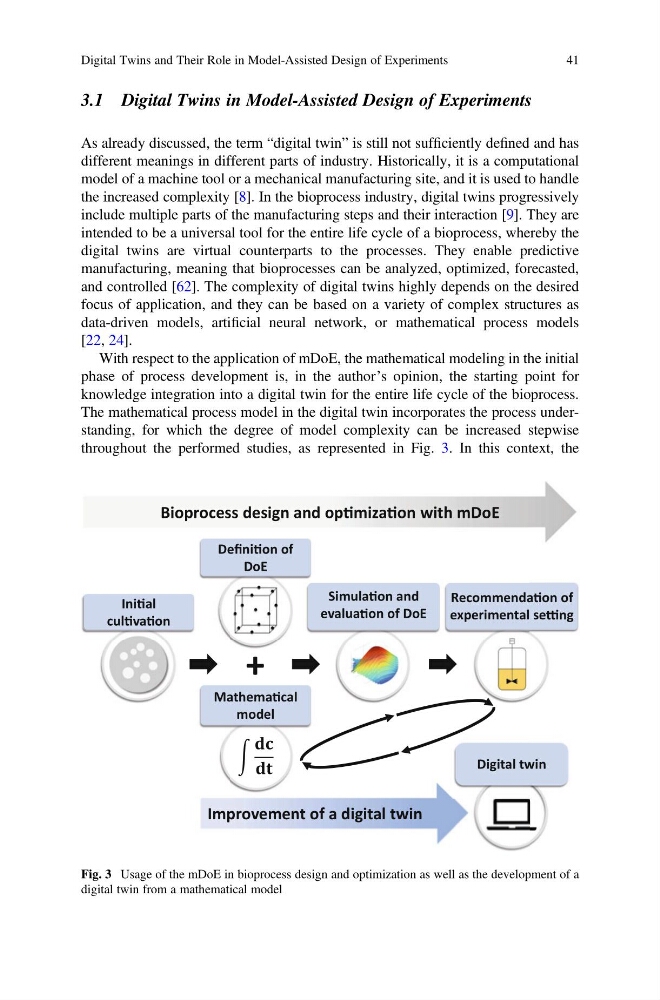
The mathematical process model in the digital twin incorporates the process understanding, for which the degree of model complexity can be increased stepwise
throughout the performed studies, as represented in Fig. 3. In this context, the
Bioprocess design and op
za
with mDoE
+
Improvement of a digital twin
Simula
and
evalua on of DoE
Defin on of
DoE
Mathema cal
model
Ini al
va on
Recommenda on of
experimental se
Digital twin
Fig. 3 Usage of the mDoE in bioprocess design and optimization as well as the development of a
digital twin from a mathematical model
Digital Twins and Their Role in Model-Assisted Design of Experiments
41
As already discussed, the term “digital twin” is still not sufficiently defined and has
different meanings in different parts of industry. Historically, it is a computational
model of a machine tool or a mechanical manufacturing site, and it is used to handle
the increased complexity [8]. In the bioprocess industry, digital twins progressively
include multiple parts of the manufacturing steps and their interaction [9]. They are
intended to be a universal tool for the entire life cycle of a bioprocess, whereby the
digital twins are virtual counterparts to the processes. They enable predictive
manufacturing, meaning that bioprocesses can be analyzed, optimized, forecasted,
and controlled [62]. The complexity of digital twins highly depends on the desired
focus of application, and they can be based on a variety of complex structures as
data-driven models, artificial neural network, or mathematical process models
[22, 24].
With respect to the application of mDoE, the mathematical modeling in the initial
phase of process development is, in the author’s opinion, the starting point for
knowledge integration into a digital twin for the entire life cycle of the bioprocess.
The mathematical process model in the digital twin incorporates the process understanding, for which the degree of model complexity can be increased stepwise
throughout the performed studies, as represented in Fig. 3. In this context, the
Bioprocess design and op
za
with mDoE
+
Improvement of a digital twin
Simula
and
evalua on of DoE
Defin on of
DoE
Mathema cal
model
Ini al
va on
Recommenda on of
experimental se
Digital twin
Fig. 3 Usage of the mDoE in bioprocess design and optimization as well as the development of a
digital twin from a mathematical model
Digital Twins and Their Role in Model-Assisted Design of Experiments
41