

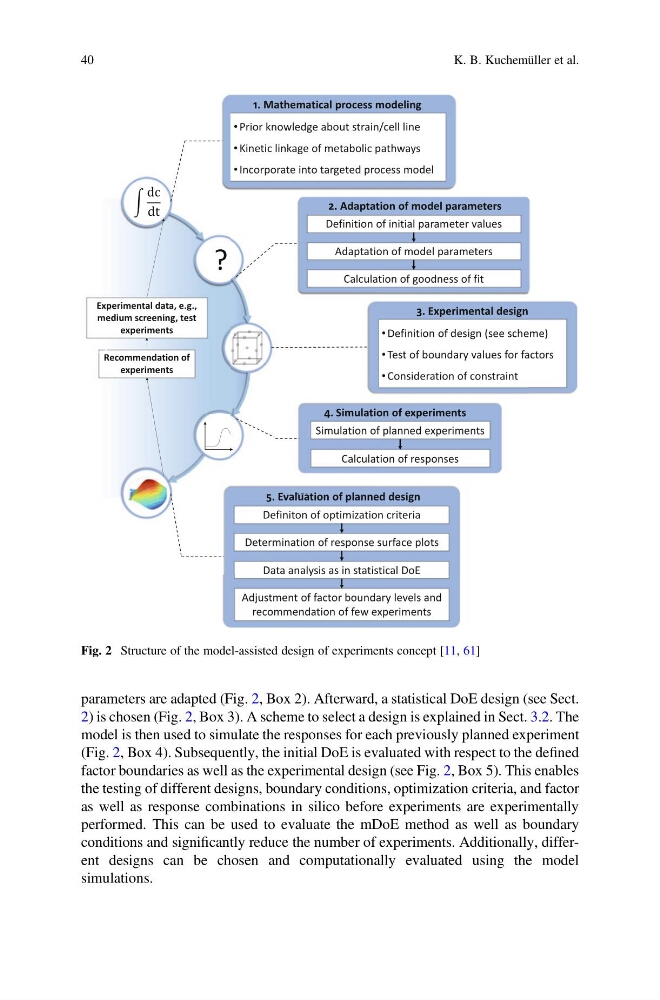
parameters are adapted (Fig. 2, Box 2). Afterward, a statistical DoE design (see Sect.
2) is chosen (Fig. 2, Box 3). A scheme to select a design is explained in Sect. 3.2. The
model is then used to simulate the responses for each previously planned experiment
(Fig. 2, Box 4). Subsequently, the initial DoE is evaluated with respect to the defined
factor boundaries as well as the experimental design (see Fig. 2, Box 5). This enables
the testing of different designs, boundary conditions, optimization criteria, and factor
as well as response combinations in silico before experiments are experimentally
performed. This can be used to evaluate the mDoE method as well as boundary
conditions and significantly reduce the number of experiments. Additionally, different designs can be chosen and computationally evaluated using the model
simulations.
25
2. Adaptation of model parameters
Definition of initial parameter values
Adaptation of model parameters
Calculation of goodness of fit
1. Mathematical process modeling
• Prior knowledge about strain/cell line
• Kinetic linkage of metabolic pathways
• Incorporate into targeted process model
3. Experimental design
• Definition of design (see scheme)
• Test of boundary values for factors
• Consideration of constraint
Simulation of planned experiments
4. Simulation of experiments
Calculation of responses
Recommendation of
experiments
Experimental data, e.g.,
medium screening, test
experiments
?
Determination of response surface plots
5. Evaluation of planned design
Data analysis as in statistical DoE
Adjustment of factor boundary levels and
recommendation of few experiments
Definiton of optimization criteria
Fig. 2 Structure of the model-assisted design of experiments concept [11, 61]
40
K. B. Kuchemüller et al.
2) is chosen (Fig. 2, Box 3). A scheme to select a design is explained in Sect. 3.2. The
model is then used to simulate the responses for each previously planned experiment
(Fig. 2, Box 4). Subsequently, the initial DoE is evaluated with respect to the defined
factor boundaries as well as the experimental design (see Fig. 2, Box 5). This enables
the testing of different designs, boundary conditions, optimization criteria, and factor
as well as response combinations in silico before experiments are experimentally
performed. This can be used to evaluate the mDoE method as well as boundary
conditions and significantly reduce the number of experiments. Additionally, different designs can be chosen and computationally evaluated using the model
simulations.
25
2. Adaptation of model parameters
Definition of initial parameter values
Adaptation of model parameters
Calculation of goodness of fit
1. Mathematical process modeling
• Prior knowledge about strain/cell line
• Kinetic linkage of metabolic pathways
• Incorporate into targeted process model
3. Experimental design
• Definition of design (see scheme)
• Test of boundary values for factors
• Consideration of constraint
Simulation of planned experiments
4. Simulation of experiments
Calculation of responses
Recommendation of
experiments
Experimental data, e.g.,
medium screening, test
experiments
?
Determination of response surface plots
5. Evaluation of planned design
Data analysis as in statistical DoE
Adjustment of factor boundary levels and
recommendation of few experiments
Definiton of optimization criteria
Fig. 2 Structure of the model-assisted design of experiments concept [11, 61]
40
K. B. Kuchemüller et al.