

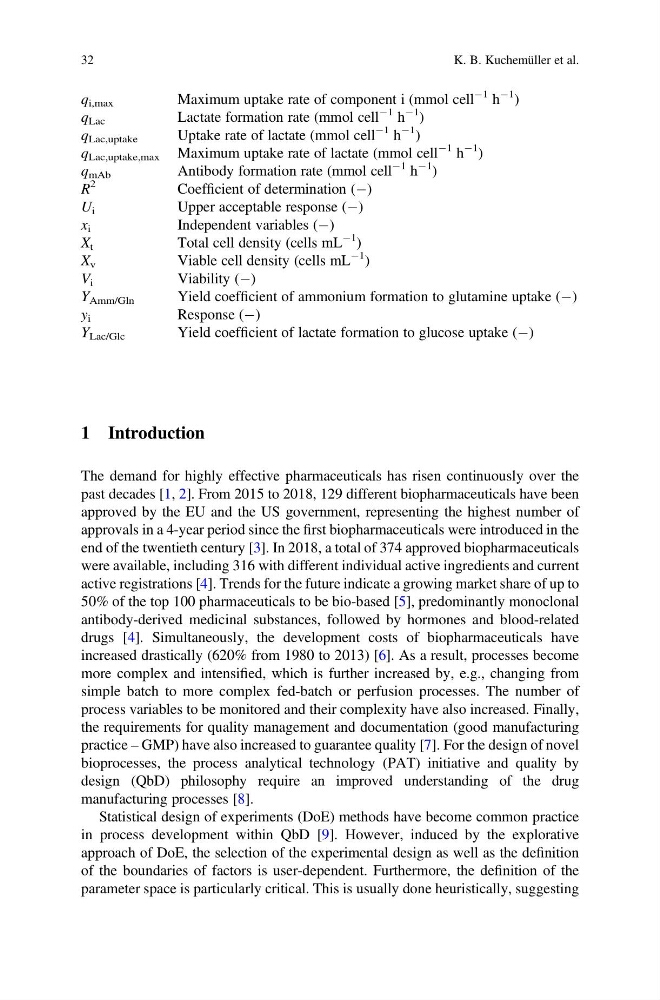
q i,max
Maximum uptake rate of component i (mmol cell
À1 h
À1 )
q Lac
Lactate formation rate (mmol cell
À1 h
À1 )
q Lac,uptake
Uptake rate of lactate (mmol cell
À1 h
À1 )
q Lac,uptake,max Maximum uptake rate of lactate (mmol cell
À1 h
À1 )
q mAb
Antibody formation rate (mmol cell
À1 h
À1 )
R
2
Coefficient of determination (À)
U i
Upper acceptable response (À)
x i
Independent variables (À)
X t
Total cell density (cells mL
À1 )
X v
Viable cell density (cells mL
À1 )
V i
Viability (À)
Y Amm/Gln
Yield coefficient of ammonium formation to glutamine uptake (À)
y i
Response (À)
Y Lac/Glc
Yield coefficient of lactate formation to glucose uptake (À)
1 Introduction
The demand for highly effective pharmaceuticals has risen continuously over the
past decades [1, 2]. From 2015 to 2018, 129 different biopharmaceuticals have been
approved by the EU and the US government, representing the highest number of
approvals in a 4-year period since the first biopharmaceuticals were introduced in the
end of the twentieth century [3]. In 2018, a total of 374 approved biopharmaceuticals
were available, including 316 with different individual active ingredients and current
active registrations [4]. Trends for the future indicate a growing market share of up to
50% of the top 100 pharmaceuticals to be bio-based [5], predominantly monoclonal
antibody-derived medicinal substances, followed by hormones and blood-related
drugs [4]. Simultaneously, the development costs of biopharmaceuticals have
increased drastically (620% from 1980 to 2013) [6]. As a result, processes become
more complex and intensified, which is further increased by, e.g., changing from
simple batch to more complex fed-batch or perfusion processes. The number of
process variables to be monitored and their complexity have also increased. Finally,
the requirements for quality management and documentation (good manufacturing
practice – GMP) have also increased to guarantee quality [7]. For the design of novel
bioprocesses, the process analytical technology (PAT) initiative and quality by
design (QbD) philosophy require an improved understanding of the drug
manufacturing processes [8].
Statistical design of experiments (DoE) methods have become common practice
in process development within QbD [9]. However, induced by the explorative
approach of DoE, the selection of the experimental design as well as the definition
of the boundaries of factors is user-dependent. Furthermore, the definition of the
parameter space is particularly critical. This is usually done heuristically, suggesting
32
K. B. Kuchemüller et al.
Maximum uptake rate of component i (mmol cell
À1 h
À1 )
q Lac
Lactate formation rate (mmol cell
À1 h
À1 )
q Lac,uptake
Uptake rate of lactate (mmol cell
À1 h
À1 )
q Lac,uptake,max Maximum uptake rate of lactate (mmol cell
À1 h
À1 )
q mAb
Antibody formation rate (mmol cell
À1 h
À1 )
R
2
Coefficient of determination (À)
U i
Upper acceptable response (À)
x i
Independent variables (À)
X t
Total cell density (cells mL
À1 )
X v
Viable cell density (cells mL
À1 )
V i
Viability (À)
Y Amm/Gln
Yield coefficient of ammonium formation to glutamine uptake (À)
y i
Response (À)
Y Lac/Glc
Yield coefficient of lactate formation to glucose uptake (À)
1 Introduction
The demand for highly effective pharmaceuticals has risen continuously over the
past decades [1, 2]. From 2015 to 2018, 129 different biopharmaceuticals have been
approved by the EU and the US government, representing the highest number of
approvals in a 4-year period since the first biopharmaceuticals were introduced in the
end of the twentieth century [3]. In 2018, a total of 374 approved biopharmaceuticals
were available, including 316 with different individual active ingredients and current
active registrations [4]. Trends for the future indicate a growing market share of up to
50% of the top 100 pharmaceuticals to be bio-based [5], predominantly monoclonal
antibody-derived medicinal substances, followed by hormones and blood-related
drugs [4]. Simultaneously, the development costs of biopharmaceuticals have
increased drastically (620% from 1980 to 2013) [6]. As a result, processes become
more complex and intensified, which is further increased by, e.g., changing from
simple batch to more complex fed-batch or perfusion processes. The number of
process variables to be monitored and their complexity have also increased. Finally,
the requirements for quality management and documentation (good manufacturing
practice – GMP) have also increased to guarantee quality [7]. For the design of novel
bioprocesses, the process analytical technology (PAT) initiative and quality by
design (QbD) philosophy require an improved understanding of the drug
manufacturing processes [8].
Statistical design of experiments (DoE) methods have become common practice
in process development within QbD [9]. However, induced by the explorative
approach of DoE, the selection of the experimental design as well as the definition
of the boundaries of factors is user-dependent. Furthermore, the definition of the
parameter space is particularly critical. This is usually done heuristically, suggesting
32
K. B. Kuchemüller et al.