

4 Mathematical Growth Modelling of MC-Based hMSC
Expansions
The development of mathematical growth models to describe or predict hMSC
growth is gaining in importance. This is not surprising since the cell material is
often limited and isolated directly from the patient. Thus, the prediction of the cell
growth depending on patient data (e.g., age, health status) is an important aspect,
especially for autologous therapies. The following section gives a brief overview of
different growth models described in the literature for the expansion of hMSCs. In
addition, a case study is presented and discussed, which presents an unstructured,
segregated growth model for the expansion of hMSCs on MCs.
4.1 Modelling Approaches
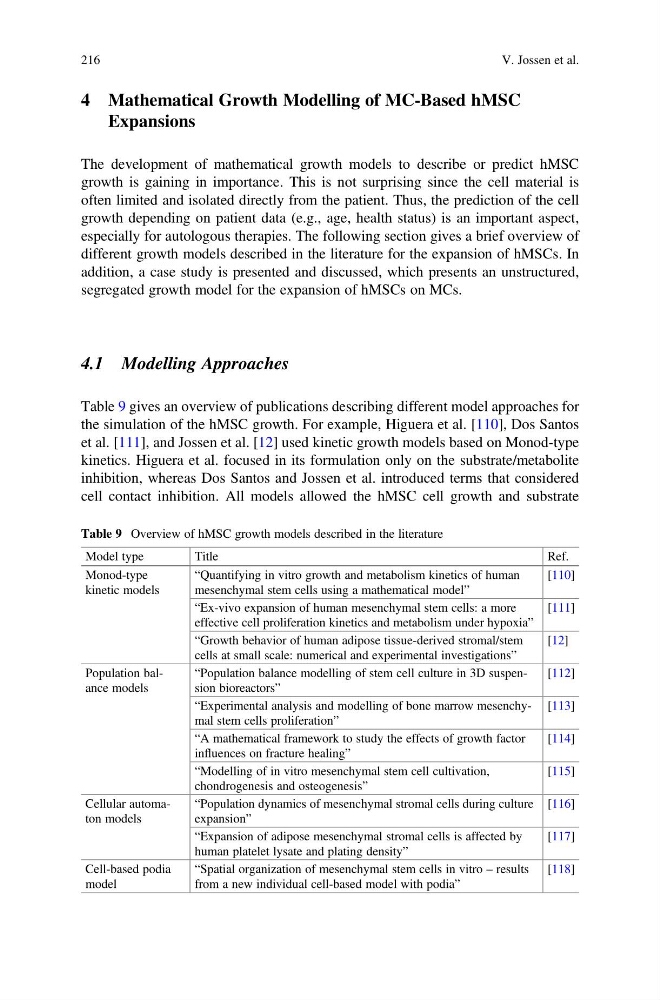
Table 9 gives an overview of publications describing different model approaches for
the simulation of the hMSC growth. For example, Higuera et al. [110], Dos Santos
et al. [111], and Jossen et al. [12] used kinetic growth models based on Monod-type
kinetics. Higuera et al. focused in its formulation only on the substrate/metabolite
inhibition, whereas Dos Santos and Jossen et al. introduced terms that considered
cell contact inhibition. All models allowed the hMSC cell growth and substrate
Table 9 Overview of hMSC growth models described in the literature
Model type
Title
Ref.
Monod-type
kinetic models
“Quantifying in vitro growth and metabolism kinetics of human
mesenchymal stem cells using a mathematical model”
[110]
“Ex-vivo expansion of human mesenchymal stem cells: a more
effective cell proliferation kinetics and metabolism under hypoxia”
[111]
“Growth behavior of human adipose tissue-derived stromal/stem
cells at small scale: numerical and experimental investigations”
[12]
Population balance models
“Population balance modelling of stem cell culture in 3D suspension bioreactors”
[112]
“Experimental analysis and modelling of bone marrow mesenchymal stem cells proliferation”
[113]
“A mathematical framework to study the effects of growth factor
influences on fracture healing”
[114]
“Modelling of in vitro mesenchymal stem cell cultivation,
chondrogenesis and osteogenesis”
[115]
Cellular automaton models
“Population dynamics of mesenchymal stromal cells during culture
expansion”
[116]
“Expansion of adipose mesenchymal stromal cells is affected by
human platelet lysate and plating density”
[117]
Cell-based podia
model
“Spatial organization of mesenchymal stem cells in vitro – results
from a new individual cell-based model with podia”
[118]
216
V. Jossen et al.
Expansions
The development of mathematical growth models to describe or predict hMSC
growth is gaining in importance. This is not surprising since the cell material is
often limited and isolated directly from the patient. Thus, the prediction of the cell
growth depending on patient data (e.g., age, health status) is an important aspect,
especially for autologous therapies. The following section gives a brief overview of
different growth models described in the literature for the expansion of hMSCs. In
addition, a case study is presented and discussed, which presents an unstructured,
segregated growth model for the expansion of hMSCs on MCs.
4.1 Modelling Approaches
Table 9 gives an overview of publications describing different model approaches for
the simulation of the hMSC growth. For example, Higuera et al. [110], Dos Santos
et al. [111], and Jossen et al. [12] used kinetic growth models based on Monod-type
kinetics. Higuera et al. focused in its formulation only on the substrate/metabolite
inhibition, whereas Dos Santos and Jossen et al. introduced terms that considered
cell contact inhibition. All models allowed the hMSC cell growth and substrate
Table 9 Overview of hMSC growth models described in the literature
Model type
Title
Ref.
Monod-type
kinetic models
“Quantifying in vitro growth and metabolism kinetics of human
mesenchymal stem cells using a mathematical model”
[110]
“Ex-vivo expansion of human mesenchymal stem cells: a more
effective cell proliferation kinetics and metabolism under hypoxia”
[111]
“Growth behavior of human adipose tissue-derived stromal/stem
cells at small scale: numerical and experimental investigations”
[12]
Population balance models
“Population balance modelling of stem cell culture in 3D suspension bioreactors”
[112]
“Experimental analysis and modelling of bone marrow mesenchymal stem cells proliferation”
[113]
“A mathematical framework to study the effects of growth factor
influences on fracture healing”
[114]
“Modelling of in vitro mesenchymal stem cell cultivation,
chondrogenesis and osteogenesis”
[115]
Cellular automaton models
“Population dynamics of mesenchymal stromal cells during culture
expansion”
[116]
“Expansion of adipose mesenchymal stromal cells is affected by
human platelet lysate and plating density”
[117]
Cell-based podia
model
“Spatial organization of mesenchymal stem cells in vitro – results
from a new individual cell-based model with podia”
[118]
216
V. Jossen et al.