

cells more robust and protected against the various stresses (e.g., hydrodynamic
stresses, physiochemical stresses, etc.) that occur during the in vitro expansion [86–
88]. The focus of this case study is on the biochemical engineering characterization
of the Corning spinner flasks (SP100 and SP300) with numerical methods (singleand multi-phase CFD simulations). Special emphasis is placed on the suspension
criteria (N s1u and N s1 ) which are investigated for their use in MC-based hMSC
expansions. The case study aims to highlight the use of CFD for the prediction of
biochemical engineering parameters and the establishment of a “Digital Twin” to
replicate real cultivation systems in silico. For this purpose, multi-phase simulations
with a continuum and discrete particle approach were performed, and timedependent hydrodynamic stresses were derived, based on the transient fluid flow.
3.2.1 Reactor Geometries and Model Approaches
The disposable Corning
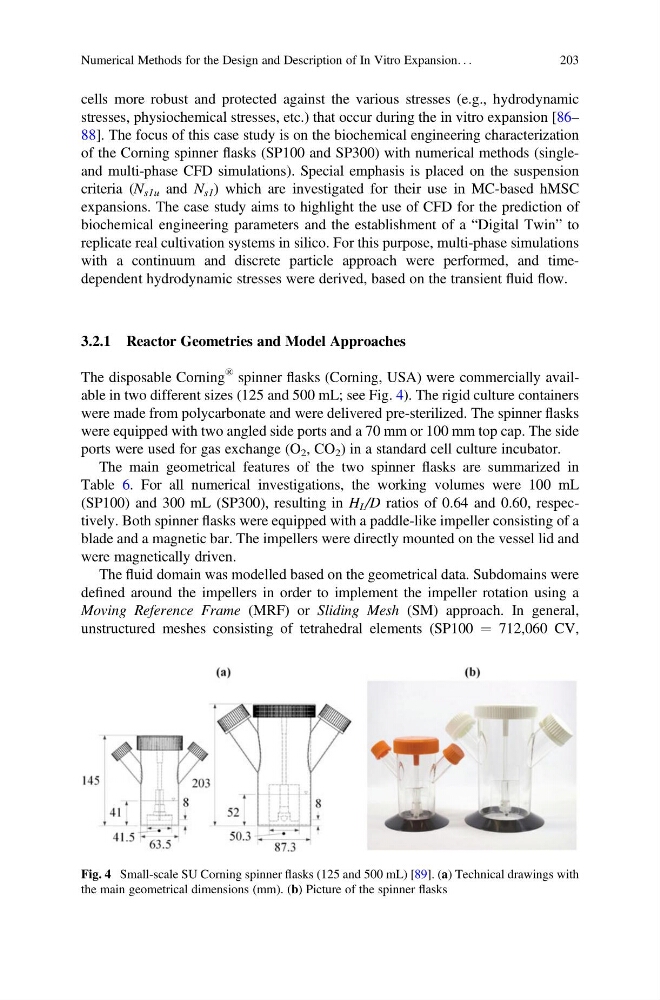
® spinner flasks (Corning, USA) were commercially available in two different sizes (125 and 500 mL; see Fig. 4). The rigid culture containers
were made from polycarbonate and were delivered pre-sterilized. The spinner flasks
were equipped with two angled side ports and a 70 mm or 100 mm top cap. The side
ports were used for gas exchange (O 2 , CO 2 ) in a standard cell culture incubator.
The main geometrical features of the two spinner flasks are summarized in
Table 6. For all numerical investigations, the working volumes were 100 mL
(SP100) and 300 mL (SP300), resulting in H L /D ratios of 0.64 and 0.60, respectively. Both spinner flasks were equipped with a paddle-like impeller consisting of a
blade and a magnetic bar. The impellers were directly mounted on the vessel lid and
were magnetically driven.
The fluid domain was modelled based on the geometrical data. Subdomains were
defined around the impellers in order to implement the impeller rotation using a
Moving Reference Frame (MRF) or Sliding Mesh (SM) approach. In general,
unstructured meshes consisting of tetrahedral elements (SP100 ¼ 712,060 CV,
Fig. 4 Small-scale SU Corning spinner flasks (125 and 500 mL) [89]. (a) Technical drawings with
the main geometrical dimensions (mm). (b) Picture of the spinner flasks
Numerical Methods for the Design and Description of In Vitro Expansion. . .
203
stresses, physiochemical stresses, etc.) that occur during the in vitro expansion [86–
88]. The focus of this case study is on the biochemical engineering characterization
of the Corning spinner flasks (SP100 and SP300) with numerical methods (singleand multi-phase CFD simulations). Special emphasis is placed on the suspension
criteria (N s1u and N s1 ) which are investigated for their use in MC-based hMSC
expansions. The case study aims to highlight the use of CFD for the prediction of
biochemical engineering parameters and the establishment of a “Digital Twin” to
replicate real cultivation systems in silico. For this purpose, multi-phase simulations
with a continuum and discrete particle approach were performed, and timedependent hydrodynamic stresses were derived, based on the transient fluid flow.
3.2.1 Reactor Geometries and Model Approaches
The disposable Corning
® spinner flasks (Corning, USA) were commercially available in two different sizes (125 and 500 mL; see Fig. 4). The rigid culture containers
were made from polycarbonate and were delivered pre-sterilized. The spinner flasks
were equipped with two angled side ports and a 70 mm or 100 mm top cap. The side
ports were used for gas exchange (O 2 , CO 2 ) in a standard cell culture incubator.
The main geometrical features of the two spinner flasks are summarized in
Table 6. For all numerical investigations, the working volumes were 100 mL
(SP100) and 300 mL (SP300), resulting in H L /D ratios of 0.64 and 0.60, respectively. Both spinner flasks were equipped with a paddle-like impeller consisting of a
blade and a magnetic bar. The impellers were directly mounted on the vessel lid and
were magnetically driven.
The fluid domain was modelled based on the geometrical data. Subdomains were
defined around the impellers in order to implement the impeller rotation using a
Moving Reference Frame (MRF) or Sliding Mesh (SM) approach. In general,
unstructured meshes consisting of tetrahedral elements (SP100 ¼ 712,060 CV,
Fig. 4 Small-scale SU Corning spinner flasks (125 and 500 mL) [89]. (a) Technical drawings with
the main geometrical dimensions (mm). (b) Picture of the spinner flasks
Numerical Methods for the Design and Description of In Vitro Expansion. . .
203