

phenotype, and differentiation [57, 58]. Thus, many efforts are being made to
develop GMP-grade biodegradable MCs. In general, cell attachment follows a
Poisson distribution, where cell-to-MC ratios of one, two, or three result in theoretical probabilities of unoccupied MCs of 0.365, 0.135, and 0.05, respectively
[59, 60]. Thus, theoretical cell densities for inoculation are in the range of between
3 and 5 cells per MC. After the cell attachment phase (4–20 h) under static or
intermitted stirred conditions, every MC should have the same number of cells
attached to its surface. However, in practice, this is not the case. As investigations
by Ferrari et al. [61] have shown, suboptimal cell seeding results in the early
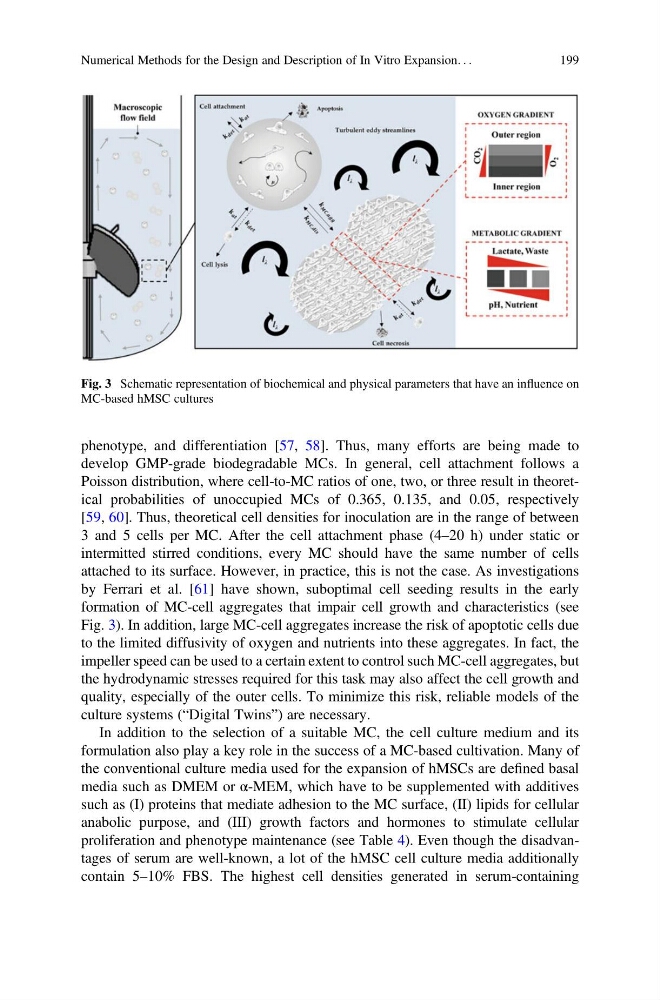
formation of MC-cell aggregates that impair cell growth and characteristics (see
Fig. 3). In addition, large MC-cell aggregates increase the risk of apoptotic cells due
to the limited diffusivity of oxygen and nutrients into these aggregates. In fact, the
impeller speed can be used to a certain extent to control such MC-cell aggregates, but
the hydrodynamic stresses required for this task may also affect the cell growth and
quality, especially of the outer cells. To minimize this risk, reliable models of the
culture systems (“Digital Twins”) are necessary.
In addition to the selection of a suitable MC, the cell culture medium and its
formulation also play a key role in the success of a MC-based cultivation. Many of
the conventional culture media used for the expansion of hMSCs are defined basal
media such as DMEM or α-MEM, which have to be supplemented with additives
such as (I) proteins that mediate adhesion to the MC surface, (II) lipids for cellular
anabolic purpose, and (III) growth factors and hormones to stimulate cellular
proliferation and phenotype maintenance (see Table 4). Even though the disadvantages of serum are well-known, a lot of the hMSC cell culture media additionally
contain 5–10% FBS. The highest cell densities generated in serum-containing
Fig. 3 Schematic representation of biochemical and physical parameters that have an influence on
MC-based hMSC cultures
Numerical Methods for the Design and Description of In Vitro Expansion. . .
199
develop GMP-grade biodegradable MCs. In general, cell attachment follows a
Poisson distribution, where cell-to-MC ratios of one, two, or three result in theoretical probabilities of unoccupied MCs of 0.365, 0.135, and 0.05, respectively
[59, 60]. Thus, theoretical cell densities for inoculation are in the range of between
3 and 5 cells per MC. After the cell attachment phase (4–20 h) under static or
intermitted stirred conditions, every MC should have the same number of cells
attached to its surface. However, in practice, this is not the case. As investigations
by Ferrari et al. [61] have shown, suboptimal cell seeding results in the early
formation of MC-cell aggregates that impair cell growth and characteristics (see
Fig. 3). In addition, large MC-cell aggregates increase the risk of apoptotic cells due
to the limited diffusivity of oxygen and nutrients into these aggregates. In fact, the
impeller speed can be used to a certain extent to control such MC-cell aggregates, but
the hydrodynamic stresses required for this task may also affect the cell growth and
quality, especially of the outer cells. To minimize this risk, reliable models of the
culture systems (“Digital Twins”) are necessary.
In addition to the selection of a suitable MC, the cell culture medium and its
formulation also play a key role in the success of a MC-based cultivation. Many of
the conventional culture media used for the expansion of hMSCs are defined basal
media such as DMEM or α-MEM, which have to be supplemented with additives
such as (I) proteins that mediate adhesion to the MC surface, (II) lipids for cellular
anabolic purpose, and (III) growth factors and hormones to stimulate cellular
proliferation and phenotype maintenance (see Table 4). Even though the disadvantages of serum are well-known, a lot of the hMSC cell culture media additionally
contain 5–10% FBS. The highest cell densities generated in serum-containing
Fig. 3 Schematic representation of biochemical and physical parameters that have an influence on
MC-based hMSC cultures
Numerical Methods for the Design and Description of In Vitro Expansion. . .
199