

amounts of growth factors (i.e., VEGF, bFGF) [45]. Therefore, spheroids are
effective for the tuning of specific cell features but limited in terms of cell proliferation. Bartosh et al. [39] have shown that proliferation-related genes are
downregulated in hMSCs upon aggregation. Thus, maximum cell densities in
spheroid-based cultures are limited to a certain spheroid size and to the number of
spheroids formed in the bioreactor, which limits their applicability for the hMSC
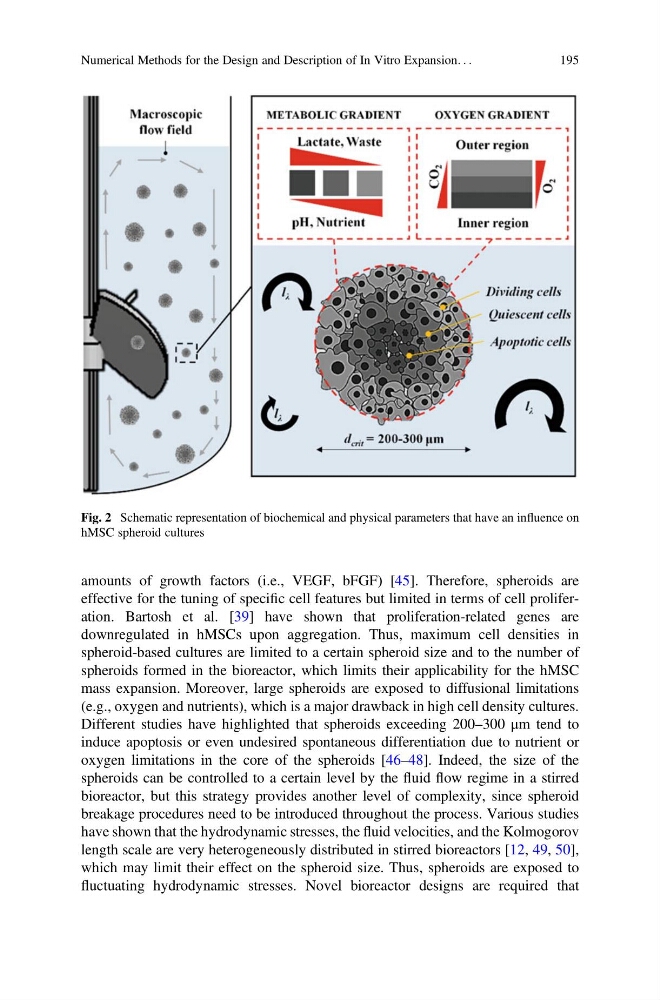
mass expansion. Moreover, large spheroids are exposed to diffusional limitations
(e.g., oxygen and nutrients), which is a major drawback in high cell density cultures.
Different studies have highlighted that spheroids exceeding 200–300 μm tend to
induce apoptosis or even undesired spontaneous differentiation due to nutrient or
oxygen limitations in the core of the spheroids [46–48]. Indeed, the size of the
spheroids can be controlled to a certain level by the fluid flow regime in a stirred
bioreactor, but this strategy provides another level of complexity, since spheroid
breakage procedures need to be introduced throughout the process. Various studies
have shown that the hydrodynamic stresses, the fluid velocities, and the Kolmogorov
length scale are very heterogeneously distributed in stirred bioreactors [12, 49, 50],
which may limit their effect on the spheroid size. Thus, spheroids are exposed to
fluctuating hydrodynamic stresses. Novel bioreactor designs are required that
Fig. 2 Schematic representation of biochemical and physical parameters that have an influence on
hMSC spheroid cultures
Numerical Methods for the Design and Description of In Vitro Expansion. . .
195
effective for the tuning of specific cell features but limited in terms of cell proliferation. Bartosh et al. [39] have shown that proliferation-related genes are
downregulated in hMSCs upon aggregation. Thus, maximum cell densities in
spheroid-based cultures are limited to a certain spheroid size and to the number of
spheroids formed in the bioreactor, which limits their applicability for the hMSC
mass expansion. Moreover, large spheroids are exposed to diffusional limitations
(e.g., oxygen and nutrients), which is a major drawback in high cell density cultures.
Different studies have highlighted that spheroids exceeding 200–300 μm tend to
induce apoptosis or even undesired spontaneous differentiation due to nutrient or
oxygen limitations in the core of the spheroids [46–48]. Indeed, the size of the
spheroids can be controlled to a certain level by the fluid flow regime in a stirred
bioreactor, but this strategy provides another level of complexity, since spheroid
breakage procedures need to be introduced throughout the process. Various studies
have shown that the hydrodynamic stresses, the fluid velocities, and the Kolmogorov
length scale are very heterogeneously distributed in stirred bioreactors [12, 49, 50],
which may limit their effect on the spheroid size. Thus, spheroids are exposed to
fluctuating hydrodynamic stresses. Novel bioreactor designs are required that
Fig. 2 Schematic representation of biochemical and physical parameters that have an influence on
hMSC spheroid cultures
Numerical Methods for the Design and Description of In Vitro Expansion. . .
195