

The main motivation for growing hMSCs as spheroids is to avoid the use of
exogenous support materials, like scaffolds or MCs. Due to the absence of the
exogenous support material, the cells are allowed to arrange themselves similar to
living tissues [22, 31]. Cells self-assemble and interact under natural forces, permitting them to generate their own extracellular matrix (ECM), which serves as support
for the cells to survive in suspension and to mimic the cell-to-cell and cell-to-matrix
signaling networks [32, 33]. Investigations by Edmonson et al. [34] have shown that
the cell morphology of hMSCs derived from spheroid cultures is comparable to
those in bodily tissues. In addition, Caron et al. [35] have demonstrated that a stable
hMSCs phenotype is retained in spheroid-based cultures, at least when only the
minimum definition of an hMSC is considered [36, 37]. A study by Cheng et al. [38]
highlighted that spheroid-derived hASCs exhibited lower cell senescence and a high
secretion of angiogenic growth factors (e.g., HGF, VEGF), which was found to be
beneficial for wound healing applications. Interestingly, several studies with
hBM-MSCs have found that the 3D structure of the spheroids leads to higher yields
of secreted immunomodulatory paracrine and anti-inflammatory factors (i.e., TSG-6,
stanniocalcin-1, prostaglandin E2) [39, 40], although this was highly dependent on
the cell culture medium formulation [41, 42]. The cell culture medium and its
formulation play a critical role in spheroid-based hMSC expansions. For example,
Zimmermann and McDevitt [41] found that hBM-MSCs expanded in serum-free cell
culture medium displayed a reduced expression of prostaglandin E2, indoleamine
2,3-dioxygenase, transforming growth factor-β1, and interleukin-6 when compared
with spheroids cultured in serum-containing cell culture medium. Since the cells are
forced to aggregate to form spheroids, the medium must also contain adhesive
molecules (e.g., laminins, integrins, E-cadherin, vitronectin) to facilitate cell-tocell attachment [43]. However, for GMP-compliant hMSC productions, these
recombinant human proteins represent a strong cost driver, which makes largescale manufacturing expensive [44]. In addition to biochemical parameters, physical
or process engineering parameters have a strong effect on the spheroid culture (see
Fig. 2).
For example, oxygen tension has been shown to play a fundamental role in the
spheroid formation. Spheroids generated in hypoxic conditions (2% O 2 ) produced
higher amounts of ECM components (i.e., fibronectin, laminin, elastin) and higher
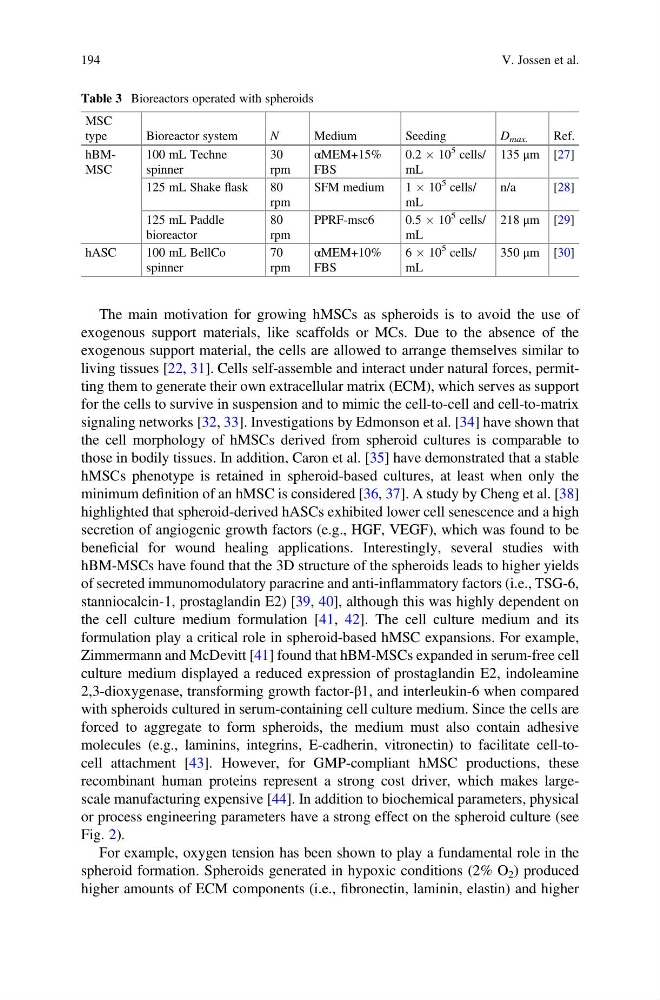
Table 3 Bioreactors operated with spheroids
MSC
type
Bioreactor system
N
Medium
Seeding
D max.
Ref.
hBMMSC
100 mL Techne
spinner
30
rpm
αMEM+15%
FBS
0.2 Â 10
5 cells/
mL
135 μm [27]
125 mL Shake flask
80
rpm
SFM medium
1 Â 10
5 cells/
mL
n/a
[28]
125 mL Paddle
bioreactor
80
rpm
PPRF-msc6
0.5 Â 10
5 cells/
mL
218 μm [29]
hASC
100 mL BellCo
spinner
70
rpm
αMEM+10%
FBS
6 Â 10
5 cells/
mL
350 μm [30]
194
V. Jossen et al.
exogenous support materials, like scaffolds or MCs. Due to the absence of the
exogenous support material, the cells are allowed to arrange themselves similar to
living tissues [22, 31]. Cells self-assemble and interact under natural forces, permitting them to generate their own extracellular matrix (ECM), which serves as support
for the cells to survive in suspension and to mimic the cell-to-cell and cell-to-matrix
signaling networks [32, 33]. Investigations by Edmonson et al. [34] have shown that
the cell morphology of hMSCs derived from spheroid cultures is comparable to
those in bodily tissues. In addition, Caron et al. [35] have demonstrated that a stable
hMSCs phenotype is retained in spheroid-based cultures, at least when only the
minimum definition of an hMSC is considered [36, 37]. A study by Cheng et al. [38]
highlighted that spheroid-derived hASCs exhibited lower cell senescence and a high
secretion of angiogenic growth factors (e.g., HGF, VEGF), which was found to be
beneficial for wound healing applications. Interestingly, several studies with
hBM-MSCs have found that the 3D structure of the spheroids leads to higher yields
of secreted immunomodulatory paracrine and anti-inflammatory factors (i.e., TSG-6,
stanniocalcin-1, prostaglandin E2) [39, 40], although this was highly dependent on
the cell culture medium formulation [41, 42]. The cell culture medium and its
formulation play a critical role in spheroid-based hMSC expansions. For example,
Zimmermann and McDevitt [41] found that hBM-MSCs expanded in serum-free cell
culture medium displayed a reduced expression of prostaglandin E2, indoleamine
2,3-dioxygenase, transforming growth factor-β1, and interleukin-6 when compared
with spheroids cultured in serum-containing cell culture medium. Since the cells are
forced to aggregate to form spheroids, the medium must also contain adhesive
molecules (e.g., laminins, integrins, E-cadherin, vitronectin) to facilitate cell-tocell attachment [43]. However, for GMP-compliant hMSC productions, these
recombinant human proteins represent a strong cost driver, which makes largescale manufacturing expensive [44]. In addition to biochemical parameters, physical
or process engineering parameters have a strong effect on the spheroid culture (see
Fig. 2).
For example, oxygen tension has been shown to play a fundamental role in the
spheroid formation. Spheroids generated in hypoxic conditions (2% O 2 ) produced
higher amounts of ECM components (i.e., fibronectin, laminin, elastin) and higher
Table 3 Bioreactors operated with spheroids
MSC
type
Bioreactor system
N
Medium
Seeding
D max.
Ref.
hBMMSC
100 mL Techne
spinner
30
rpm
αMEM+15%
FBS
0.2 Â 10
5 cells/
mL
135 μm [27]
125 mL Shake flask
80
rpm
SFM medium
1 Â 10
5 cells/
mL
n/a
[28]
125 mL Paddle
bioreactor
80
rpm
PPRF-msc6
0.5 Â 10
5 cells/
mL
218 μm [29]
hASC
100 mL BellCo
spinner
70
rpm
αMEM+10%
FBS
6 Â 10
5 cells/
mL
350 μm [30]
194
V. Jossen et al.