

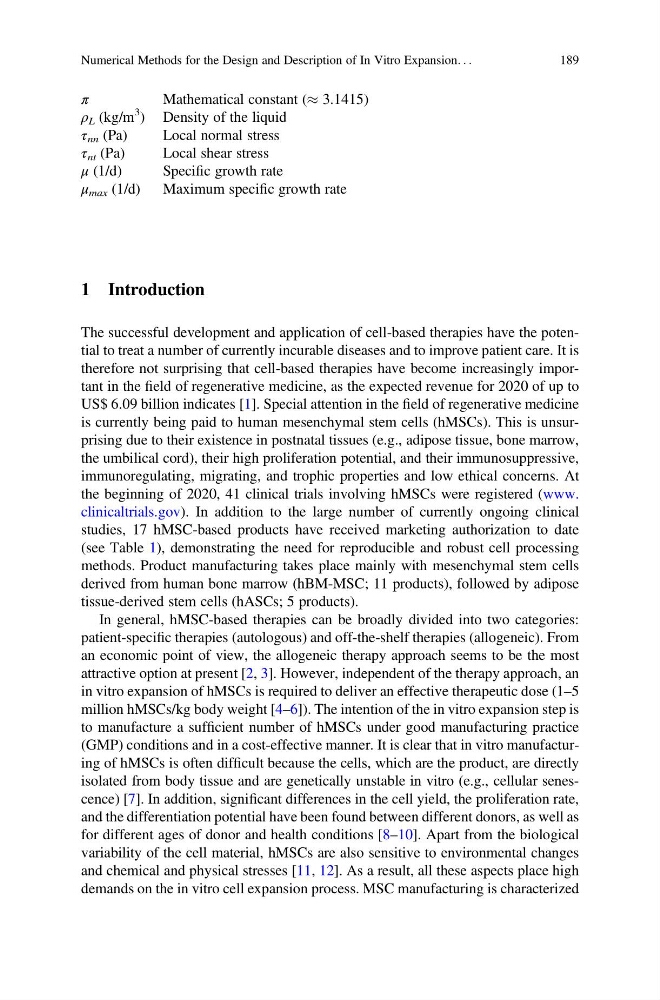
π
Mathematical constant (% 3.1415)
ρ L (kg/m
3 ) Density of the liquid
τ nn (Pa)
Local normal stress
τ nt (Pa)
Local shear stress
μ (1/d)
Specific growth rate
μ max (1/d)
Maximum specific growth rate
1 Introduction
The successful development and application of cell-based therapies have the potential to treat a number of currently incurable diseases and to improve patient care. It is
therefore not surprising that cell-based therapies have become increasingly important in the field of regenerative medicine, as the expected revenue for 2020 of up to
US$ 6.09 billion indicates [1]. Special attention in the field of regenerative medicine
is currently being paid to human mesenchymal stem cells (hMSCs). This is unsurprising due to their existence in postnatal tissues (e.g., adipose tissue, bone marrow,
the umbilical cord), their high proliferation potential, and their immunosuppressive,
immunoregulating, migrating, and trophic properties and low ethical concerns. At
the beginning of 2020, 41 clinical trials involving hMSCs were registered (www.
clinicaltrials.gov). In addition to the large number of currently ongoing clinical
studies, 17 hMSC-based products have received marketing authorization to date
(see Table 1), demonstrating the need for reproducible and robust cell processing
methods. Product manufacturing takes place mainly with mesenchymal stem cells
derived from human bone marrow (hBM-MSC; 11 products), followed by adipose
tissue-derived stem cells (hASCs; 5 products).
In general, hMSC-based therapies can be broadly divided into two categories:
patient-specific therapies (autologous) and off-the-shelf therapies (allogeneic). From
an economic point of view, the allogeneic therapy approach seems to be the most
attractive option at present [2, 3]. However, independent of the therapy approach, an
in vitro expansion of hMSCs is required to deliver an effective therapeutic dose (1–5
million hMSCs/kg body weight [4–6]). The intention of the in vitro expansion step is
to manufacture a sufficient number of hMSCs under good manufacturing practice
(GMP) conditions and in a cost-effective manner. It is clear that in vitro manufacturing of hMSCs is often difficult because the cells, which are the product, are directly
isolated from body tissue and are genetically unstable in vitro (e.g., cellular senescence) [7]. In addition, significant differences in the cell yield, the proliferation rate,
and the differentiation potential have been found between different donors, as well as
for different ages of donor and health conditions [8–10]. Apart from the biological
variability of the cell material, hMSCs are also sensitive to environmental changes
and chemical and physical stresses [11, 12]. As a result, all these aspects place high
demands on the in vitro cell expansion process. MSC manufacturing is characterized
Numerical Methods for the Design and Description of In Vitro Expansion. . .
189
Mathematical constant (% 3.1415)
ρ L (kg/m
3 ) Density of the liquid
τ nn (Pa)
Local normal stress
τ nt (Pa)
Local shear stress
μ (1/d)
Specific growth rate
μ max (1/d)
Maximum specific growth rate
1 Introduction
The successful development and application of cell-based therapies have the potential to treat a number of currently incurable diseases and to improve patient care. It is
therefore not surprising that cell-based therapies have become increasingly important in the field of regenerative medicine, as the expected revenue for 2020 of up to
US$ 6.09 billion indicates [1]. Special attention in the field of regenerative medicine
is currently being paid to human mesenchymal stem cells (hMSCs). This is unsurprising due to their existence in postnatal tissues (e.g., adipose tissue, bone marrow,
the umbilical cord), their high proliferation potential, and their immunosuppressive,
immunoregulating, migrating, and trophic properties and low ethical concerns. At
the beginning of 2020, 41 clinical trials involving hMSCs were registered (www.
clinicaltrials.gov). In addition to the large number of currently ongoing clinical
studies, 17 hMSC-based products have received marketing authorization to date
(see Table 1), demonstrating the need for reproducible and robust cell processing
methods. Product manufacturing takes place mainly with mesenchymal stem cells
derived from human bone marrow (hBM-MSC; 11 products), followed by adipose
tissue-derived stem cells (hASCs; 5 products).
In general, hMSC-based therapies can be broadly divided into two categories:
patient-specific therapies (autologous) and off-the-shelf therapies (allogeneic). From
an economic point of view, the allogeneic therapy approach seems to be the most
attractive option at present [2, 3]. However, independent of the therapy approach, an
in vitro expansion of hMSCs is required to deliver an effective therapeutic dose (1–5
million hMSCs/kg body weight [4–6]). The intention of the in vitro expansion step is
to manufacture a sufficient number of hMSCs under good manufacturing practice
(GMP) conditions and in a cost-effective manner. It is clear that in vitro manufacturing of hMSCs is often difficult because the cells, which are the product, are directly
isolated from body tissue and are genetically unstable in vitro (e.g., cellular senescence) [7]. In addition, significant differences in the cell yield, the proliferation rate,
and the differentiation potential have been found between different donors, as well as
for different ages of donor and health conditions [8–10]. Apart from the biological
variability of the cell material, hMSCs are also sensitive to environmental changes
and chemical and physical stresses [11, 12]. As a result, all these aspects place high
demands on the in vitro cell expansion process. MSC manufacturing is characterized
Numerical Methods for the Design and Description of In Vitro Expansion. . .
189