

secrets or intellectual property. This can be a challenging step, due to unclear internal
and external communication channels at the beginning of the planning process. In
the planning phase, all potential weak points need to be considered.
Further data challenges include concepts like data acquisition, type, transfer
points, streams, database handling, big data storing, and data security. One potential
risk is that the data collected from plants or products are not adequately representing
the same concept. This can lead to, e.g., information available in digital twins being
incomplete or not up-to-date, and not being sufficient for, e.g., getting reliable results
from a root cause analysis. One possible solution is an overview of the treatment of
food safety issues, which helps identify relevant information, and allows for early
measures to provide this information, e.g., by installing new sensors and capturing
new relevant data. By early and detailed planning, this risk can be reduced. Especially these points show the challenges of a DTMS implementation. Nevertheless,
they are not unknown problems, and therefore they can be minimized by proper and
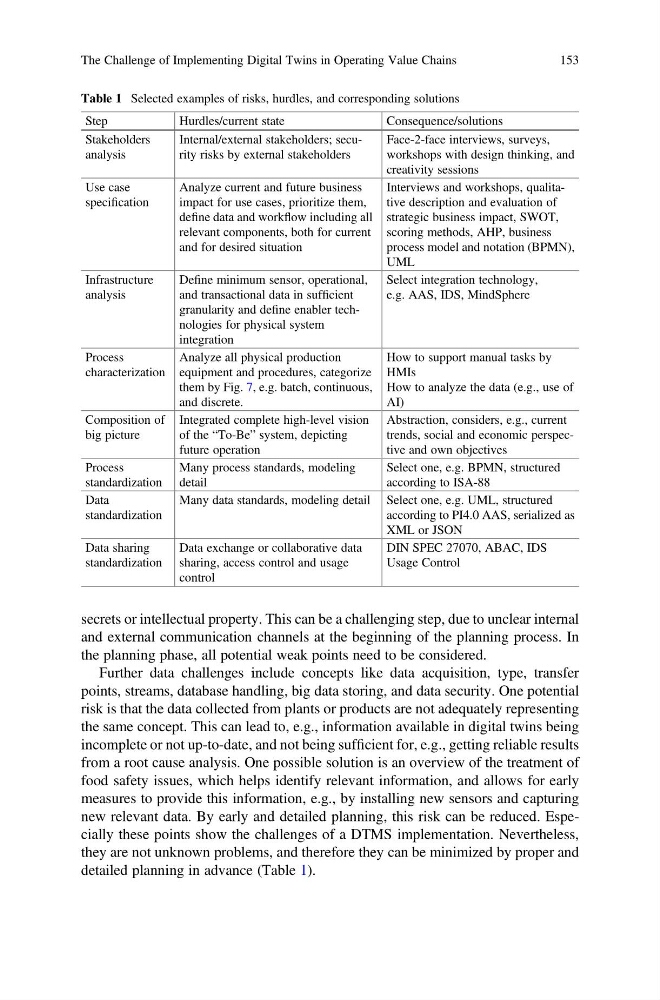
detailed planning in advance (Table 1).
Table 1 Selected examples of risks, hurdles, and corresponding solutions
Step
Hurdles/current state
Consequence/solutions
Stakeholders
analysis
Internal/external stakeholders; security risks by external stakeholders
Face-2-face interviews, surveys,
workshops with design thinking, and
creativity sessions
Use case
specification
Analyze current and future business
impact for use cases, prioritize them,
define data and workflow including all
relevant components, both for current
and for desired situation
Interviews and workshops, qualitative description and evaluation of
strategic business impact, SWOT,
scoring methods, AHP, business
process model and notation (BPMN),
UML
Infrastructure
analysis
Define minimum sensor, operational,
and transactional data in sufficient
granularity and define enabler technologies for physical system
integration
Select integration technology,
e.g. AAS, IDS, MindSphere
Process
characterization
Analyze all physical production
equipment and procedures, categorize
them by Fig. 7, e.g. batch, continuous,
and discrete.
How to support manual tasks by
HMIs
How to analyze the data (e.g., use of
AI)
Composition of
big picture
Integrated complete high-level vision
of the “To-Be” system, depicting
future operation
Abstraction, considers, e.g., current
trends, social and economic perspective and own objectives
Process
standardization
Many process standards, modeling
detail
Select one, e.g. BPMN, structured
according to ISA-88
Data
standardization
Many data standards, modeling detail Select one, e.g. UML, structured
according to PI4.0 AAS, serialized as
XML or JSON
Data sharing
standardization
Data exchange or collaborative data
sharing, access control and usage
control
DIN SPEC 27070, ABAC, IDS
Usage Control
The Challenge of Implementing Digital Twins in Operating Value Chains
153
and external communication channels at the beginning of the planning process. In
the planning phase, all potential weak points need to be considered.
Further data challenges include concepts like data acquisition, type, transfer
points, streams, database handling, big data storing, and data security. One potential
risk is that the data collected from plants or products are not adequately representing
the same concept. This can lead to, e.g., information available in digital twins being
incomplete or not up-to-date, and not being sufficient for, e.g., getting reliable results
from a root cause analysis. One possible solution is an overview of the treatment of
food safety issues, which helps identify relevant information, and allows for early
measures to provide this information, e.g., by installing new sensors and capturing
new relevant data. By early and detailed planning, this risk can be reduced. Especially these points show the challenges of a DTMS implementation. Nevertheless,
they are not unknown problems, and therefore they can be minimized by proper and
detailed planning in advance (Table 1).
Table 1 Selected examples of risks, hurdles, and corresponding solutions
Step
Hurdles/current state
Consequence/solutions
Stakeholders
analysis
Internal/external stakeholders; security risks by external stakeholders
Face-2-face interviews, surveys,
workshops with design thinking, and
creativity sessions
Use case
specification
Analyze current and future business
impact for use cases, prioritize them,
define data and workflow including all
relevant components, both for current
and for desired situation
Interviews and workshops, qualitative description and evaluation of
strategic business impact, SWOT,
scoring methods, AHP, business
process model and notation (BPMN),
UML
Infrastructure
analysis
Define minimum sensor, operational,
and transactional data in sufficient
granularity and define enabler technologies for physical system
integration
Select integration technology,
e.g. AAS, IDS, MindSphere
Process
characterization
Analyze all physical production
equipment and procedures, categorize
them by Fig. 7, e.g. batch, continuous,
and discrete.
How to support manual tasks by
HMIs
How to analyze the data (e.g., use of
AI)
Composition of
big picture
Integrated complete high-level vision
of the “To-Be” system, depicting
future operation
Abstraction, considers, e.g., current
trends, social and economic perspective and own objectives
Process
standardization
Many process standards, modeling
detail
Select one, e.g. BPMN, structured
according to ISA-88
Data
standardization
Many data standards, modeling detail Select one, e.g. UML, structured
according to PI4.0 AAS, serialized as
XML or JSON
Data sharing
standardization
Data exchange or collaborative data
sharing, access control and usage
control
DIN SPEC 27070, ABAC, IDS
Usage Control
The Challenge of Implementing Digital Twins in Operating Value Chains
153