

introduction to the different roles and some useful rules for data sharing can be found
in the EU code of conduct on agriculture data sharing [78].
For successful integration in terms of I4.0, the Reference Architecture Model
Industry 4.0 (RAMI 4.0) is a well-established guidance for implementation. It unifies
the most relevant aspects of the I4.0 architecture and represents the holistic life cycle
of assets. The RAMI 4.0 supports a uniform structure, wording, entire scope of I4.0,
and complex relationships in small and clear parts. The RAMI 4.0 model consists of
three dimensions: hierarchy, product life cycle, and architecture. Architecture is
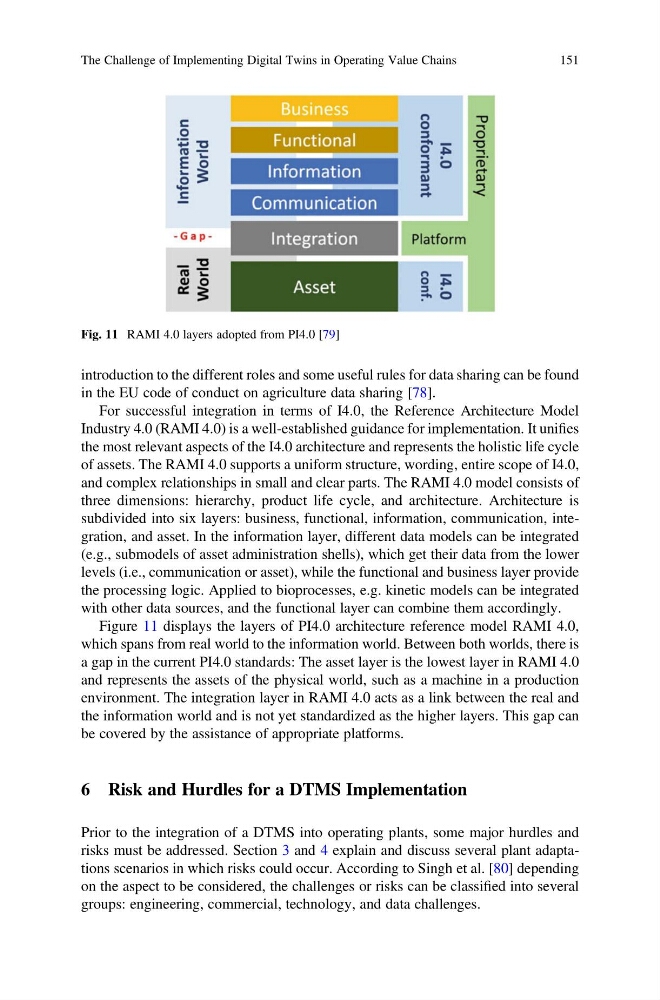
subdivided into six layers: business, functional, information, communication, integration, and asset. In the information layer, different data models can be integrated
(e.g., submodels of asset administration shells), which get their data from the lower
levels (i.e., communication or asset), while the functional and business layer provide
the processing logic. Applied to bioprocesses, e.g. kinetic models can be integrated
with other data sources, and the functional layer can combine them accordingly.
Figure 11 displays the layers of PI4.0 architecture reference model RAMI 4.0,
which spans from real world to the information world. Between both worlds, there is
a gap in the current PI4.0 standards: The asset layer is the lowest layer in RAMI 4.0
and represents the assets of the physical world, such as a machine in a production
environment. The integration layer in RAMI 4.0 acts as a link between the real and
the information world and is not yet standardized as the higher layers. This gap can
be covered by the assistance of appropriate platforms.
6 Risk and Hurdles for a DTMS Implementation
Prior to the integration of a DTMS into operating plants, some major hurdles and
risks must be addressed. Section 3 and 4 explain and discuss several plant adaptations scenarios in which risks could occur. According to Singh et al. [80] depending
on the aspect to be considered, the challenges or risks can be classified into several
groups: engineering, commercial, technology, and data challenges.
Fig. 11 RAMI 4.0 layers adopted from PI4.0 [79]
The Challenge of Implementing Digital Twins in Operating Value Chains
151
in the EU code of conduct on agriculture data sharing [78].
For successful integration in terms of I4.0, the Reference Architecture Model
Industry 4.0 (RAMI 4.0) is a well-established guidance for implementation. It unifies
the most relevant aspects of the I4.0 architecture and represents the holistic life cycle
of assets. The RAMI 4.0 supports a uniform structure, wording, entire scope of I4.0,
and complex relationships in small and clear parts. The RAMI 4.0 model consists of
three dimensions: hierarchy, product life cycle, and architecture. Architecture is
subdivided into six layers: business, functional, information, communication, integration, and asset. In the information layer, different data models can be integrated
(e.g., submodels of asset administration shells), which get their data from the lower
levels (i.e., communication or asset), while the functional and business layer provide
the processing logic. Applied to bioprocesses, e.g. kinetic models can be integrated
with other data sources, and the functional layer can combine them accordingly.
Figure 11 displays the layers of PI4.0 architecture reference model RAMI 4.0,
which spans from real world to the information world. Between both worlds, there is
a gap in the current PI4.0 standards: The asset layer is the lowest layer in RAMI 4.0
and represents the assets of the physical world, such as a machine in a production
environment. The integration layer in RAMI 4.0 acts as a link between the real and
the information world and is not yet standardized as the higher layers. This gap can
be covered by the assistance of appropriate platforms.
6 Risk and Hurdles for a DTMS Implementation
Prior to the integration of a DTMS into operating plants, some major hurdles and
risks must be addressed. Section 3 and 4 explain and discuss several plant adaptations scenarios in which risks could occur. According to Singh et al. [80] depending
on the aspect to be considered, the challenges or risks can be classified into several
groups: engineering, commercial, technology, and data challenges.
Fig. 11 RAMI 4.0 layers adopted from PI4.0 [79]
The Challenge of Implementing Digital Twins in Operating Value Chains
151