

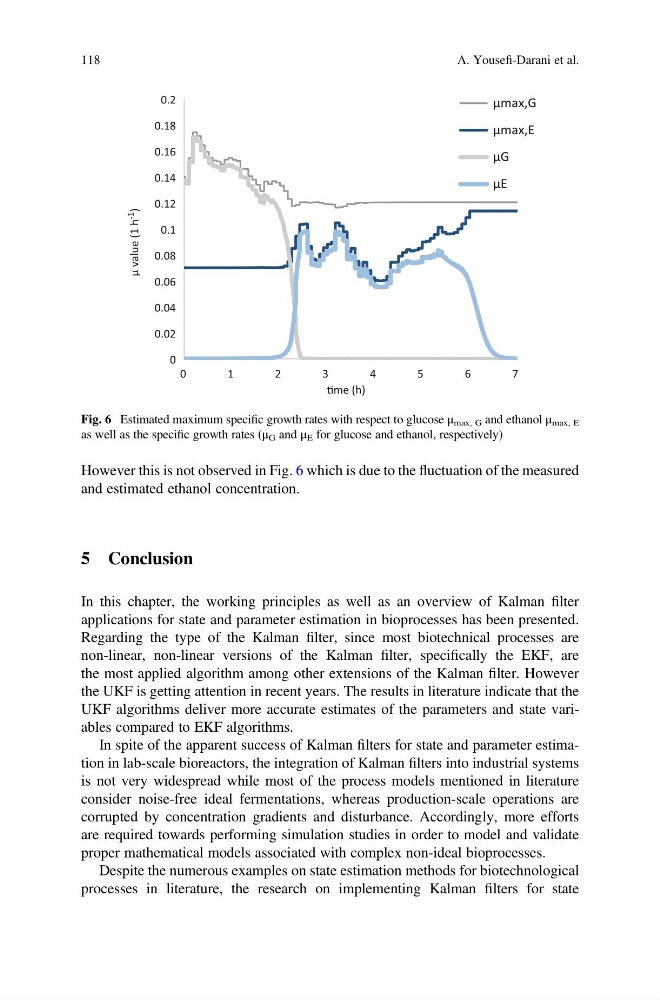
However this is not observed in Fig. 6 which is due to the fluctuation of the measured
and estimated ethanol concentration.
5 Conclusion
In this chapter, the working principles as well as an overview of Kalman filter
applications for state and parameter estimation in bioprocesses has been presented.
Regarding the type of the Kalman filter, since most biotechnical processes are
non-linear, non-linear versions of the Kalman filter, specifically the EKF, are
the most applied algorithm among other extensions of the Kalman filter. However
the UKF is getting attention in recent years. The results in literature indicate that the
UKF algorithms deliver more accurate estimates of the parameters and state variables compared to EKF algorithms.
In spite of the apparent success of Kalman filters for state and parameter estimation in lab-scale bioreactors, the integration of Kalman filters into industrial systems
is not very widespread while most of the process models mentioned in literature
consider noise-free ideal fermentations, whereas production-scale operations are
corrupted by concentration gradients and disturbance. Accordingly, more efforts
are required towards performing simulation studies in order to model and validate
proper mathematical models associated with complex non-ideal bioprocesses.
Despite the numerous examples on state estimation methods for biotechnological
processes in literature, the research on implementing Kalman filters for state
0
0.02
0.04
0.06
0.08
0.1
0.12
0.14
0.16
0.18
0.2
0
1
2
3
4
5
6
7
Ɵme (h)
μmax,G
μmax,E
μG
μE
μ value (1 h
-1
)
Fig. 6 Estimated maximum specific growth rates with respect to glucose μ max, G and ethanol μ max, E
as well as the specific growth rates (μ G and μ E for glucose and ethanol, respectively)
118
A. Yousefi-Darani et al.
and estimated ethanol concentration.
5 Conclusion
In this chapter, the working principles as well as an overview of Kalman filter
applications for state and parameter estimation in bioprocesses has been presented.
Regarding the type of the Kalman filter, since most biotechnical processes are
non-linear, non-linear versions of the Kalman filter, specifically the EKF, are
the most applied algorithm among other extensions of the Kalman filter. However
the UKF is getting attention in recent years. The results in literature indicate that the
UKF algorithms deliver more accurate estimates of the parameters and state variables compared to EKF algorithms.
In spite of the apparent success of Kalman filters for state and parameter estimation in lab-scale bioreactors, the integration of Kalman filters into industrial systems
is not very widespread while most of the process models mentioned in literature
consider noise-free ideal fermentations, whereas production-scale operations are
corrupted by concentration gradients and disturbance. Accordingly, more efforts
are required towards performing simulation studies in order to model and validate
proper mathematical models associated with complex non-ideal bioprocesses.
Despite the numerous examples on state estimation methods for biotechnological
processes in literature, the research on implementing Kalman filters for state
0
0.02
0.04
0.06
0.08
0.1
0.12
0.14
0.16
0.18
0.2
0
1
2
3
4
5
6
7
Ɵme (h)
μmax,G
μmax,E
μG
μE
μ value (1 h
-1
)
Fig. 6 Estimated maximum specific growth rates with respect to glucose μ max, G and ethanol μ max, E
as well as the specific growth rates (μ G and μ E for glucose and ethanol, respectively)
118
A. Yousefi-Darani et al.