

5 g L
À1 as well as 1 mL L
À1 trace elements solution (0.015 g L
À1 FeCl 3 Á6H 2 O,
9 mg L
À1 ZnSO 4 Á7H 2 O, 10.5 mg L
À1 MnSO 4 Á2H 2 O, and 2.4 mg L
À1 CuSO 4 5H 2 O)
and 1 mL L
À1 vitamin solution (0.06 g L
À1 myoinositol, 0.03 g L
À1
Ca-pantothenate, 6 mg L
À1 thiamine HCl, 1.5 mg L
À1 pyridoxine HCl, and
0.03 mg L
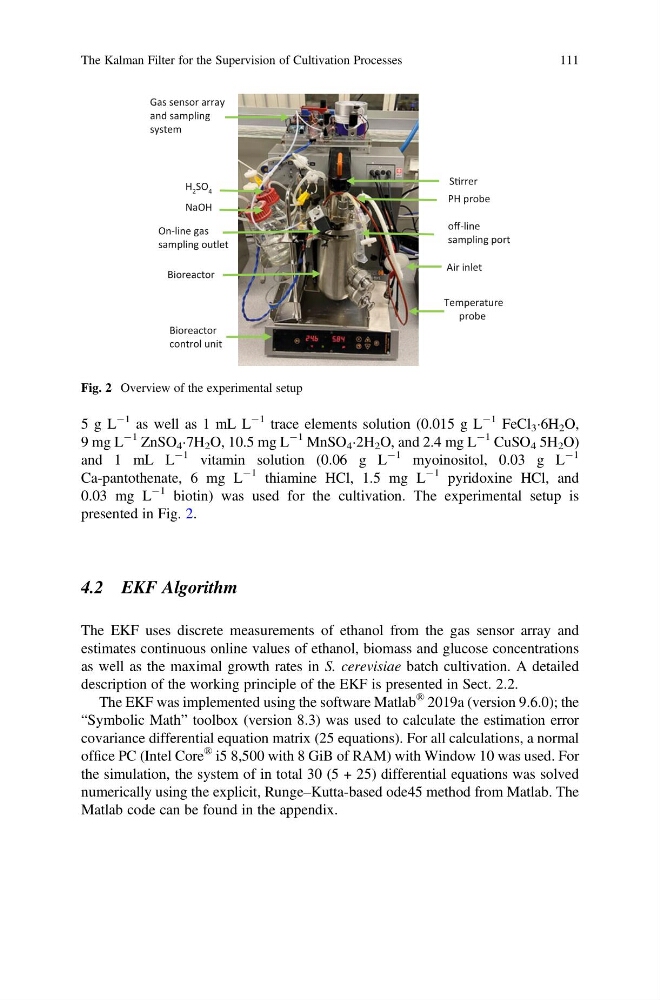
À1 biotin) was used for the cultivation. The experimental setup is
presented in Fig. 2.
4.2 EKF Algorithm
The EKF uses discrete measurements of ethanol from the gas sensor array and
estimates continuous online values of ethanol, biomass and glucose concentrations
as well as the maximal growth rates in S. cerevisiae batch cultivation. A detailed
description of the working principle of the EKF is presented in Sect. 2.2.
The EKF was implemented using the software Matlab
® 2019a (version 9.6.0); the
“Symbolic Math” toolbox (version 8.3) was used to calculate the estimation error
covariance differential equation matrix (25 equations). For all calculations, a normal
office PC (Intel Core
® i5 8,500 with 8 GiB of RAM) with Window 10 was used. For
the simulation, the system of in total 30 (5 + 25) differential equations was solved
numerically using the explicit, Runge–Kutta-based ode45 method from Matlab. The
Matlab code can be found in the appendix.
Gas sensor array
and sampling
system
On-line gas
sampling outlet
H 2 SO 4
off-line
sampling port
Temperature
probe
NaOH
Air inlet
Bioreactor
control unit
Bioreactor
PH probe
SƟrrer
Fig. 2 Overview of the experimental setup
The Kalman Filter for the Supervision of Cultivation Processes
111
À1 as well as 1 mL L
À1 trace elements solution (0.015 g L
À1 FeCl 3 Á6H 2 O,
9 mg L
À1 ZnSO 4 Á7H 2 O, 10.5 mg L
À1 MnSO 4 Á2H 2 O, and 2.4 mg L
À1 CuSO 4 5H 2 O)
and 1 mL L
À1 vitamin solution (0.06 g L
À1 myoinositol, 0.03 g L
À1
Ca-pantothenate, 6 mg L
À1 thiamine HCl, 1.5 mg L
À1 pyridoxine HCl, and
0.03 mg L
À1 biotin) was used for the cultivation. The experimental setup is
presented in Fig. 2.
4.2 EKF Algorithm
The EKF uses discrete measurements of ethanol from the gas sensor array and
estimates continuous online values of ethanol, biomass and glucose concentrations
as well as the maximal growth rates in S. cerevisiae batch cultivation. A detailed
description of the working principle of the EKF is presented in Sect. 2.2.
The EKF was implemented using the software Matlab
® 2019a (version 9.6.0); the
“Symbolic Math” toolbox (version 8.3) was used to calculate the estimation error
covariance differential equation matrix (25 equations). For all calculations, a normal
office PC (Intel Core
® i5 8,500 with 8 GiB of RAM) with Window 10 was used. For
the simulation, the system of in total 30 (5 + 25) differential equations was solved
numerically using the explicit, Runge–Kutta-based ode45 method from Matlab. The
Matlab code can be found in the appendix.
Gas sensor array
and sampling
system
On-line gas
sampling outlet
H 2 SO 4
off-line
sampling port
Temperature
probe
NaOH
Air inlet
Bioreactor
control unit
Bioreactor
PH probe
SƟrrer
Fig. 2 Overview of the experimental setup
The Kalman Filter for the Supervision of Cultivation Processes
111