

x f t k
½
À Á ¼ x t k
½
À Á þ K k
½ z k
½ À h x t k
½
À Á
Â
Ã
Â
Ã
ð14Þ
P f t k
½
À Á ¼ I À K k
½ H k
½
Â
Ã
P t k
½
À Á
I À K k
½ H k
½
Â
à T þ K k
½ RK
T
k
½
ð15Þ
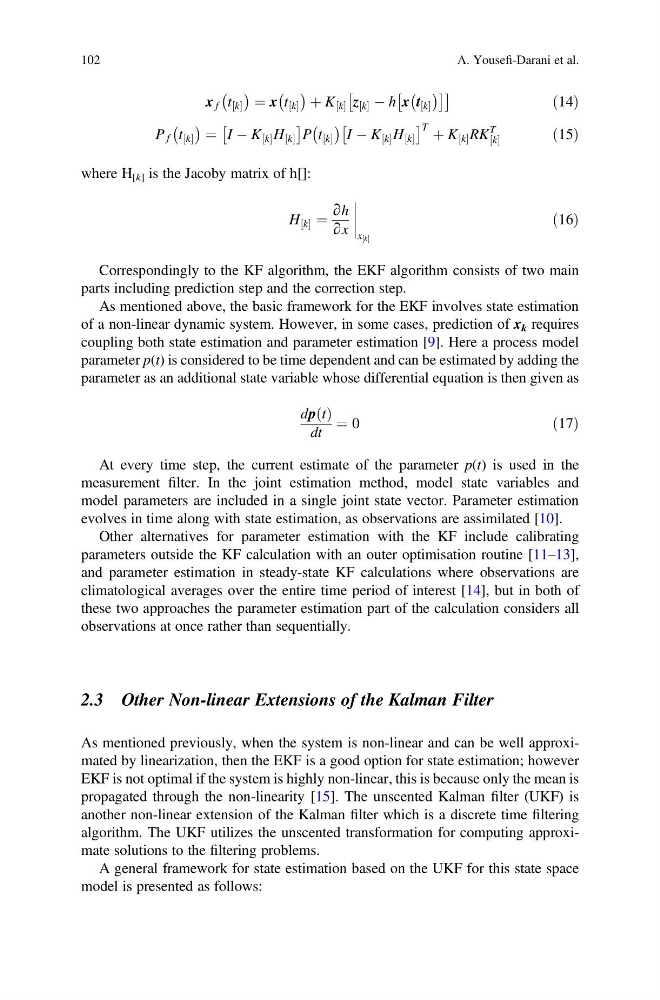
where H [k] is the Jacoby matrix of h[]:
H k
½ ¼
∂h
∂x
x k
½
ð16Þ
Correspondingly to the KF algorithm, the EKF algorithm consists of two main
parts including prediction step and the correction step.
As mentioned above, the basic framework for the EKF involves state estimation
of a non-linear dynamic system. However, in some cases, prediction of x k requires
coupling both state estimation and parameter estimation [9]. Here a process model
parameter p(t) is considered to be time dependent and can be estimated by adding the
parameter as an additional state variable whose differential equation is then given as
dp t
ð Þ
dt
¼ 0
ð17Þ
At every time step, the current estimate of the parameter p(t) is used in the
measurement filter. In the joint estimation method, model state variables and
model parameters are included in a single joint state vector. Parameter estimation
evolves in time along with state estimation, as observations are assimilated [10].
Other alternatives for parameter estimation with the KF include calibrating
parameters outside the KF calculation with an outer optimisation routine [11–13],
and parameter estimation in steady-state KF calculations where observations are
climatological averages over the entire time period of interest [14], but in both of
these two approaches the parameter estimation part of the calculation considers all
observations at once rather than sequentially.
2.3 Other Non-linear Extensions of the Kalman Filter
As mentioned previously, when the system is non-linear and can be well approximated by linearization, then the EKF is a good option for state estimation; however
EKF is not optimal if the system is highly non-linear, this is because only the mean is
propagated through the non-linearity [15]. The unscented Kalman filter (UKF) is
another non-linear extension of the Kalman filter which is a discrete time filtering
algorithm. The UKF utilizes the unscented transformation for computing approximate solutions to the filtering problems.
A general framework for state estimation based on the UKF for this state space
model is presented as follows:
102
A. Yousefi-Darani et al.
½
À Á ¼ x t k
½
À Á þ K k
½ z k
½ À h x t k
½
À Á
Â
Ã
Â
Ã
ð14Þ
P f t k
½
À Á ¼ I À K k
½ H k
½
Â
Ã
P t k
½
À Á
I À K k
½ H k
½
Â
à T þ K k
½ RK
T
k
½
ð15Þ
where H [k] is the Jacoby matrix of h[]:
H k
½ ¼
∂h
∂x
x k
½
ð16Þ
Correspondingly to the KF algorithm, the EKF algorithm consists of two main
parts including prediction step and the correction step.
As mentioned above, the basic framework for the EKF involves state estimation
of a non-linear dynamic system. However, in some cases, prediction of x k requires
coupling both state estimation and parameter estimation [9]. Here a process model
parameter p(t) is considered to be time dependent and can be estimated by adding the
parameter as an additional state variable whose differential equation is then given as
dp t
ð Þ
dt
¼ 0
ð17Þ
At every time step, the current estimate of the parameter p(t) is used in the
measurement filter. In the joint estimation method, model state variables and
model parameters are included in a single joint state vector. Parameter estimation
evolves in time along with state estimation, as observations are assimilated [10].
Other alternatives for parameter estimation with the KF include calibrating
parameters outside the KF calculation with an outer optimisation routine [11–13],
and parameter estimation in steady-state KF calculations where observations are
climatological averages over the entire time period of interest [14], but in both of
these two approaches the parameter estimation part of the calculation considers all
observations at once rather than sequentially.
2.3 Other Non-linear Extensions of the Kalman Filter
As mentioned previously, when the system is non-linear and can be well approximated by linearization, then the EKF is a good option for state estimation; however
EKF is not optimal if the system is highly non-linear, this is because only the mean is
propagated through the non-linearity [15]. The unscented Kalman filter (UKF) is
another non-linear extension of the Kalman filter which is a discrete time filtering
algorithm. The UKF utilizes the unscented transformation for computing approximate solutions to the filtering problems.
A general framework for state estimation based on the UKF for this state space
model is presented as follows:
102
A. Yousefi-Darani et al.