

4.1 Electromagnetic Radiation
73
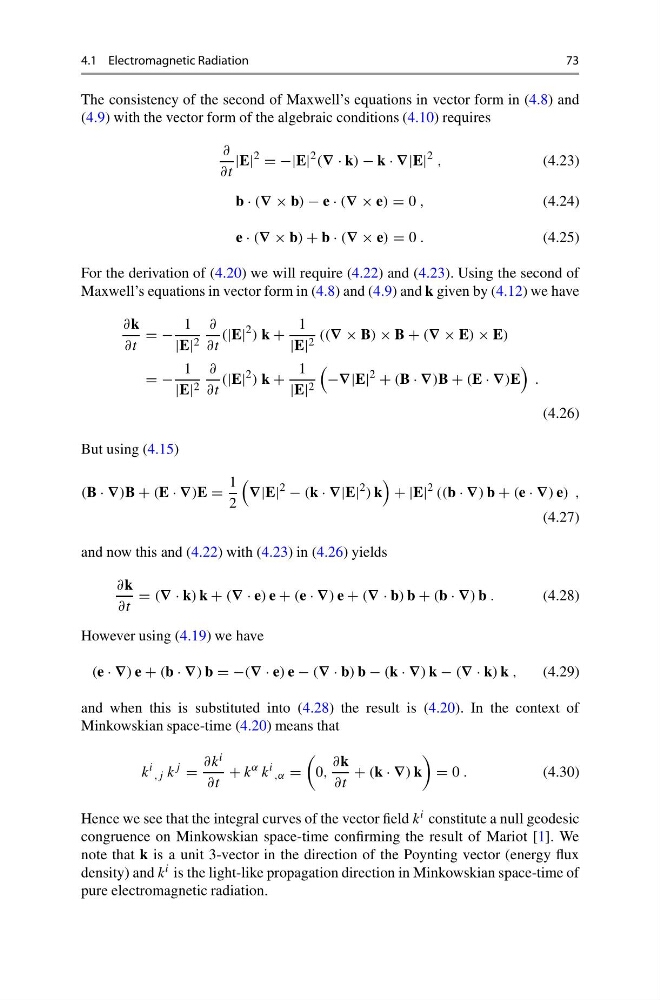
The consistency of the second of Maxwell’s equations in vector form in (4.8) and
(4.9) with the vector form of the algebraic conditions (4.10) requires
∂
∂t
|E|
2
= −|E|
2 (∇ · k) − k · ∇|E|
2 ,
(4.23)
b · (∇ × b) − e · (∇ × e) = 0 ,
(4.24)
e · (∇ × b) + b · (∇ × e) = 0 .
(4.25)
For the derivation of (4.20) we will require (4.22) and (4.23). Using the second of
Maxwell’s equations in vector form in (4.8) and (4.9) and k given by (4.12) we have
∂k
∂t
= −
1
|E| 2
∂
∂t
(|E|
2 ) k +
1
|E| 2 ((∇ × B) × B + (∇ × E) × E)
= −
1
|E| 2
∂
∂t
(|E|
2 ) k +
1
|E| 2
−∇|E|
2
+ (B · ∇)B + (E · ∇)E
.
(4.26)
But using (4.15)
(B · ∇)B + (E · ∇)E =
1
2
∇|E|
2
− (k · ∇|E|
2 ) k
+ |E|
2 ((b · ∇) b + (e · ∇) e) ,
(4.27)
and now this and (4.22) with (4.23) in (4.26) yields
∂k
∂t
= (∇ · k) k + (∇ · e) e + (e · ∇) e + (∇ · b) b + (b · ∇) b .
(4.28)
However using (4.19) we have
(e · ∇) e + (b · ∇) b = −(∇ · e) e − (∇ · b) b − (k · ∇) k − (∇ · k) k ,
(4.29)
and when this is substituted into (4.28) the result is (4.20). In the context of
Minkowskian space-time (4.20) means that
k
i
,j k
j
=
∂k i
∂t
+ k
α k
i
,α =
0,
∂k
∂t
+ (k · ∇) k
= 0 .
(4.30)
Hence we see that the integral curves of the vector field k i constitute a null geodesic
congruence on Minkowskian space-time confirming the result of Mariot [1]. We
note that k is a unit 3-vector in the direction of the Poynting vector (energy flux
density) and k i is the light-like propagation direction in Minkowskian space-time of
pure electromagnetic radiation.
73
The consistency of the second of Maxwell’s equations in vector form in (4.8) and
(4.9) with the vector form of the algebraic conditions (4.10) requires
∂
∂t
|E|
2
= −|E|
2 (∇ · k) − k · ∇|E|
2 ,
(4.23)
b · (∇ × b) − e · (∇ × e) = 0 ,
(4.24)
e · (∇ × b) + b · (∇ × e) = 0 .
(4.25)
For the derivation of (4.20) we will require (4.22) and (4.23). Using the second of
Maxwell’s equations in vector form in (4.8) and (4.9) and k given by (4.12) we have
∂k
∂t
= −
1
|E| 2
∂
∂t
(|E|
2 ) k +
1
|E| 2 ((∇ × B) × B + (∇ × E) × E)
= −
1
|E| 2
∂
∂t
(|E|
2 ) k +
1
|E| 2
−∇|E|
2
+ (B · ∇)B + (E · ∇)E
.
(4.26)
But using (4.15)
(B · ∇)B + (E · ∇)E =
1
2
∇|E|
2
− (k · ∇|E|
2 ) k
+ |E|
2 ((b · ∇) b + (e · ∇) e) ,
(4.27)
and now this and (4.22) with (4.23) in (4.26) yields
∂k
∂t
= (∇ · k) k + (∇ · e) e + (e · ∇) e + (∇ · b) b + (b · ∇) b .
(4.28)
However using (4.19) we have
(e · ∇) e + (b · ∇) b = −(∇ · e) e − (∇ · b) b − (k · ∇) k − (∇ · k) k ,
(4.29)
and when this is substituted into (4.28) the result is (4.20). In the context of
Minkowskian space-time (4.20) means that
k
i
,j k
j
=
∂k i
∂t
+ k
α k
i
,α =
0,
∂k
∂t
+ (k · ∇) k
= 0 .
(4.30)
Hence we see that the integral curves of the vector field k i constitute a null geodesic
congruence on Minkowskian space-time confirming the result of Mariot [1]. We
note that k is a unit 3-vector in the direction of the Poynting vector (energy flux
density) and k i is the light-like propagation direction in Minkowskian space-time of
pure electromagnetic radiation.