

72
4 Bateman Waves
on Minkowskian space-time which are both orthogonal to k i and to each other. To
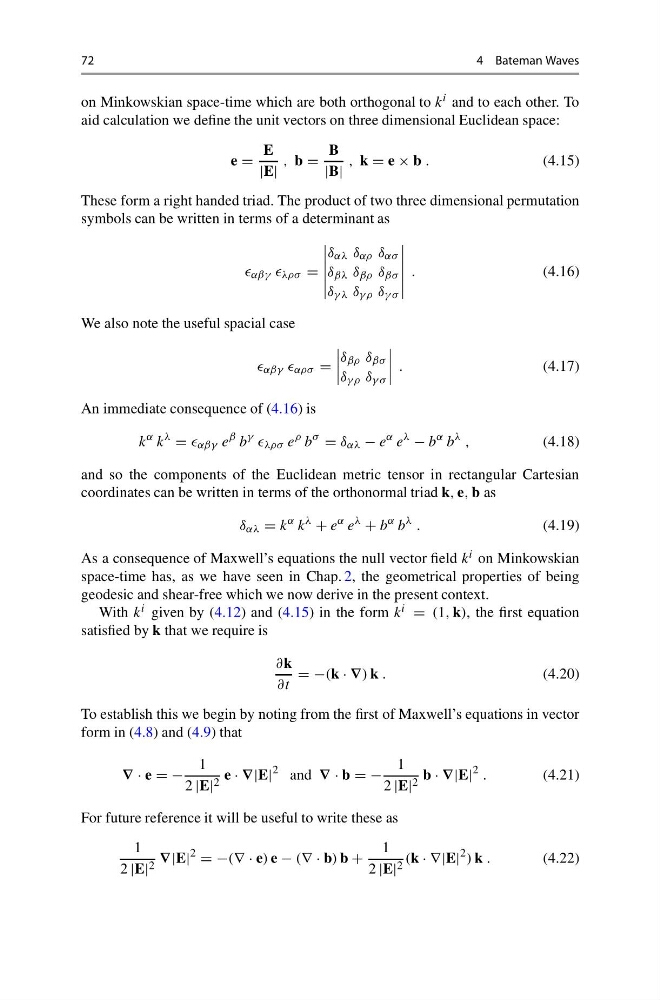
aid calculation we define the unit vectors on three dimensional Euclidean space:
e =
E
|E|
, b =
B
|B|
, k = e × b .
(4.15)
These form a right handed triad. The product of two three dimensional permutation
symbols can be written in terms of a determinant as
αβγ λρσ =
δ αλ δ αρ δ ασ
δ βλ δ βρ δ βσ
δ γ λ δ γρ δ γ σ
.
(4.16)
We also note the useful spacial case
αβγ αρσ =
δ βρ δ βσ
δ γρ δ γ σ
.
(4.17)
An immediate consequence of (4.16) is
k
α k
λ
= αβγ e
β b
γ λρσ e
ρ b
σ
= δ αλ − e
α e
λ
− b
α b
λ ,
(4.18)
and so the components of the Euclidean metric tensor in rectangular Cartesian
coordinates can be written in terms of the orthonormal triad k, e, b as
δ αλ = k
α k
λ
+ e
α e
λ
+ b
α b
λ .
(4.19)
As a consequence of Maxwell’s equations the null vector field k i on Minkowskian
space-time has, as we have seen in Chap. 2, the geometrical properties of being
geodesic and shear-free which we now derive in the present context.
With k i given by (4.12) and (4.15) in the form k i = (1, k), the first equation
satisfied by k that we require is
∂k
∂t
= −(k · ∇) k .
(4.20)
To establish this we begin by noting from the first of Maxwell’s equations in vector
form in (4.8) and (4.9) that
∇ · e = −
1
2 |E| 2 e · ∇|E|
2 and ∇ · b = −
1
2 |E| 2 b · ∇|E|
2 .
(4.21)
For future reference it will be useful to write these as
1
2 |E| 2 ∇|E|
2
= −(∇ · e) e − (∇ · b) b +
1
2 |E| 2 (k · ∇|E|
2 ) k .
(4.22)
4 Bateman Waves
on Minkowskian space-time which are both orthogonal to k i and to each other. To
aid calculation we define the unit vectors on three dimensional Euclidean space:
e =
E
|E|
, b =
B
|B|
, k = e × b .
(4.15)
These form a right handed triad. The product of two three dimensional permutation
symbols can be written in terms of a determinant as
αβγ λρσ =
δ αλ δ αρ δ ασ
δ βλ δ βρ δ βσ
δ γ λ δ γρ δ γ σ
.
(4.16)
We also note the useful spacial case
αβγ αρσ =
δ βρ δ βσ
δ γρ δ γ σ
.
(4.17)
An immediate consequence of (4.16) is
k
α k
λ
= αβγ e
β b
γ λρσ e
ρ b
σ
= δ αλ − e
α e
λ
− b
α b
λ ,
(4.18)
and so the components of the Euclidean metric tensor in rectangular Cartesian
coordinates can be written in terms of the orthonormal triad k, e, b as
δ αλ = k
α k
λ
+ e
α e
λ
+ b
α b
λ .
(4.19)
As a consequence of Maxwell’s equations the null vector field k i on Minkowskian
space-time has, as we have seen in Chap. 2, the geometrical properties of being
geodesic and shear-free which we now derive in the present context.
With k i given by (4.12) and (4.15) in the form k i = (1, k), the first equation
satisfied by k that we require is
∂k
∂t
= −(k · ∇) k .
(4.20)
To establish this we begin by noting from the first of Maxwell’s equations in vector
form in (4.8) and (4.9) that
∇ · e = −
1
2 |E| 2 e · ∇|E|
2 and ∇ · b = −
1
2 |E| 2 b · ∇|E|
2 .
(4.21)
For future reference it will be useful to write these as
1
2 |E| 2 ∇|E|
2
= −(∇ · e) e − (∇ · b) b +
1
2 |E| 2 (k · ∇|E|
2 ) k .
(4.22)