

3.3 Maxwell Field of a Non-Geodesic Charge
59
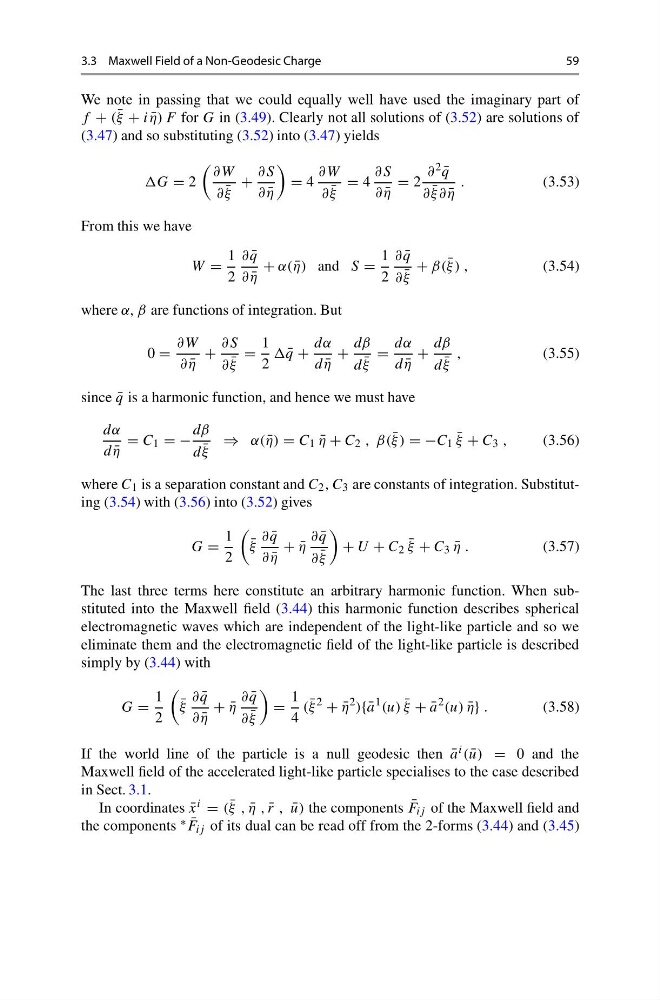
We note in passing that we could equally well have used the imaginary part of
f + ( ¯
ξ + i ¯
η) F for G in (3.49). Clearly not all solutions of (3.52) are solutions of
(3.47) and so substituting (3.52) into (3.47) yields
= 2
∂W
∂ ¯
ξ
+
∂S
∂ ¯
η
= 4
∂W
∂ ¯
ξ
= 4
∂S
∂ ¯
η
= 2
∂ 2 ¯
q
∂ ¯
ξ∂ ¯
η
.
(3.53)
From this we have
W =
1
2
∂ ¯
q
∂ ¯
η
+ α( ¯
η) and S =
1
2
∂ ¯
q
∂ ¯
ξ
+ β( ¯
ξ ) ,
(3.54)
where α, β are functions of integration. But
0 =
∂W
∂ ¯
η
+
∂S
∂ ¯
ξ
=
1
2
¯
q +
dα
d ¯
η
+
dβ
d ¯
ξ
=
dα
d ¯
η
+
dβ
d ¯
ξ
,
(3.55)
since ¯
q is a harmonic function, and hence we must have
dα
d ¯
η
= C 1 = −
dβ
d ¯
ξ
⇒ α( ¯
η) = C 1 ¯
η + C 2 , β( ¯
ξ) = −C 1 ¯
ξ + C 3 ,
(3.56)
where C 1 is a separation constant and C 2 , C 3 are constants of integration. Substituting (3.54) with (3.56) into (3.52) gives
G =
1
2
¯
ξ
∂ ¯
q
∂ ¯
η
+ ¯
η
∂ ¯
q
∂ ¯
ξ
+ U + C 2 ¯
ξ + C 3 ¯
η .
(3.57)
The last three terms here constitute an arbitrary harmonic function. When substituted into the Maxwell field (3.44) this harmonic function describes spherical
electromagnetic waves which are independent of the light-like particle and so we
eliminate them and the electromagnetic field of the light-like particle is described
simply by (3.44) with
G =
1
2
¯
ξ
∂ ¯
q
∂ ¯
η
+ ¯
η
∂ ¯
q
∂ ¯
ξ
=
1
4
( ¯
ξ
2
+ ¯
η
2 ){ ¯
a
1 (u) ¯
ξ + ¯
a
2 (u) ¯
η} .
(3.58)
If the world line of the particle is a null geodesic then ¯
a i ( ¯
u) = 0 and the
Maxwell field of the accelerated light-like particle specialises to the case described
in Sect. 3.1.
In coordinates ¯
x i = ( ¯
ξ , ¯
η , ¯
r , ¯
u) the components ¯
F ij of the Maxwell field and
the components ∗ ¯
F ij of its dual can be read off from the 2-forms (3.44) and (3.45)
59
We note in passing that we could equally well have used the imaginary part of
f + ( ¯
ξ + i ¯
η) F for G in (3.49). Clearly not all solutions of (3.52) are solutions of
(3.47) and so substituting (3.52) into (3.47) yields
= 2
∂W
∂ ¯
ξ
+
∂S
∂ ¯
η
= 4
∂W
∂ ¯
ξ
= 4
∂S
∂ ¯
η
= 2
∂ 2 ¯
q
∂ ¯
ξ∂ ¯
η
.
(3.53)
From this we have
W =
1
2
∂ ¯
q
∂ ¯
η
+ α( ¯
η) and S =
1
2
∂ ¯
q
∂ ¯
ξ
+ β( ¯
ξ ) ,
(3.54)
where α, β are functions of integration. But
0 =
∂W
∂ ¯
η
+
∂S
∂ ¯
ξ
=
1
2
¯
q +
dα
d ¯
η
+
dβ
d ¯
ξ
=
dα
d ¯
η
+
dβ
d ¯
ξ
,
(3.55)
since ¯
q is a harmonic function, and hence we must have
dα
d ¯
η
= C 1 = −
dβ
d ¯
ξ
⇒ α( ¯
η) = C 1 ¯
η + C 2 , β( ¯
ξ) = −C 1 ¯
ξ + C 3 ,
(3.56)
where C 1 is a separation constant and C 2 , C 3 are constants of integration. Substituting (3.54) with (3.56) into (3.52) gives
G =
1
2
¯
ξ
∂ ¯
q
∂ ¯
η
+ ¯
η
∂ ¯
q
∂ ¯
ξ
+ U + C 2 ¯
ξ + C 3 ¯
η .
(3.57)
The last three terms here constitute an arbitrary harmonic function. When substituted into the Maxwell field (3.44) this harmonic function describes spherical
electromagnetic waves which are independent of the light-like particle and so we
eliminate them and the electromagnetic field of the light-like particle is described
simply by (3.44) with
G =
1
2
¯
ξ
∂ ¯
q
∂ ¯
η
+ ¯
η
∂ ¯
q
∂ ¯
ξ
=
1
4
( ¯
ξ
2
+ ¯
η
2 ){ ¯
a
1 (u) ¯
ξ + ¯
a
2 (u) ¯
η} .
(3.58)
If the world line of the particle is a null geodesic then ¯
a i ( ¯
u) = 0 and the
Maxwell field of the accelerated light-like particle specialises to the case described
in Sect. 3.1.
In coordinates ¯
x i = ( ¯
ξ , ¯
η , ¯
r , ¯
u) the components ¯
F ij of the Maxwell field and
the components ∗ ¯
F ij of its dual can be read off from the 2-forms (3.44) and (3.45)