

58
3 Hypothetical Objects in Electromagnetism and Gravity
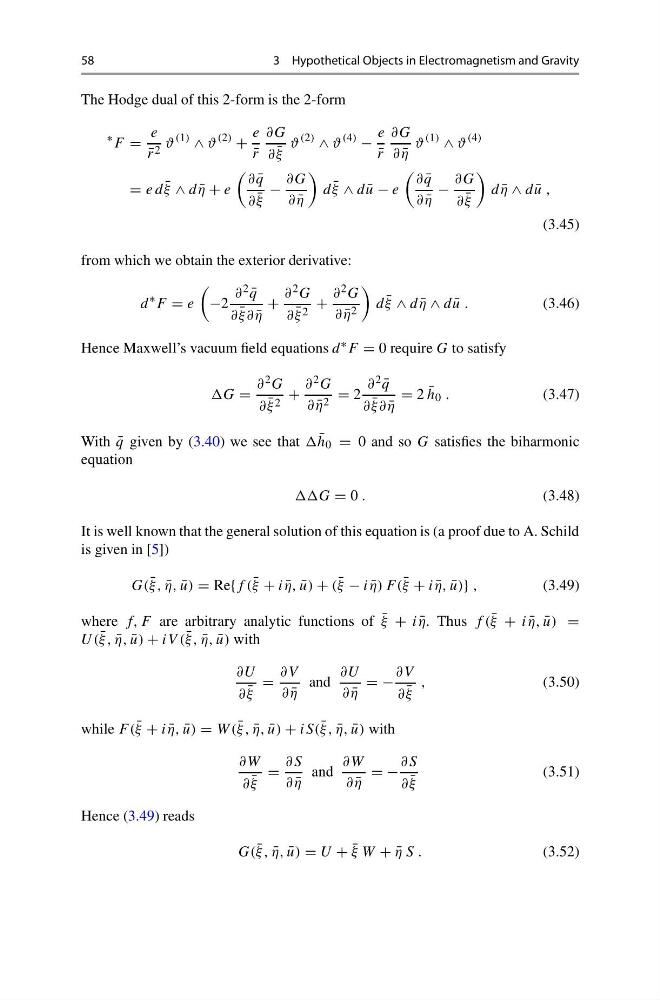
The Hodge dual of this 2-form is the 2-form
∗ F =
e
¯
r 2 ϑ
(1)
∧ ϑ
(2)
+
e
¯
r
∂G
∂ ¯
ξ
ϑ
(2)
∧ ϑ
(4)
−
e
¯
r
∂G
∂ ¯
η
ϑ
(1)
∧ ϑ
(4)
= e d ¯
ξ ∧ d ¯
η + e
∂ ¯
q
∂ ¯
ξ
−
∂G
∂ ¯
η
d ¯
ξ ∧ d ¯
u − e
∂ ¯
q
∂ ¯
η
−
∂G
∂ ¯
ξ
d ¯
η ∧ d ¯
u ,
(3.45)
from which we obtain the exterior derivative:
d
∗ F = e
−2
∂ 2 ¯
q
∂ ¯
ξ∂ ¯
η
+
∂ 2 G
∂ ¯
ξ 2 +
∂ 2 G
∂ ¯
η 2
d ¯
ξ ∧ d ¯
η ∧ d ¯
u .
(3.46)
Hence Maxwell’s vacuum field equations d ∗ F = 0 require G to satisfy
=
∂ 2 G
∂ ¯
ξ 2 +
∂ 2 G
∂ ¯
η 2 = 2
∂ 2 ¯
q
∂ ¯
ξ∂ ¯
η
= 2 ¯
h 0 .
(3.47)
With ¯
q given by (3.40) we see that ¯
h 0 = 0 and so G satisfies the biharmonic
equation
= 0 .
(3.48)
It is well known that the general solution of this equation is (a proof due to A. Schild
is given in [5])
G( ¯
ξ, ¯
η, ¯
u) = Re{f ( ¯
ξ + i ¯
η, ¯
u) + ( ¯
ξ − i ¯
η) F ( ¯
ξ + i ¯
η, ¯
u)} ,
(3.49)
where f, F are arbitrary analytic functions of ¯
ξ + i ¯
η. Thus f ( ¯
ξ + i ¯
η, ¯
u) =
U( ¯
ξ, ¯
η, ¯
u) + iV ( ¯
ξ, ¯
η, ¯
u) with
∂U
∂ ¯
ξ
=
∂V
∂ ¯
η
and
∂U
∂ ¯
η
= −
∂V
∂ ¯
ξ
,
(3.50)
while F ( ¯
ξ + i ¯
η, ¯
u) = W ( ¯
ξ , ¯
η, ¯
u) + iS( ¯
ξ , ¯
η, ¯
u) with
∂W
∂ ¯
ξ
=
∂S
∂ ¯
η
and
∂W
∂ ¯
η
= −
∂S
∂ ¯
ξ
(3.51)
Hence (3.49) reads
G( ¯
ξ , ¯
η, ¯
u) = U + ¯
ξ W + ¯
η S .
(3.52)
3 Hypothetical Objects in Electromagnetism and Gravity
The Hodge dual of this 2-form is the 2-form
∗ F =
e
¯
r 2 ϑ
(1)
∧ ϑ
(2)
+
e
¯
r
∂G
∂ ¯
ξ
ϑ
(2)
∧ ϑ
(4)
−
e
¯
r
∂G
∂ ¯
η
ϑ
(1)
∧ ϑ
(4)
= e d ¯
ξ ∧ d ¯
η + e
∂ ¯
q
∂ ¯
ξ
−
∂G
∂ ¯
η
d ¯
ξ ∧ d ¯
u − e
∂ ¯
q
∂ ¯
η
−
∂G
∂ ¯
ξ
d ¯
η ∧ d ¯
u ,
(3.45)
from which we obtain the exterior derivative:
d
∗ F = e
−2
∂ 2 ¯
q
∂ ¯
ξ∂ ¯
η
+
∂ 2 G
∂ ¯
ξ 2 +
∂ 2 G
∂ ¯
η 2
d ¯
ξ ∧ d ¯
η ∧ d ¯
u .
(3.46)
Hence Maxwell’s vacuum field equations d ∗ F = 0 require G to satisfy
=
∂ 2 G
∂ ¯
ξ 2 +
∂ 2 G
∂ ¯
η 2 = 2
∂ 2 ¯
q
∂ ¯
ξ∂ ¯
η
= 2 ¯
h 0 .
(3.47)
With ¯
q given by (3.40) we see that ¯
h 0 = 0 and so G satisfies the biharmonic
equation
= 0 .
(3.48)
It is well known that the general solution of this equation is (a proof due to A. Schild
is given in [5])
G( ¯
ξ, ¯
η, ¯
u) = Re{f ( ¯
ξ + i ¯
η, ¯
u) + ( ¯
ξ − i ¯
η) F ( ¯
ξ + i ¯
η, ¯
u)} ,
(3.49)
where f, F are arbitrary analytic functions of ¯
ξ + i ¯
η. Thus f ( ¯
ξ + i ¯
η, ¯
u) =
U( ¯
ξ, ¯
η, ¯
u) + iV ( ¯
ξ, ¯
η, ¯
u) with
∂U
∂ ¯
ξ
=
∂V
∂ ¯
η
and
∂U
∂ ¯
η
= −
∂V
∂ ¯
ξ
,
(3.50)
while F ( ¯
ξ + i ¯
η, ¯
u) = W ( ¯
ξ , ¯
η, ¯
u) + iS( ¯
ξ , ¯
η, ¯
u) with
∂W
∂ ¯
ξ
=
∂S
∂ ¯
η
and
∂W
∂ ¯
η
= −
∂S
∂ ¯
ξ
(3.51)
Hence (3.49) reads
G( ¯
ξ , ¯
η, ¯
u) = U + ¯
ξ W + ¯
η S .
(3.52)