

2.4 The Kerr Space-Time
41
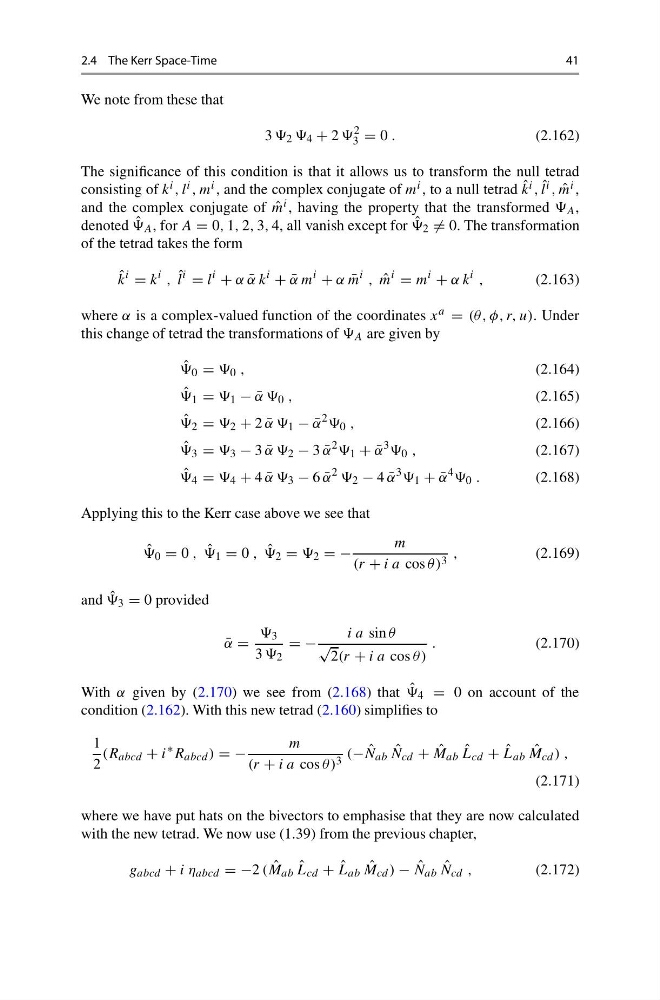
We note from these that
3 2 4 + 2
2
3 = 0 .
(2.162)
The significance of this condition is that it allows us to transform the null tetrad
consisting of k i , l i , m i , and the complex conjugate of m i , to a null tetrad ˆ
k i , ˆ
l i , ˆ
m i ,
and the complex conjugate of ˆ
m i , having the property that the transformed A ,
denoted ˆ
A , for A = 0, 1, 2, 3, 4, all vanish except for ˆ
2 = 0. The transformation
of the tetrad takes the form
ˆ
k
i
= k
i , ˆ
l
i
= l
i
+ α ¯
α k
i
+ ¯
α m
i
+ α ¯
m
i , ˆ
m
i
= m
i
+ α k
i ,
(2.163)
where α is a complex-valued function of the coordinates x a = (θ, φ, r, u). Under
this change of tetrad the transformations of A are given by
ˆ
0 = 0 ,
(2.164)
ˆ
1 = 1 − ¯
α α 0 ,
(2.165)
ˆ
2 = 2 + 2 ¯
α α 1 − ¯
α
2 0 ,
(2.166)
ˆ
3 = 3 − 3 ¯
α α 2 − 3 ¯
α
2 1 + ¯
α
3 0 ,
(2.167)
ˆ
4 = 4 + 4 ¯
α α 3 − 6 ¯
α
2 2 − 4 ¯
α
3 1 + ¯
α
4 0 .
(2.168)
Applying this to the Kerr case above we see that
ˆ
0 = 0 , ˆ
1 = 0 , ˆ
2 = 2 = −
m
(r + i a cos θ) 3 ,
(2.169)
and ˆ
3 = 0 provided
¯
α =
3
3 2
= −
i a sin θ
√
2(r + i a cos θ)
.
(2.170)
With α given by (2.170) we see from (2.168) that ˆ
4 = 0 on account of the
condition (2.162). With this new tetrad (2.160) simplifies to
1
2
(R abcd + i
∗ R abcd ) = −
m
(r + i a cos θ) 3 (− ˆ
N ab ˆ
N cd + ˆ
M ab ˆ
L cd + ˆ
L ab ˆ
M cd ) ,
(2.171)
where we have put hats on the bivectors to emphasise that they are now calculated
with the new tetrad. We now use (1.39) from the previous chapter,
g abcd + i η abcd = −2 ( ˆ
M ab ˆ
L cd + ˆ
L ab ˆ
M cd ) − ˆ
N ab ˆ
N cd ,
(2.172)
41
We note from these that
3 2 4 + 2
2
3 = 0 .
(2.162)
The significance of this condition is that it allows us to transform the null tetrad
consisting of k i , l i , m i , and the complex conjugate of m i , to a null tetrad ˆ
k i , ˆ
l i , ˆ
m i ,
and the complex conjugate of ˆ
m i , having the property that the transformed A ,
denoted ˆ
A , for A = 0, 1, 2, 3, 4, all vanish except for ˆ
2 = 0. The transformation
of the tetrad takes the form
ˆ
k
i
= k
i , ˆ
l
i
= l
i
+ α ¯
α k
i
+ ¯
α m
i
+ α ¯
m
i , ˆ
m
i
= m
i
+ α k
i ,
(2.163)
where α is a complex-valued function of the coordinates x a = (θ, φ, r, u). Under
this change of tetrad the transformations of A are given by
ˆ
0 = 0 ,
(2.164)
ˆ
1 = 1 − ¯
α α 0 ,
(2.165)
ˆ
2 = 2 + 2 ¯
α α 1 − ¯
α
2 0 ,
(2.166)
ˆ
3 = 3 − 3 ¯
α α 2 − 3 ¯
α
2 1 + ¯
α
3 0 ,
(2.167)
ˆ
4 = 4 + 4 ¯
α α 3 − 6 ¯
α
2 2 − 4 ¯
α
3 1 + ¯
α
4 0 .
(2.168)
Applying this to the Kerr case above we see that
ˆ
0 = 0 , ˆ
1 = 0 , ˆ
2 = 2 = −
m
(r + i a cos θ) 3 ,
(2.169)
and ˆ
3 = 0 provided
¯
α =
3
3 2
= −
i a sin θ
√
2(r + i a cos θ)
.
(2.170)
With α given by (2.170) we see from (2.168) that ˆ
4 = 0 on account of the
condition (2.162). With this new tetrad (2.160) simplifies to
1
2
(R abcd + i
∗ R abcd ) = −
m
(r + i a cos θ) 3 (− ˆ
N ab ˆ
N cd + ˆ
M ab ˆ
L cd + ˆ
L ab ˆ
M cd ) ,
(2.171)
where we have put hats on the bivectors to emphasise that they are now calculated
with the new tetrad. We now use (1.39) from the previous chapter,
g abcd + i η abcd = −2 ( ˆ
M ab ˆ
L cd + ˆ
L ab ˆ
M cd ) − ˆ
N ab ˆ
N cd ,
(2.172)