

40
2 Bivector Formalism
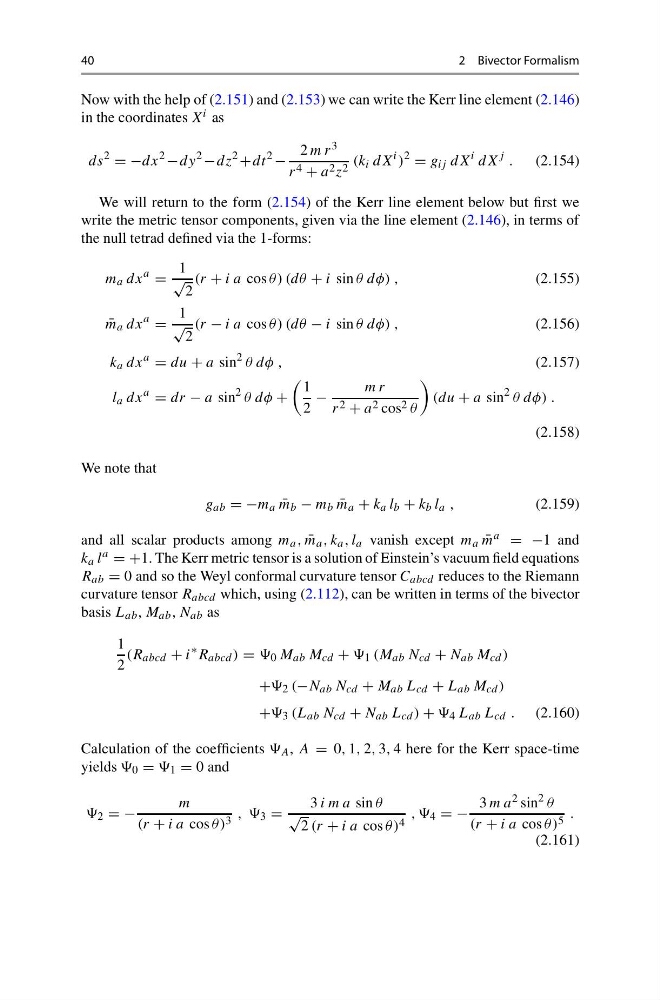
Now with the help of (2.151) and (2.153) we can write the Kerr line element (2.146)
in the coordinates X i as
ds
2
= −dx
2
−dy
2
−dz
2
+dt
2
−
2 m r 3
r 4 + a 2 z 2 (k i dX
i )
2
= g ij dX
i dX
j .
(2.154)
We will return to the form (2.154) of the Kerr line element below but first we
write the metric tensor components, given via the line element (2.146), in terms of
the null tetrad defined via the 1-forms:
m a dx
a
=
1
√
2
(r + i a cos θ) (dθ + i sin θ dφ) ,
(2.155)
¯
m a dx
a
=
1
√
2
(r − i a cos θ) (dθ − i sin θ dφ) ,
(2.156)
k a dx
a
= du + a sin
2 θ dφ ,
(2.157)
l a dx
a
= dr − a sin
2 θ dφ +
1
2
−
m r
r 2 + a 2 cos 2 θ
(du + a sin
2 θ dφ) .
(2.158)
We note that
g ab = −m a ¯
m b − m b ¯
m a + k a l b + k b l a ,
(2.159)
and all scalar products among m a , ¯
m a , k a , l a vanish except m a ¯
m a = −1 and
k a l a = +1. The Kerr metric tensor is a solution of Einstein’s vacuum field equations
R ab = 0 and so the Weyl conformal curvature tensor C abcd reduces to the Riemann
curvature tensor R abcd which, using (2.112), can be written in terms of the bivector
basis L ab , M ab , N ab as
1
2
(R abcd + i
∗ R abcd ) = 0 M ab M cd + 1 (M ab N cd + N ab M cd )
+ 2 (−N ab N cd + M ab L cd + L ab M cd )
+ 3 (L ab N cd + N ab L cd ) + 4 L ab L cd . (2.160)
Calculation of the coefficients A , A = 0, 1, 2, 3, 4 here for the Kerr space-time
yields 0 = 1 = 0 and
2 = −
m
(r + i a cos θ) 3 , , 3 =
3 i m a sin θ
√
2 (r + i a cos θ) 4
, , 4 = −
3 m a 2 sin
2 θ
(r + i a cos θ) 5 .
(2.161)
2 Bivector Formalism
Now with the help of (2.151) and (2.153) we can write the Kerr line element (2.146)
in the coordinates X i as
ds
2
= −dx
2
−dy
2
−dz
2
+dt
2
−
2 m r 3
r 4 + a 2 z 2 (k i dX
i )
2
= g ij dX
i dX
j .
(2.154)
We will return to the form (2.154) of the Kerr line element below but first we
write the metric tensor components, given via the line element (2.146), in terms of
the null tetrad defined via the 1-forms:
m a dx
a
=
1
√
2
(r + i a cos θ) (dθ + i sin θ dφ) ,
(2.155)
¯
m a dx
a
=
1
√
2
(r − i a cos θ) (dθ − i sin θ dφ) ,
(2.156)
k a dx
a
= du + a sin
2 θ dφ ,
(2.157)
l a dx
a
= dr − a sin
2 θ dφ +
1
2
−
m r
r 2 + a 2 cos 2 θ
(du + a sin
2 θ dφ) .
(2.158)
We note that
g ab = −m a ¯
m b − m b ¯
m a + k a l b + k b l a ,
(2.159)
and all scalar products among m a , ¯
m a , k a , l a vanish except m a ¯
m a = −1 and
k a l a = +1. The Kerr metric tensor is a solution of Einstein’s vacuum field equations
R ab = 0 and so the Weyl conformal curvature tensor C abcd reduces to the Riemann
curvature tensor R abcd which, using (2.112), can be written in terms of the bivector
basis L ab , M ab , N ab as
1
2
(R abcd + i
∗ R abcd ) = 0 M ab M cd + 1 (M ab N cd + N ab M cd )
+ 2 (−N ab N cd + M ab L cd + L ab M cd )
+ 3 (L ab N cd + N ab L cd ) + 4 L ab L cd . (2.160)
Calculation of the coefficients A , A = 0, 1, 2, 3, 4 here for the Kerr space-time
yields 0 = 1 = 0 and
2 = −
m
(r + i a cos θ) 3 , , 3 =
3 i m a sin θ
√
2 (r + i a cos θ) 4
, , 4 = −
3 m a 2 sin
2 θ
(r + i a cos θ) 5 .
(2.161)