

2.3 Bivectors and Gravitational Fields
33
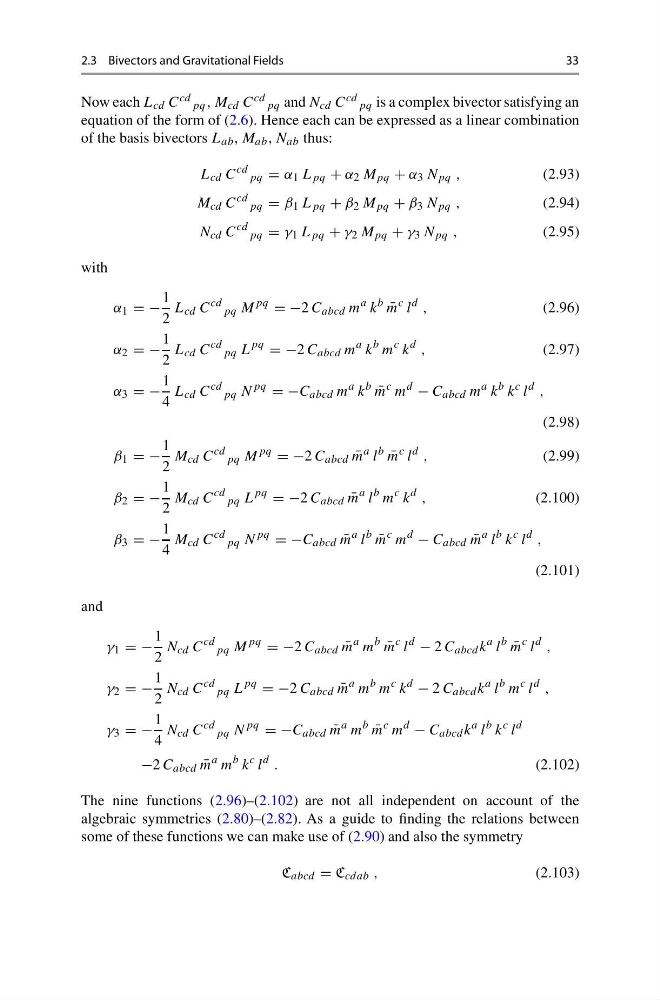
Now each L cd C cd pq , M cd C cd pq and N cd C cd pq is a complex bivector satisfying an
equation of the form of (2.6). Hence each can be expressed as a linear combination
of the basis bivectors L ab , M ab , N ab thus:
L cd C
cd
pq = α 1 L pq + α 2 M pq + α 3 N pq ,
(2.93)
M cd C
cd
pq = β 1 L pq + β 2 M pq + β 3 N pq ,
(2.94)
N cd C
cd
pq = γ 1 L pq + γ 2 M pq + γ 3 N pq ,
(2.95)
with
α 1 = −
1
2
L cd C
cd
pq M
pq
= −2 C abcd m
a k
b
¯
m
c l
d ,
(2.96)
α 2 = −
1
2
L cd C
cd
pq L
pq
= −2 C abcd m
a k
b m
c k
d ,
(2.97)
α 3 = −
1
4
L cd C
cd
pq N
pq
= −C abcd m
a k
b
¯
m
c m
d
− C abcd m
a k
b k
c l
d ,
(2.98)
β 1 = −
1
2
M cd C
cd
pq M
pq
= −2 C abcd ¯
m
a l
b
¯
m
c l
d ,
(2.99)
β 2 = −
1
2
M cd C
cd
pq L
pq
= −2 C abcd ¯
m
a l
b m
c k
d ,
(2.100)
β 3 = −
1
4
M cd C
cd
pq N
pq
= −C abcd ¯
m
a l
b
¯
m
c m
d
− C abcd ¯
m
a l
b k
c l
d ,
(2.101)
and
γ 1 = −
1
2
N cd C
cd
pq M
pq
= −2 C abcd ¯
m
a m
b
¯
m
c l
d
− 2 C abcd k
a l
b
¯
m
c l
d ,
γ 2 = −
1
2
N cd C
cd
pq L
pq
= −2 C abcd ¯
m
a m
b m
c k
d
− 2 C abcd k
a l
b m
c l
d ,
γ 3 = −
1
4
N cd C
cd
pq N
pq
= −C abcd ¯
m
a m
b
¯
m
c m
d
− C abcd k
a l
b k
c l
d
−2 C abcd ¯
m
a m
b k
c l
d .
(2.102)
The nine functions (2.96)–(2.102) are not all independent on account of the
algebraic symmetries (2.80)–(2.82). As a guide to finding the relations between
some of these functions we can make use of (2.90) and also the symmetry
C abcd = C cdab ,
(2.103)
33
Now each L cd C cd pq , M cd C cd pq and N cd C cd pq is a complex bivector satisfying an
equation of the form of (2.6). Hence each can be expressed as a linear combination
of the basis bivectors L ab , M ab , N ab thus:
L cd C
cd
pq = α 1 L pq + α 2 M pq + α 3 N pq ,
(2.93)
M cd C
cd
pq = β 1 L pq + β 2 M pq + β 3 N pq ,
(2.94)
N cd C
cd
pq = γ 1 L pq + γ 2 M pq + γ 3 N pq ,
(2.95)
with
α 1 = −
1
2
L cd C
cd
pq M
pq
= −2 C abcd m
a k
b
¯
m
c l
d ,
(2.96)
α 2 = −
1
2
L cd C
cd
pq L
pq
= −2 C abcd m
a k
b m
c k
d ,
(2.97)
α 3 = −
1
4
L cd C
cd
pq N
pq
= −C abcd m
a k
b
¯
m
c m
d
− C abcd m
a k
b k
c l
d ,
(2.98)
β 1 = −
1
2
M cd C
cd
pq M
pq
= −2 C abcd ¯
m
a l
b
¯
m
c l
d ,
(2.99)
β 2 = −
1
2
M cd C
cd
pq L
pq
= −2 C abcd ¯
m
a l
b m
c k
d ,
(2.100)
β 3 = −
1
4
M cd C
cd
pq N
pq
= −C abcd ¯
m
a l
b
¯
m
c m
d
− C abcd ¯
m
a l
b k
c l
d ,
(2.101)
and
γ 1 = −
1
2
N cd C
cd
pq M
pq
= −2 C abcd ¯
m
a m
b
¯
m
c l
d
− 2 C abcd k
a l
b
¯
m
c l
d ,
γ 2 = −
1
2
N cd C
cd
pq L
pq
= −2 C abcd ¯
m
a m
b m
c k
d
− 2 C abcd k
a l
b m
c l
d ,
γ 3 = −
1
4
N cd C
cd
pq N
pq
= −C abcd ¯
m
a m
b
¯
m
c m
d
− C abcd k
a l
b k
c l
d
−2 C abcd ¯
m
a m
b k
c l
d .
(2.102)
The nine functions (2.96)–(2.102) are not all independent on account of the
algebraic symmetries (2.80)–(2.82). As a guide to finding the relations between
some of these functions we can make use of (2.90) and also the symmetry
C abcd = C cdab ,
(2.103)