

32
2 Bivector Formalism
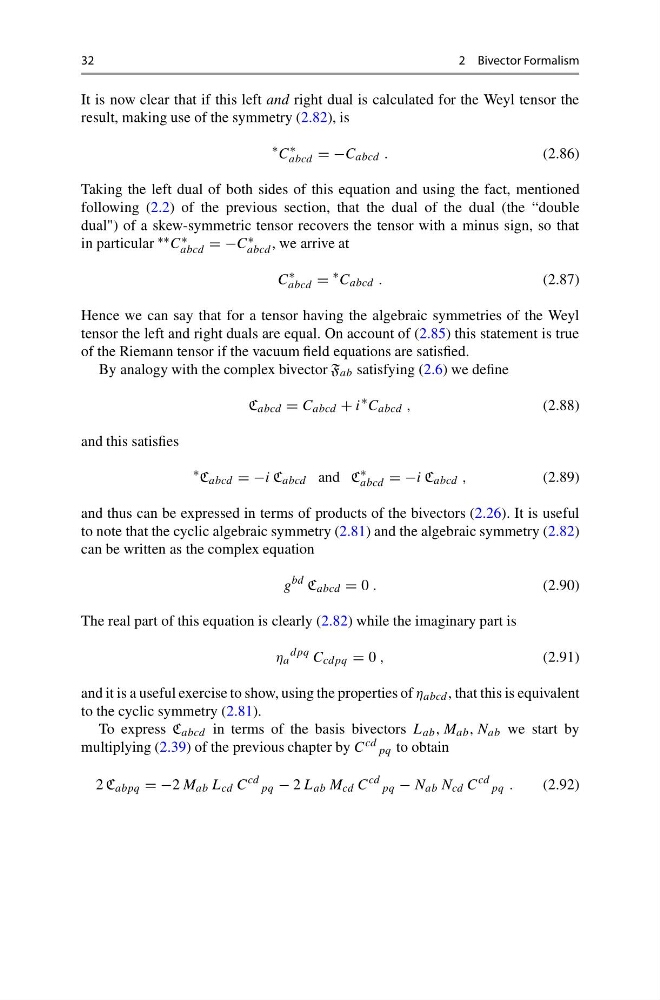
It is now clear that if this left and right dual is calculated for the Weyl tensor the
result, making use of the symmetry (2.82), is
∗ C
∗
abcd = −C abcd .
(2.86)
Taking the left dual of both sides of this equation and using the fact, mentioned
following (2.2) of the previous section, that the dual of the dual (the “double
dual") of a skew-symmetric tensor recovers the tensor with a minus sign, so that
in particular ∗∗ C ∗
abcd = −C ∗
abcd , we arrive at
C
∗
abcd =
∗ C abcd .
(2.87)
Hence we can say that for a tensor having the algebraic symmetries of the Weyl
tensor the left and right duals are equal. On account of (2.85) this statement is true
of the Riemann tensor if the vacuum field equations are satisfied.
By analogy with the complex bivector F ab satisfying (2.6) we define
C abcd = C abcd + i
∗ C abcd ,
(2.88)
and this satisfies
∗
C abcd = −i C abcd and C
∗
abcd = −i C abcd ,
(2.89)
and thus can be expressed in terms of products of the bivectors (2.26). It is useful
to note that the cyclic algebraic symmetry (2.81) and the algebraic symmetry (2.82)
can be written as the complex equation
g
bd
C abcd = 0 .
(2.90)
The real part of this equation is clearly (2.82) while the imaginary part is
η a
dpq C cdpq = 0 ,
(2.91)
and it is a useful exercise to show, using the properties of η abcd , that this is equivalent
to the cyclic symmetry (2.81).
To express C abcd in terms of the basis bivectors L ab , M ab , N ab we start by
multiplying (2.39) of the previous chapter by C cd pq to obtain
2 C abpq = −2 M ab L cd C
cd
pq − 2 L ab M cd C
cd
pq − N ab N cd C
cd
pq .
(2.92)
2 Bivector Formalism
It is now clear that if this left and right dual is calculated for the Weyl tensor the
result, making use of the symmetry (2.82), is
∗ C
∗
abcd = −C abcd .
(2.86)
Taking the left dual of both sides of this equation and using the fact, mentioned
following (2.2) of the previous section, that the dual of the dual (the “double
dual") of a skew-symmetric tensor recovers the tensor with a minus sign, so that
in particular ∗∗ C ∗
abcd = −C ∗
abcd , we arrive at
C
∗
abcd =
∗ C abcd .
(2.87)
Hence we can say that for a tensor having the algebraic symmetries of the Weyl
tensor the left and right duals are equal. On account of (2.85) this statement is true
of the Riemann tensor if the vacuum field equations are satisfied.
By analogy with the complex bivector F ab satisfying (2.6) we define
C abcd = C abcd + i
∗ C abcd ,
(2.88)
and this satisfies
∗
C abcd = −i C abcd and C
∗
abcd = −i C abcd ,
(2.89)
and thus can be expressed in terms of products of the bivectors (2.26). It is useful
to note that the cyclic algebraic symmetry (2.81) and the algebraic symmetry (2.82)
can be written as the complex equation
g
bd
C abcd = 0 .
(2.90)
The real part of this equation is clearly (2.82) while the imaginary part is
η a
dpq C cdpq = 0 ,
(2.91)
and it is a useful exercise to show, using the properties of η abcd , that this is equivalent
to the cyclic symmetry (2.81).
To express C abcd in terms of the basis bivectors L ab , M ab , N ab we start by
multiplying (2.39) of the previous chapter by C cd pq to obtain
2 C abpq = −2 M ab L cd C
cd
pq − 2 L ab M cd C
cd
pq − N ab N cd C
cd
pq .
(2.92)