

2.2 Electromagnetic Radiation
29
of l a , m a , ¯
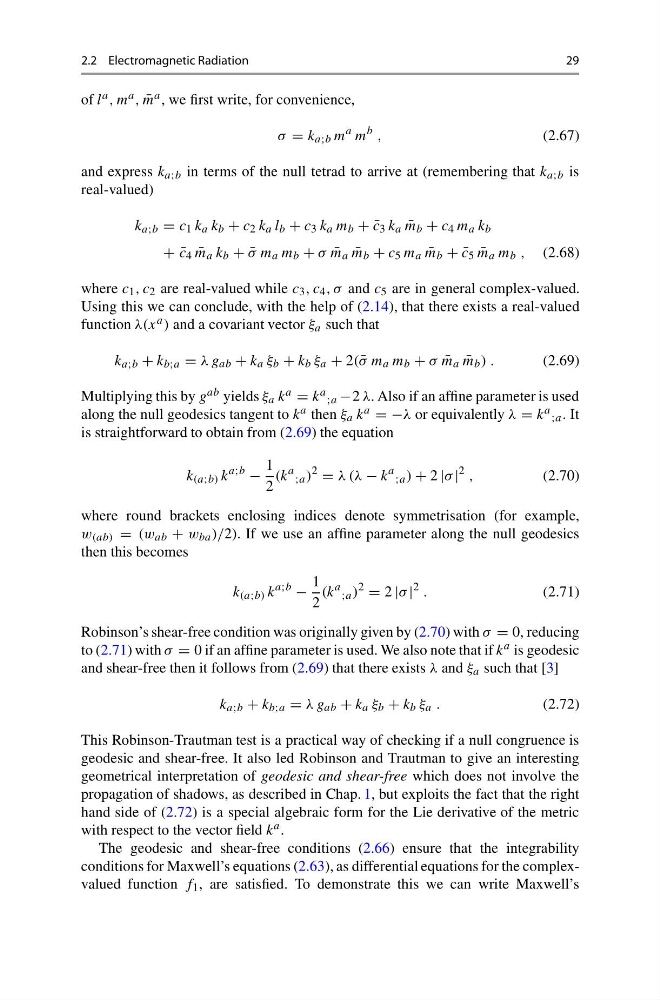
m a , we first write, for convenience,
σ = k a;b m
a m
b ,
(2.67)
and express k a;b in terms of the null tetrad to arrive at (remembering that k a;b is
real-valued)
k a;b = c 1 k a k b + c 2 k a l b + c 3 k a m b + ¯
c 3 k a ¯
m b + c 4 m a k b
+ ¯
c 4 ¯
m a k b + ¯
σ m a m b + σ ¯
m a ¯
m b + c 5 m a ¯
m b + ¯
c 5 ¯
m a m b , (2.68)
where c 1 , c 2 are real-valued while c 3 , c 4 , σ and c 5 are in general complex-valued.
Using this we can conclude, with the help of (2.14), that there exists a real-valued
function λ(x a ) and a covariant vector ξ a such that
k a;b + k b;a = λ g ab + k a ξ b + k b ξ a + 2( ¯
σ m a m b + σ ¯
m a ¯
m b ) .
(2.69)
Multiplying this by g ab yields ξ a k a = k a ;a −2 λ. Also if an affine parameter is used
along the null geodesics tangent to k a then ξ a k a = −λ or equivalently λ = k a ;a . It
is straightforward to obtain from (2.69) the equation
k (a;b) k
a;b
−
1
2
(k
a ;a )
2
= λ (λ − k
a ;a ) + 2 |σ |
2 ,
(2.70)
where round brackets enclosing indices denote symmetrisation (for example,
w (ab) = (w ab + w ba )/2). If we use an affine parameter along the null geodesics
then this becomes
k (a;b) k
a;b
−
1
2
(k
a ;a )
2
= 2 |σ |
2 .
(2.71)
Robinson’s shear-free condition was originally given by (2.70) with σ = 0, reducing
to (2.71) with σ = 0 if an affine parameter is used. We also note that if k a is geodesic
and shear-free then it follows from (2.69) that there exists λ and ξ a such that [3]
k a;b + k b;a = λ g ab + k a ξ b + k b ξ a .
(2.72)
This Robinson-Trautman test is a practical way of checking if a null congruence is
geodesic and shear-free. It also led Robinson and Trautman to give an interesting
geometrical interpretation of geodesic and shear-free which does not involve the
propagation of shadows, as described in Chap. 1, but exploits the fact that the right
hand side of (2.72) is a special algebraic form for the Lie derivative of the metric
with respect to the vector field k a .
The geodesic and shear-free conditions (2.66) ensure that the integrability
conditions for Maxwell’s equations (2.63), as differential equations for the complexvalued function f 1 , are satisfied. To demonstrate this we can write Maxwell’s
29
of l a , m a , ¯
m a , we first write, for convenience,
σ = k a;b m
a m
b ,
(2.67)
and express k a;b in terms of the null tetrad to arrive at (remembering that k a;b is
real-valued)
k a;b = c 1 k a k b + c 2 k a l b + c 3 k a m b + ¯
c 3 k a ¯
m b + c 4 m a k b
+ ¯
c 4 ¯
m a k b + ¯
σ m a m b + σ ¯
m a ¯
m b + c 5 m a ¯
m b + ¯
c 5 ¯
m a m b , (2.68)
where c 1 , c 2 are real-valued while c 3 , c 4 , σ and c 5 are in general complex-valued.
Using this we can conclude, with the help of (2.14), that there exists a real-valued
function λ(x a ) and a covariant vector ξ a such that
k a;b + k b;a = λ g ab + k a ξ b + k b ξ a + 2( ¯
σ m a m b + σ ¯
m a ¯
m b ) .
(2.69)
Multiplying this by g ab yields ξ a k a = k a ;a −2 λ. Also if an affine parameter is used
along the null geodesics tangent to k a then ξ a k a = −λ or equivalently λ = k a ;a . It
is straightforward to obtain from (2.69) the equation
k (a;b) k
a;b
−
1
2
(k
a ;a )
2
= λ (λ − k
a ;a ) + 2 |σ |
2 ,
(2.70)
where round brackets enclosing indices denote symmetrisation (for example,
w (ab) = (w ab + w ba )/2). If we use an affine parameter along the null geodesics
then this becomes
k (a;b) k
a;b
−
1
2
(k
a ;a )
2
= 2 |σ |
2 .
(2.71)
Robinson’s shear-free condition was originally given by (2.70) with σ = 0, reducing
to (2.71) with σ = 0 if an affine parameter is used. We also note that if k a is geodesic
and shear-free then it follows from (2.69) that there exists λ and ξ a such that [3]
k a;b + k b;a = λ g ab + k a ξ b + k b ξ a .
(2.72)
This Robinson-Trautman test is a practical way of checking if a null congruence is
geodesic and shear-free. It also led Robinson and Trautman to give an interesting
geometrical interpretation of geodesic and shear-free which does not involve the
propagation of shadows, as described in Chap. 1, but exploits the fact that the right
hand side of (2.72) is a special algebraic form for the Lie derivative of the metric
with respect to the vector field k a .
The geodesic and shear-free conditions (2.66) ensure that the integrability
conditions for Maxwell’s equations (2.63), as differential equations for the complexvalued function f 1 , are satisfied. To demonstrate this we can write Maxwell’s