

22
2 Bivector Formalism
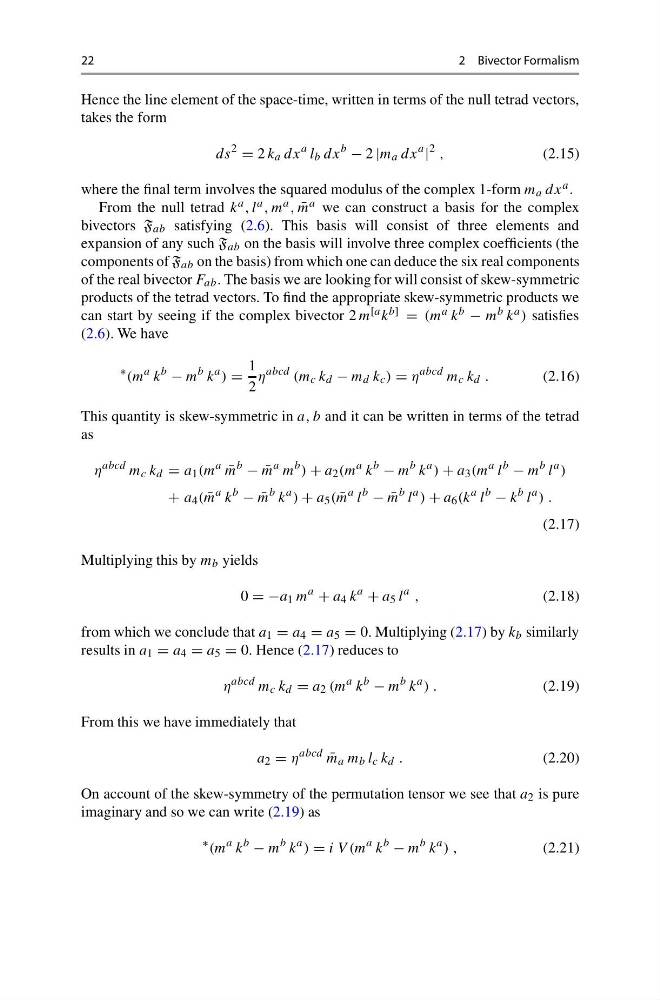
Hence the line element of the space-time, written in terms of the null tetrad vectors,
takes the form
ds
2
= 2 k a dx
a l b dx
b
− 2 |m a dx
a
|
2 ,
(2.15)
where the final term involves the squared modulus of the complex 1-form m a dx a .
From the null tetrad k a , l a , m a , ¯
m a we can construct a basis for the complex
bivectors F ab satisfying (2.6). This basis will consist of three elements and
expansion of any such F ab on the basis will involve three complex coefficients (the
components of F ab on the basis) from which one can deduce the six real components
of the real bivector F ab . The basis we are looking for will consist of skew-symmetric
products of the tetrad vectors. To find the appropriate skew-symmetric products we
can start by seeing if the complex bivector 2 m [a k b] = (m a k b − m b k a ) satisfies
(2.6). We have
∗ (m
a k
b
− m
b k
a ) =
1
2
η
abcd (m c k d − m d k c ) = η
abcd m c k d .
(2.16)
This quantity is skew-symmetric in a, b and it can be written in terms of the tetrad
as
η
abcd m c k d = a 1 (m
a
¯
m
b
− ¯
m
a m
b ) + a 2 (m
a k
b
− m
b k
a ) + a 3 (m
a l
b
− m
b l
a )
+ a 4 ( ¯
m
a k
b
− ¯
m
b k
a ) + a 5 ( ¯
m
a l
b
− ¯
m
b l
a ) + a 6 (k
a l
b
− k
b l
a ) .
(2.17)
Multiplying this by m b yields
0 = −a 1 m
a
+ a 4 k
a
+ a 5 l
a ,
(2.18)
from which we conclude that a 1 = a 4 = a 5 = 0. Multiplying (2.17) by k b similarly
results in a 1 = a 4 = a 5 = 0. Hence (2.17) reduces to
η
abcd m c k d = a 2 (m
a k
b
− m
b k
a ) .
(2.19)
From this we have immediately that
a 2 = η
abcd
¯
m a m b l c k d .
(2.20)
On account of the skew-symmetry of the permutation tensor we see that a 2 is pure
imaginary and so we can write (2.19) as
∗ (m
a k
b
− m
b k
a ) = i V (m
a k
b
− m
b k
a ) ,
(2.21)
2 Bivector Formalism
Hence the line element of the space-time, written in terms of the null tetrad vectors,
takes the form
ds
2
= 2 k a dx
a l b dx
b
− 2 |m a dx
a
|
2 ,
(2.15)
where the final term involves the squared modulus of the complex 1-form m a dx a .
From the null tetrad k a , l a , m a , ¯
m a we can construct a basis for the complex
bivectors F ab satisfying (2.6). This basis will consist of three elements and
expansion of any such F ab on the basis will involve three complex coefficients (the
components of F ab on the basis) from which one can deduce the six real components
of the real bivector F ab . The basis we are looking for will consist of skew-symmetric
products of the tetrad vectors. To find the appropriate skew-symmetric products we
can start by seeing if the complex bivector 2 m [a k b] = (m a k b − m b k a ) satisfies
(2.6). We have
∗ (m
a k
b
− m
b k
a ) =
1
2
η
abcd (m c k d − m d k c ) = η
abcd m c k d .
(2.16)
This quantity is skew-symmetric in a, b and it can be written in terms of the tetrad
as
η
abcd m c k d = a 1 (m
a
¯
m
b
− ¯
m
a m
b ) + a 2 (m
a k
b
− m
b k
a ) + a 3 (m
a l
b
− m
b l
a )
+ a 4 ( ¯
m
a k
b
− ¯
m
b k
a ) + a 5 ( ¯
m
a l
b
− ¯
m
b l
a ) + a 6 (k
a l
b
− k
b l
a ) .
(2.17)
Multiplying this by m b yields
0 = −a 1 m
a
+ a 4 k
a
+ a 5 l
a ,
(2.18)
from which we conclude that a 1 = a 4 = a 5 = 0. Multiplying (2.17) by k b similarly
results in a 1 = a 4 = a 5 = 0. Hence (2.17) reduces to
η
abcd m c k d = a 2 (m
a k
b
− m
b k
a ) .
(2.19)
From this we have immediately that
a 2 = η
abcd
¯
m a m b l c k d .
(2.20)
On account of the skew-symmetry of the permutation tensor we see that a 2 is pure
imaginary and so we can write (2.19) as
∗ (m
a k
b
− m
b k
a ) = i V (m
a k
b
− m
b k
a ) ,
(2.21)