

228
C Gravitational (Clock) Compass
The waves have two degrees of freedom of polarization reflected in the presence of
the two arbitrary functions a(T −Z) and b(T −Z) and, in addition, their arbitrariness
represents the freedom to choose the profile of the waves. In the coordinates X i =
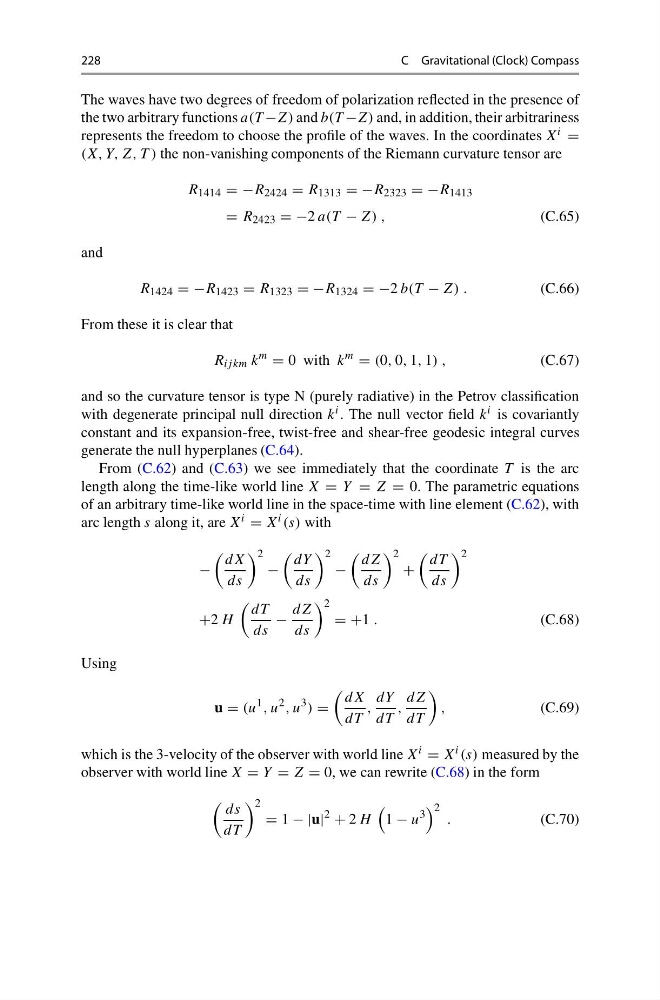
(X, Y, Z, T ) the non-vanishing components of the Riemann curvature tensor are
R 1414 = −R 2424 = R 1313 = −R 2323 = −R 1413
= R 2423 = −2 a(T − Z) ,
(C.65)
and
R 1424 = −R 1423 = R 1323 = −R 1324 = −2 b(T − Z) .
(C.66)
From these it is clear that
R ij km k
m
= 0 with k
m
= (0, 0, 1, 1) ,
(C.67)
and so the curvature tensor is type N (purely radiative) in the Petrov classification
with degenerate principal null direction k i . The null vector field k i is covariantly
constant and its expansion-free, twist-free and shear-free geodesic integral curves
generate the null hyperplanes (C.64).
From (C.62) and (C.63) we see immediately that the coordinate T is the arc
length along the time-like world line X = Y = Z = 0. The parametric equations
of an arbitrary time-like world line in the space-time with line element (C.62), with
arc length s along it, are X i = X i (s) with
−
dX
ds
2
−
dY
ds
2
−
dZ
ds
2
+
dT
ds
2
+2 H
dT
ds
−
dZ
ds
2
= +1 .
(C.68)
Using
u = (u
1 , u
2 , u
3 ) =
dX
dT
,
dY
dT
,
dZ
dT
,
(C.69)
which is the 3-velocity of the observer with world line X i = X i (s) measured by the
observer with world line X = Y = Z = 0, we can rewrite (C.68) in the form
ds
dT
2
= 1 − |u|
2
+ 2 H
1 − u
3
2
.
(C.70)
C Gravitational (Clock) Compass
The waves have two degrees of freedom of polarization reflected in the presence of
the two arbitrary functions a(T −Z) and b(T −Z) and, in addition, their arbitrariness
represents the freedom to choose the profile of the waves. In the coordinates X i =
(X, Y, Z, T ) the non-vanishing components of the Riemann curvature tensor are
R 1414 = −R 2424 = R 1313 = −R 2323 = −R 1413
= R 2423 = −2 a(T − Z) ,
(C.65)
and
R 1424 = −R 1423 = R 1323 = −R 1324 = −2 b(T − Z) .
(C.66)
From these it is clear that
R ij km k
m
= 0 with k
m
= (0, 0, 1, 1) ,
(C.67)
and so the curvature tensor is type N (purely radiative) in the Petrov classification
with degenerate principal null direction k i . The null vector field k i is covariantly
constant and its expansion-free, twist-free and shear-free geodesic integral curves
generate the null hyperplanes (C.64).
From (C.62) and (C.63) we see immediately that the coordinate T is the arc
length along the time-like world line X = Y = Z = 0. The parametric equations
of an arbitrary time-like world line in the space-time with line element (C.62), with
arc length s along it, are X i = X i (s) with
−
dX
ds
2
−
dY
ds
2
−
dZ
ds
2
+
dT
ds
2
+2 H
dT
ds
−
dZ
ds
2
= +1 .
(C.68)
Using
u = (u
1 , u
2 , u
3 ) =
dX
dT
,
dY
dT
,
dZ
dT
,
(C.69)
which is the 3-velocity of the observer with world line X i = X i (s) measured by the
observer with world line X = Y = Z = 0, we can rewrite (C.68) in the form
ds
dT
2
= 1 − |u|
2
+ 2 H
1 − u
3
2
.
(C.70)