

C Gravitational (Clock) Compass
227
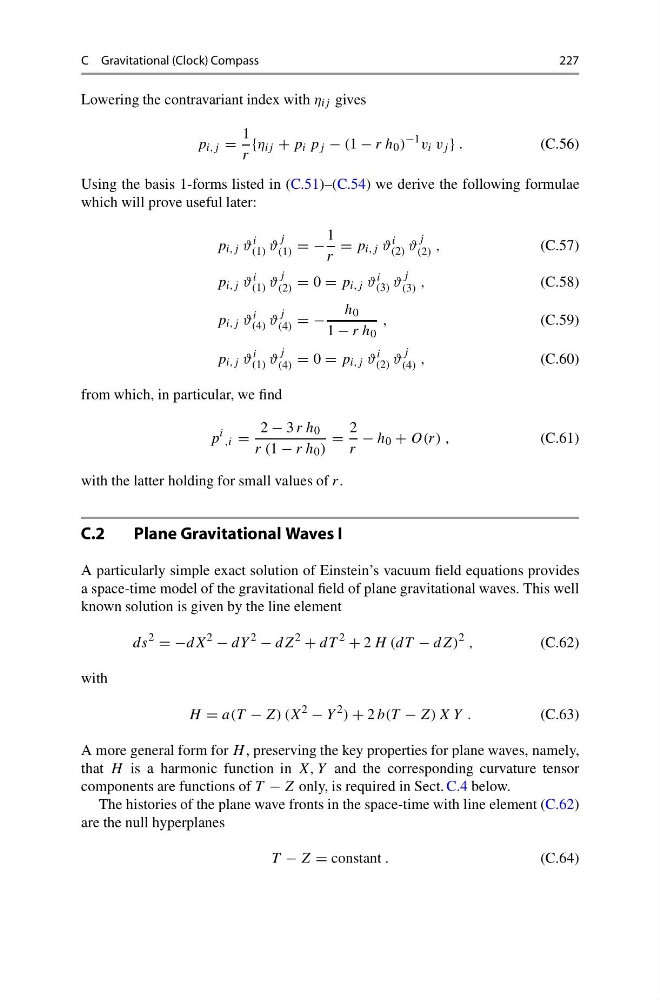
Lowering the contravariant index with η ij gives
p i,j =
1
r
{η ij + p i p j − (1 − r h 0 )
−1 v i v j } .
(C.56)
Using the basis 1-forms listed in (C.51)–(C.54) we derive the following formulae
which will prove useful later:
p i,j ϑ
i
(1) ϑ
j
(1) = −
1
r
= p i,j ϑ
i
(2) ϑ
j
(2) ,
(C.57)
p i,j ϑ
i
(1) ϑ
j
(2) = 0 = p i,j ϑ
i
(3) ϑ
j
(3) ,
(C.58)
p i,j ϑ
i
(4) ϑ
j
(4) = −
h 0
1 − r h 0
,
(C.59)
p i,j ϑ
i
(1) ϑ
j
(4) = 0 = p i,j ϑ
i
(2) ϑ
j
(4) ,
(C.60)
from which, in particular, we find
p
i
,i =
2 − 3 r h 0
r (1 − r h 0 )
=
2
r
− h 0 + O(r) ,
(C.61)
with the latter holding for small values of r.
C.2
Plane Gravitational Waves I
A particularly simple exact solution of Einstein’s vacuum field equations provides
a space-time model of the gravitational field of plane gravitational waves. This well
known solution is given by the line element
ds
2
= −dX
2
− dY
2
− dZ
2
+ dT
2
+ 2 H (dT − dZ)
2 ,
(C.62)
with
H = a(T − Z) (X
2
− Y
2 ) + 2 b(T − Z) X Y .
(C.63)
A more general form for H , preserving the key properties for plane waves, namely,
that H is a harmonic function in X, Y and the corresponding curvature tensor
components are functions of T − Z only, is required in Sect. C.4 below.
The histories of the plane wave fronts in the space-time with line element (C.62)
are the null hyperplanes
T − Z = constant .
(C.64)
227
Lowering the contravariant index with η ij gives
p i,j =
1
r
{η ij + p i p j − (1 − r h 0 )
−1 v i v j } .
(C.56)
Using the basis 1-forms listed in (C.51)–(C.54) we derive the following formulae
which will prove useful later:
p i,j ϑ
i
(1) ϑ
j
(1) = −
1
r
= p i,j ϑ
i
(2) ϑ
j
(2) ,
(C.57)
p i,j ϑ
i
(1) ϑ
j
(2) = 0 = p i,j ϑ
i
(3) ϑ
j
(3) ,
(C.58)
p i,j ϑ
i
(4) ϑ
j
(4) = −
h 0
1 − r h 0
,
(C.59)
p i,j ϑ
i
(1) ϑ
j
(4) = 0 = p i,j ϑ
i
(2) ϑ
j
(4) ,
(C.60)
from which, in particular, we find
p
i
,i =
2 − 3 r h 0
r (1 − r h 0 )
=
2
r
− h 0 + O(r) ,
(C.61)
with the latter holding for small values of r.
C.2
Plane Gravitational Waves I
A particularly simple exact solution of Einstein’s vacuum field equations provides
a space-time model of the gravitational field of plane gravitational waves. This well
known solution is given by the line element
ds
2
= −dX
2
− dY
2
− dZ
2
+ dT
2
+ 2 H (dT − dZ)
2 ,
(C.62)
with
H = a(T − Z) (X
2
− Y
2 ) + 2 b(T − Z) X Y .
(C.63)
A more general form for H , preserving the key properties for plane waves, namely,
that H is a harmonic function in X, Y and the corresponding curvature tensor
components are functions of T − Z only, is required in Sect. C.4 below.
The histories of the plane wave fronts in the space-time with line element (C.62)
are the null hyperplanes
T − Z = constant .
(C.64)