

B Bateman Waves
217
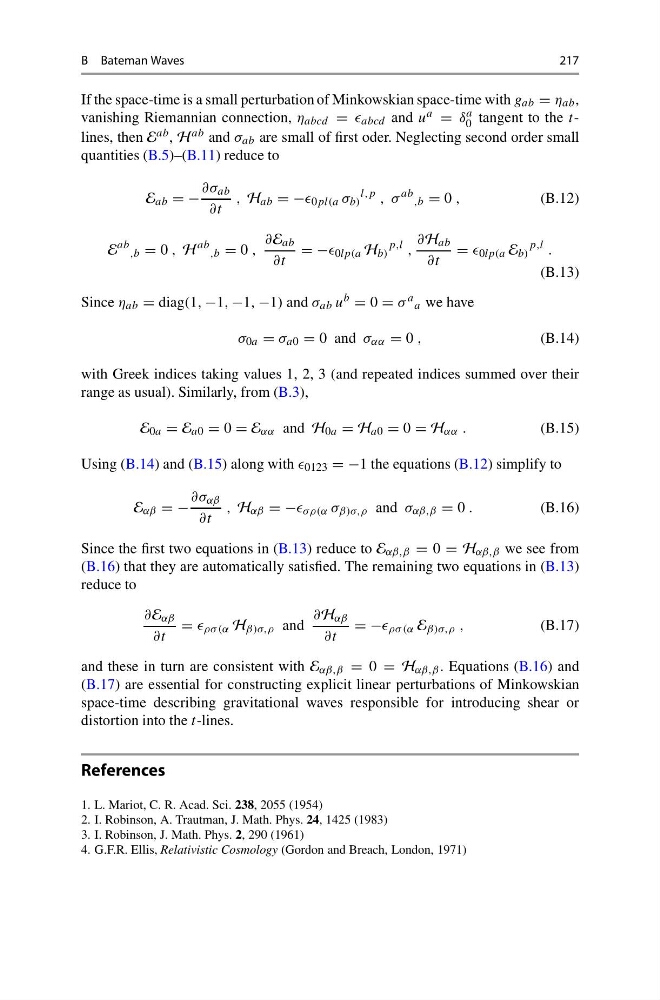
If the space-time is a small perturbation of Minkowskian space-time with g ab = η ab ,
vanishing Riemannian connection, η abcd = abcd and u a = δ a
0 tangent to the tlines, then E ab , H ab and σ ab are small of first oder. Neglecting second order small
quantities (B.5)–(B.11) reduce to
E ab = −
∂σ ab
∂t
, H ab = − 0pl(a σ b)
l,p , σ
ab
,b = 0 ,
(B.12)
E
ab
,b = 0 , H
ab
,b = 0 ,
∂E ab
∂t
= − 0lp(a H b)
p,l ,
∂H ab
∂t
= 0lp(a E b)
p,l .
(B.13)
Since η ab = diag(1, −1, −1, −1) and σ ab u b = 0 = σ a a we have
σ 0a = σ a0 = 0 and σ αα = 0 ,
(B.14)
with Greek indices taking values 1, 2, 3 (and repeated indices summed over their
range as usual). Similarly, from (B.3),
E 0a = E a0 = 0 = E αα and H 0a = H a0 = 0 = H αα .
(B.15)
Using (B.14) and (B.15) along with 0123 = −1 the equations (B.12) simplify to
E αβ = −
∂σ αβ
∂t
, H αβ = − σρ(α σ β)σ,ρ and σ αβ,β = 0 .
(B.16)
Since the first two equations in (B.13) reduce to E αβ,β = 0 = H αβ,β we see from
(B.16) that they are automatically satisfied. The remaining two equations in (B.13)
reduce to
∂E αβ
∂t
= ρσ (α H β)σ,ρ and
∂H αβ
∂t
= − ρσ (α E β)σ,ρ ,
(B.17)
and these in turn are consistent with E αβ,β = 0 = H αβ,β . Equations (B.16) and
(B.17) are essential for constructing explicit linear perturbations of Minkowskian
space-time describing gravitational waves responsible for introducing shear or
distortion into the t-lines.
References
1. L. Mariot, C. R. Acad. Sci. 238, 2055 (1954)
2. I. Robinson, A. Trautman, J. Math. Phys. 24, 1425 (1983)
3. I. Robinson, J. Math. Phys. 2, 290 (1961)
4. G.F.R. Ellis, Relativistic Cosmology (Gordon and Breach, London, 1971)
217
If the space-time is a small perturbation of Minkowskian space-time with g ab = η ab ,
vanishing Riemannian connection, η abcd = abcd and u a = δ a
0 tangent to the tlines, then E ab , H ab and σ ab are small of first oder. Neglecting second order small
quantities (B.5)–(B.11) reduce to
E ab = −
∂σ ab
∂t
, H ab = − 0pl(a σ b)
l,p , σ
ab
,b = 0 ,
(B.12)
E
ab
,b = 0 , H
ab
,b = 0 ,
∂E ab
∂t
= − 0lp(a H b)
p,l ,
∂H ab
∂t
= 0lp(a E b)
p,l .
(B.13)
Since η ab = diag(1, −1, −1, −1) and σ ab u b = 0 = σ a a we have
σ 0a = σ a0 = 0 and σ αα = 0 ,
(B.14)
with Greek indices taking values 1, 2, 3 (and repeated indices summed over their
range as usual). Similarly, from (B.3),
E 0a = E a0 = 0 = E αα and H 0a = H a0 = 0 = H αα .
(B.15)
Using (B.14) and (B.15) along with 0123 = −1 the equations (B.12) simplify to
E αβ = −
∂σ αβ
∂t
, H αβ = − σρ(α σ β)σ,ρ and σ αβ,β = 0 .
(B.16)
Since the first two equations in (B.13) reduce to E αβ,β = 0 = H αβ,β we see from
(B.16) that they are automatically satisfied. The remaining two equations in (B.13)
reduce to
∂E αβ
∂t
= ρσ (α H β)σ,ρ and
∂H αβ
∂t
= − ρσ (α E β)σ,ρ ,
(B.17)
and these in turn are consistent with E αβ,β = 0 = H αβ,β . Equations (B.16) and
(B.17) are essential for constructing explicit linear perturbations of Minkowskian
space-time describing gravitational waves responsible for introducing shear or
distortion into the t-lines.
References
1. L. Mariot, C. R. Acad. Sci. 238, 2055 (1954)
2. I. Robinson, A. Trautman, J. Math. Phys. 24, 1425 (1983)
3. I. Robinson, J. Math. Phys. 2, 290 (1961)
4. G.F.R. Ellis, Relativistic Cosmology (Gordon and Breach, London, 1971)