

216
B Bateman Waves
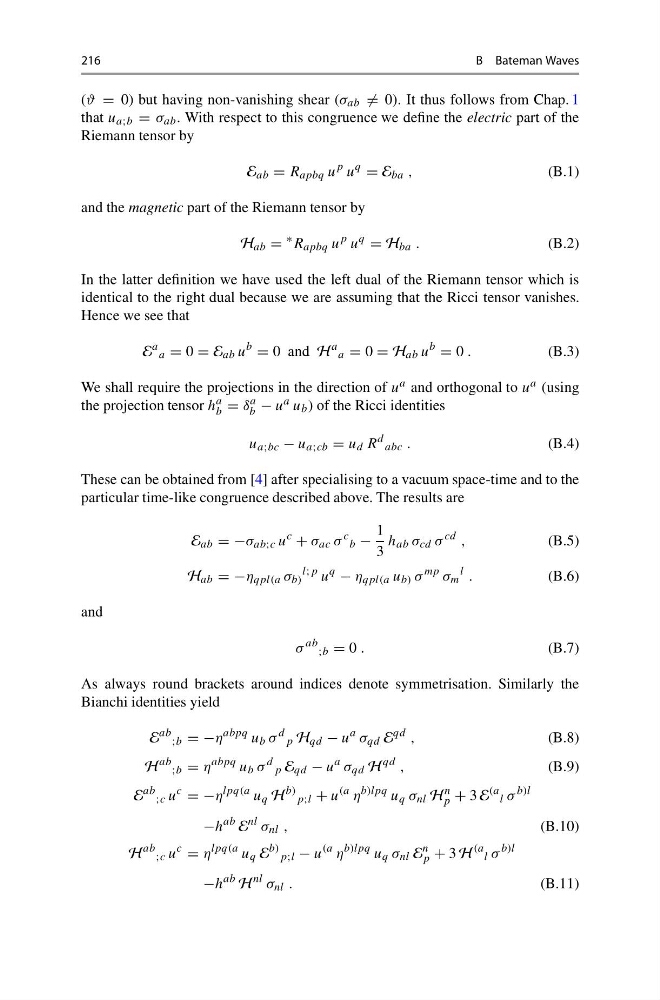
(ϑ = 0) but having non-vanishing shear (σ ab = 0). It thus follows from Chap. 1
that u a;b = σ ab . With respect to this congruence we define the electric part of the
Riemann tensor by
E ab = R apbq u
p u
q
= E ba ,
(B.1)
and the magnetic part of the Riemann tensor by
H ab =
∗ R apbq u
p u
q
= H ba .
(B.2)
In the latter definition we have used the left dual of the Riemann tensor which is
identical to the right dual because we are assuming that the Ricci tensor vanishes.
Hence we see that
E
a
a = 0 = E ab u
b
= 0 and H
a
a = 0 = H ab u
b
= 0 .
(B.3)
We shall require the projections in the direction of u a and orthogonal to u a (using
the projection tensor h
a
b = δ
a
b − u a u b ) of the Ricci identities
u a;bc − u a;cb = u d R
d
abc .
(B.4)
These can be obtained from [4] after specialising to a vacuum space-time and to the
particular time-like congruence described above. The results are
E ab = −σ ab;c u
c
+ σ ac σ
c
b −
1
3
h ab σ cd σ
cd ,
(B.5)
H ab = −η qpl(a σ b)
l;p u
q
− η qpl(a u b) σ
mp σ m
l .
(B.6)
and
σ
ab ;b = 0 .
(B.7)
As always round brackets around indices denote symmetrisation. Similarly the
Bianchi identities yield
E
ab ;b = −η
abpq u b σ
d
p H qd − u
a σ qd E
qd ,
(B.8)
H
ab ;b = η
abpq u b σ
d
p E qd − u
a σ qd H
qd ,
(B.9)
E
ab ;c u
c
= −η
lpq(a u q H
b)
p;l + u
(a η
b)lpq u q σ nl H
n
p + 3 E
(a
l σ
b)l
−h
ab
E
nl σ nl ,
(B.10)
H
ab ;c u
c
= η
lpq(a u q E
b)
p;l − u
(a η
b)lpq u q σ nl E
n
p + 3 H
(a
l σ
b)l
−h
ab
H
nl σ nl .
(B.11)
B Bateman Waves
(ϑ = 0) but having non-vanishing shear (σ ab = 0). It thus follows from Chap. 1
that u a;b = σ ab . With respect to this congruence we define the electric part of the
Riemann tensor by
E ab = R apbq u
p u
q
= E ba ,
(B.1)
and the magnetic part of the Riemann tensor by
H ab =
∗ R apbq u
p u
q
= H ba .
(B.2)
In the latter definition we have used the left dual of the Riemann tensor which is
identical to the right dual because we are assuming that the Ricci tensor vanishes.
Hence we see that
E
a
a = 0 = E ab u
b
= 0 and H
a
a = 0 = H ab u
b
= 0 .
(B.3)
We shall require the projections in the direction of u a and orthogonal to u a (using
the projection tensor h
a
b = δ
a
b − u a u b ) of the Ricci identities
u a;bc − u a;cb = u d R
d
abc .
(B.4)
These can be obtained from [4] after specialising to a vacuum space-time and to the
particular time-like congruence described above. The results are
E ab = −σ ab;c u
c
+ σ ac σ
c
b −
1
3
h ab σ cd σ
cd ,
(B.5)
H ab = −η qpl(a σ b)
l;p u
q
− η qpl(a u b) σ
mp σ m
l .
(B.6)
and
σ
ab ;b = 0 .
(B.7)
As always round brackets around indices denote symmetrisation. Similarly the
Bianchi identities yield
E
ab ;b = −η
abpq u b σ
d
p H qd − u
a σ qd E
qd ,
(B.8)
H
ab ;b = η
abpq u b σ
d
p E qd − u
a σ qd H
qd ,
(B.9)
E
ab ;c u
c
= −η
lpq(a u q H
b)
p;l + u
(a η
b)lpq u q σ nl H
n
p + 3 E
(a
l σ
b)l
−h
ab
E
nl σ nl ,
(B.10)
H
ab ;c u
c
= η
lpq(a u q E
b)
p;l − u
(a η
b)lpq u q σ nl E
n
p + 3 H
(a
l σ
b)l
−h
ab
H
nl σ nl .
(B.11)