

198
8 Reissner–Nordström Particle
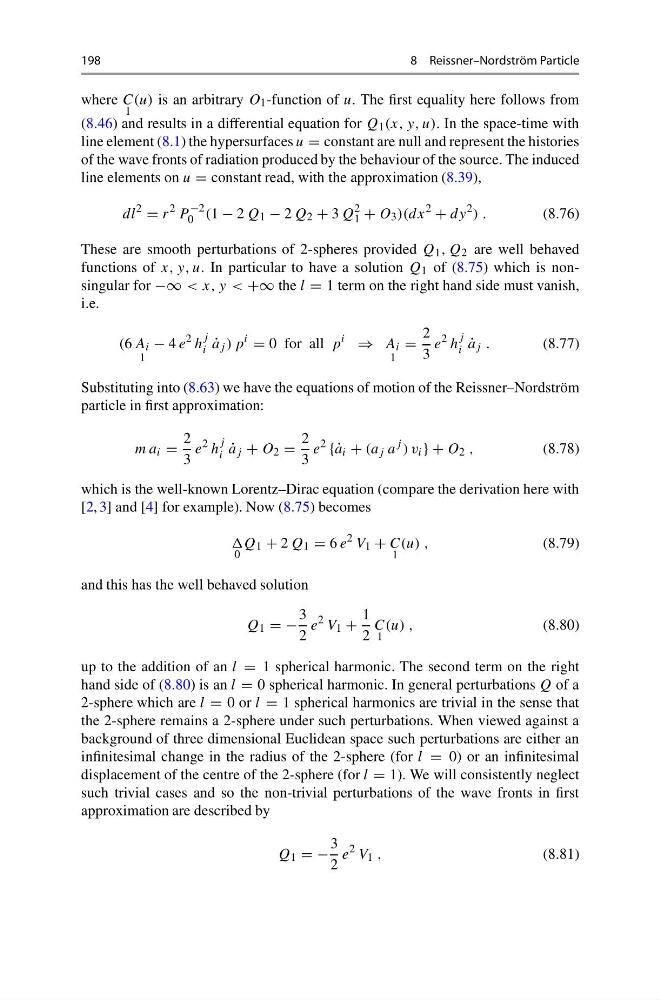
where C
1
(u) is an arbitrary O 1 -function of u. The first equality here follows from
(8.46) and results in a differential equation for Q 1 (x, y, u). In the space-time with
line element (8.1) the hypersurfaces u = constant are null and represent the histories
of the wave fronts of radiation produced by the behaviour of the source. The induced
line elements on u = constant read, with the approximation (8.39),
dl
2
= r
2 P
−2
0 (1 − 2 Q 1 − 2 Q 2 + 3 Q
2
1 + O 3 )(dx
2
+ dy
2 ) .
(8.76)
These are smooth perturbations of 2-spheres provided Q 1 , Q 2 are well behaved
functions of x, y, u. In particular to have a solution Q 1 of (8.75) which is nonsingular for −∞ < x, y < +∞ the l = 1 term on the right hand side must vanish,
i.e.
(6 A i
1
− 4 e
2 h
j
i ˙
a j ) p
i
= 0 for all p
i
⇒ A i
1
=
2
3
e
2 h
j
i ˙
a j .
(8.77)
Substituting into (8.63) we have the equations of motion of the Reissner–Nordström
particle in first approximation:
m a i =
2
3
e
2 h
j
i ˙
a j + O 2 =
2
3
e
2
{ ˙
a i + (a j a
j ) v i } + O 2 ,
(8.78)
which is the well-known Lorentz–Dirac equation (compare the derivation here with
[2, 3] and [4] for example). Now (8.75) becomes
0
Q 1 + 2 Q 1 = 6 e
2 V 1 + C
1
(u) ,
(8.79)
and this has the well behaved solution
Q 1 = −
3
2
e
2 V 1 +
1
2
C
1
(u) ,
(8.80)
up to the addition of an l = 1 spherical harmonic. The second term on the right
hand side of (8.80) is an l = 0 spherical harmonic. In general perturbations Q of a
2-sphere which are l = 0 or l = 1 spherical harmonics are trivial in the sense that
the 2-sphere remains a 2-sphere under such perturbations. When viewed against a
background of three dimensional Euclidean space such perturbations are either an
infinitesimal change in the radius of the 2-sphere (for l = 0) or an infinitesimal
displacement of the centre of the 2-sphere (for l = 1). We will consistently neglect
such trivial cases and so the non-trivial perturbations of the wave fronts in first
approximation are described by
Q 1 = −
3
2
e
2 V 1 ,
(8.81)
8 Reissner–Nordström Particle
where C
1
(u) is an arbitrary O 1 -function of u. The first equality here follows from
(8.46) and results in a differential equation for Q 1 (x, y, u). In the space-time with
line element (8.1) the hypersurfaces u = constant are null and represent the histories
of the wave fronts of radiation produced by the behaviour of the source. The induced
line elements on u = constant read, with the approximation (8.39),
dl
2
= r
2 P
−2
0 (1 − 2 Q 1 − 2 Q 2 + 3 Q
2
1 + O 3 )(dx
2
+ dy
2 ) .
(8.76)
These are smooth perturbations of 2-spheres provided Q 1 , Q 2 are well behaved
functions of x, y, u. In particular to have a solution Q 1 of (8.75) which is nonsingular for −∞ < x, y < +∞ the l = 1 term on the right hand side must vanish,
i.e.
(6 A i
1
− 4 e
2 h
j
i ˙
a j ) p
i
= 0 for all p
i
⇒ A i
1
=
2
3
e
2 h
j
i ˙
a j .
(8.77)
Substituting into (8.63) we have the equations of motion of the Reissner–Nordström
particle in first approximation:
m a i =
2
3
e
2 h
j
i ˙
a j + O 2 =
2
3
e
2
{ ˙
a i + (a j a
j ) v i } + O 2 ,
(8.78)
which is the well-known Lorentz–Dirac equation (compare the derivation here with
[2, 3] and [4] for example). Now (8.75) becomes
0
Q 1 + 2 Q 1 = 6 e
2 V 1 + C
1
(u) ,
(8.79)
and this has the well behaved solution
Q 1 = −
3
2
e
2 V 1 +
1
2
C
1
(u) ,
(8.80)
up to the addition of an l = 1 spherical harmonic. The second term on the right
hand side of (8.80) is an l = 0 spherical harmonic. In general perturbations Q of a
2-sphere which are l = 0 or l = 1 spherical harmonics are trivial in the sense that
the 2-sphere remains a 2-sphere under such perturbations. When viewed against a
background of three dimensional Euclidean space such perturbations are either an
infinitesimal change in the radius of the 2-sphere (for l = 0) or an infinitesimal
displacement of the centre of the 2-sphere (for l = 1). We will consistently neglect
such trivial cases and so the non-trivial perturbations of the wave fronts in first
approximation are described by
Q 1 = −
3
2
e
2 V 1 ,
(8.81)