

194
8 Reissner–Nordström Particle
with
K 1 =
0
Q 1 + 2 Q 1 ,
(8.46)
K 2 =
0
Q 2 + 2 Q 2 −
1
2
0
Q
2
1 + 2 Q 1
0
Q 1 + Q
2
1 ,
(8.47)
and thus
=
0
K 1 +
0
K 2 + 2 Q 1
0
K 1 + O 3 .
(8.48)
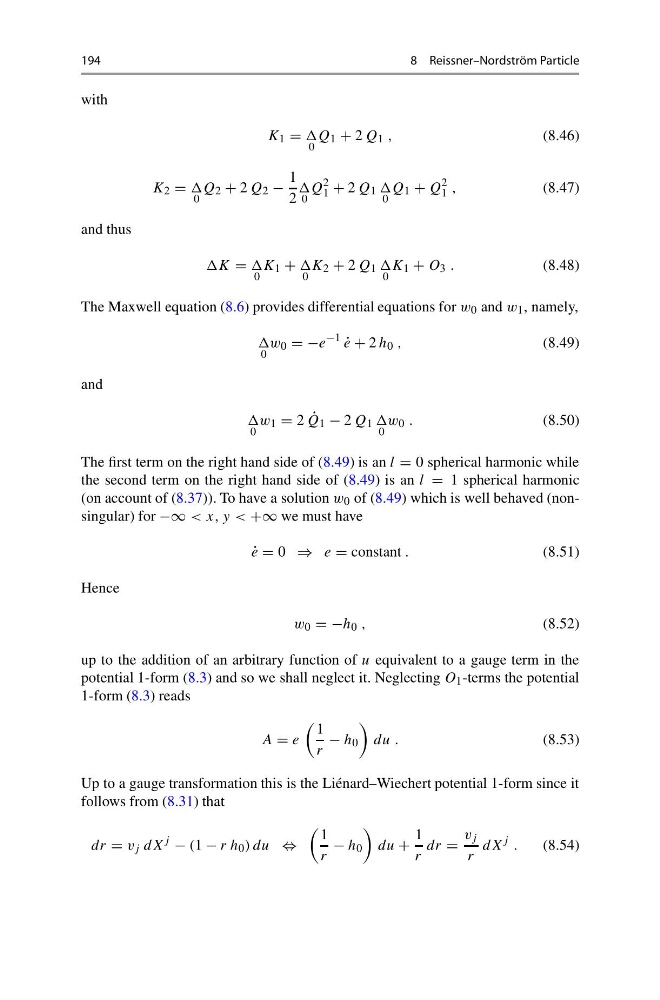
The Maxwell equation (8.6) provides differential equations for w 0 and w 1 , namely,
0
w 0 = −e
−1
˙
e + 2 h 0 ,
(8.49)
and
0
w 1 = 2 ˙
Q 1 − 2 Q 1
0
w 0 .
(8.50)
The first term on the right hand side of (8.49) is an l = 0 spherical harmonic while
the second term on the right hand side of (8.49) is an l = 1 spherical harmonic
(on account of (8.37)). To have a solution w 0 of (8.49) which is well behaved (nonsingular) for −∞ < x, y < +∞ we must have
˙
e = 0 ⇒ e = constant .
(8.51)
Hence
w 0 = −h 0 ,
(8.52)
up to the addition of an arbitrary function of u equivalent to a gauge term in the
potential 1-form (8.3) and so we shall neglect it. Neglecting O 1 -terms the potential
1-form (8.3) reads
A = e
1
r
− h 0
du .
(8.53)
Up to a gauge transformation this is the Liénard–Wiechert potential 1-form since it
follows from (8.31) that
dr = v j dX
j
− (1 − r h 0 ) du ⇔
1
r
− h 0
du +
1
r
dr =
v j
r
dX
j .
(8.54)
8 Reissner–Nordström Particle
with
K 1 =
0
Q 1 + 2 Q 1 ,
(8.46)
K 2 =
0
Q 2 + 2 Q 2 −
1
2
0
Q
2
1 + 2 Q 1
0
Q 1 + Q
2
1 ,
(8.47)
and thus
=
0
K 1 +
0
K 2 + 2 Q 1
0
K 1 + O 3 .
(8.48)
The Maxwell equation (8.6) provides differential equations for w 0 and w 1 , namely,
0
w 0 = −e
−1
˙
e + 2 h 0 ,
(8.49)
and
0
w 1 = 2 ˙
Q 1 − 2 Q 1
0
w 0 .
(8.50)
The first term on the right hand side of (8.49) is an l = 0 spherical harmonic while
the second term on the right hand side of (8.49) is an l = 1 spherical harmonic
(on account of (8.37)). To have a solution w 0 of (8.49) which is well behaved (nonsingular) for −∞ < x, y < +∞ we must have
˙
e = 0 ⇒ e = constant .
(8.51)
Hence
w 0 = −h 0 ,
(8.52)
up to the addition of an arbitrary function of u equivalent to a gauge term in the
potential 1-form (8.3) and so we shall neglect it. Neglecting O 1 -terms the potential
1-form (8.3) reads
A = e
1
r
− h 0
du .
(8.53)
Up to a gauge transformation this is the Liénard–Wiechert potential 1-form since it
follows from (8.31) that
dr = v j dX
j
− (1 − r h 0 ) du ⇔
1
r
− h 0
du +
1
r
dr =
v j
r
dX
j .
(8.54)