

182
7 Small Magnetic Black Hole
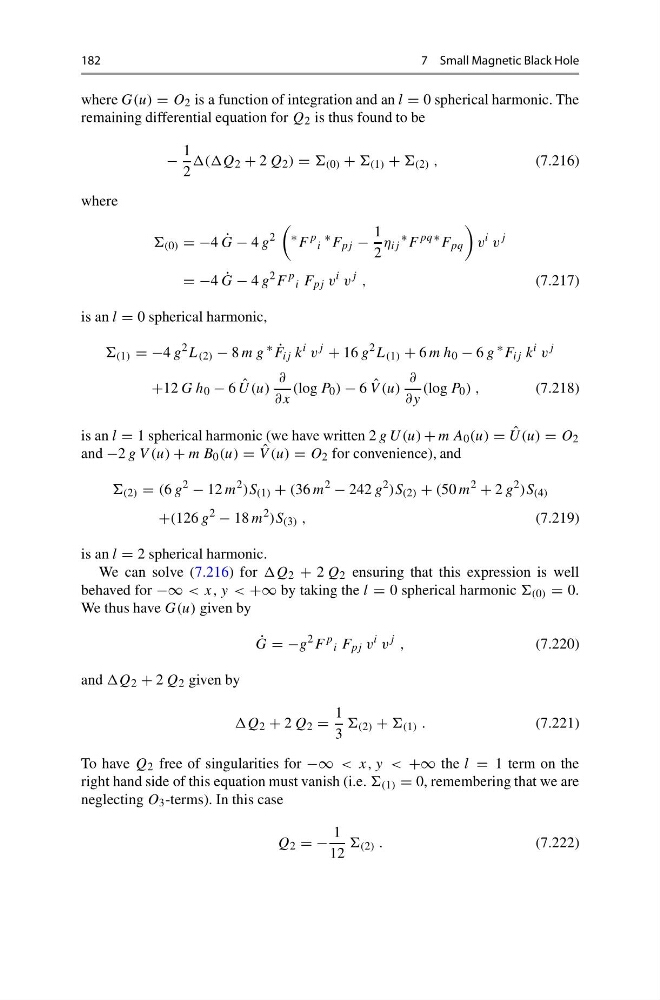
where G(u) = O 2 is a function of integration and an l = 0 spherical harmonic. The
remaining differential equation for Q 2 is thus found to be
−
1
2
2 + 2 Q 2 ) = (0) + (1) + (2) ,
(7.216)
where
(0) = −4 ˙
G − 4 g
2
∗ F
p
i
∗ F pj −
1
2
η ij
∗ F
pq ∗ F pq
v
i v
j
= −4 ˙
G − 4 g
2 F
p
i F pj v
i v
j ,
(7.217)
is an l = 0 spherical harmonic,
(1) = −4 g
2 L (2) − 8 m g
∗ ˙
F ij k
i v
j
+ 16 g
2 L (1) + 6 m h 0 − 6 g
∗ F ij k
i v
j
+12 G h 0 − 6 ˆ
U(u)
∂
∂x
(log P 0 ) − 6 ˆ
V (u)
∂
∂y
(log P 0 ) ,
(7.218)
is an l = 1 spherical harmonic (we have written 2 g U(u) + m A 0 (u) = ˆ
U(u) = O 2
and −2 g V (u) + m B 0 (u) = ˆ
V (u) = O 2 for convenience), and
(2) = (6 g
2
− 12 m
2 )S (1) + (36 m
2
− 242 g
2 )S (2) + (50 m
2
+ 2 g
2 )S (4)
+(126 g
2
− 18 m
2 )S (3) ,
(7.219)
is an l = 2 spherical harmonic.
We can solve (7.216) for 2 + 2 Q 2 ensuring that this expression is well
behaved for −∞ < x, y < +∞ by taking the l = 0 spherical harmonic (0) = 0.
We thus have G(u) given by
˙
G = −g
2 F
p
i F pj v
i v
j ,
(7.220)
and 2 + 2 Q 2 given by
2 + 2 Q 2 =
1
3
(2) + (1) .
(7.221)
To have Q 2 free of singularities for −∞ < x, y < +∞ the l = 1 term on the
right hand side of this equation must vanish (i.e. (1) = 0, remembering that we are
neglecting O 3 -terms). In this case
Q 2 = −
1
12
(2) .
(7.222)
7 Small Magnetic Black Hole
where G(u) = O 2 is a function of integration and an l = 0 spherical harmonic. The
remaining differential equation for Q 2 is thus found to be
−
1
2
2 + 2 Q 2 ) = (0) + (1) + (2) ,
(7.216)
where
(0) = −4 ˙
G − 4 g
2
∗ F
p
i
∗ F pj −
1
2
η ij
∗ F
pq ∗ F pq
v
i v
j
= −4 ˙
G − 4 g
2 F
p
i F pj v
i v
j ,
(7.217)
is an l = 0 spherical harmonic,
(1) = −4 g
2 L (2) − 8 m g
∗ ˙
F ij k
i v
j
+ 16 g
2 L (1) + 6 m h 0 − 6 g
∗ F ij k
i v
j
+12 G h 0 − 6 ˆ
U(u)
∂
∂x
(log P 0 ) − 6 ˆ
V (u)
∂
∂y
(log P 0 ) ,
(7.218)
is an l = 1 spherical harmonic (we have written 2 g U(u) + m A 0 (u) = ˆ
U(u) = O 2
and −2 g V (u) + m B 0 (u) = ˆ
V (u) = O 2 for convenience), and
(2) = (6 g
2
− 12 m
2 )S (1) + (36 m
2
− 242 g
2 )S (2) + (50 m
2
+ 2 g
2 )S (4)
+(126 g
2
− 18 m
2 )S (3) ,
(7.219)
is an l = 2 spherical harmonic.
We can solve (7.216) for 2 + 2 Q 2 ensuring that this expression is well
behaved for −∞ < x, y < +∞ by taking the l = 0 spherical harmonic (0) = 0.
We thus have G(u) given by
˙
G = −g
2 F
p
i F pj v
i v
j ,
(7.220)
and 2 + 2 Q 2 given by
2 + 2 Q 2 =
1
3
(2) + (1) .
(7.221)
To have Q 2 free of singularities for −∞ < x, y < +∞ the l = 1 term on the
right hand side of this equation must vanish (i.e. (1) = 0, remembering that we are
neglecting O 3 -terms). In this case
Q 2 = −
1
12
(2) .
(7.222)