

7.5 Equations of Motion in Second Approximation
181
and
W = 4
∂ ˆ
f −1
∂u
− 6 m h 0 −
1
2
ˆ
c 0 +
1
2
ˆ
c 0 P
2
0
∂
∂x
(P
−2
0 ˆ
a −1 ) +
∂
∂y
(P
−2
0
ˆ
b −1 )
+
5
2
g
2 P
2
0
∂
∂x
(P
−2
0 a 1 ) +
∂
∂y
(P
−2
0 b 1 )
− 3 m P
2
0
∂
∂x
(P
−2
0 ˆ
a 0 )
+
∂
∂y
(P
−2
0
ˆ
b 0 )
− 12 h 0 ˆ
f −1 + 8 g
2 (
∗ F ij k
i v
j )
2
− 6(g
2
+ 2 m
2 ) q 2 ,
(7.210)
while, again neglecting O 3 -terms,
E (4)(4) =
1
r 2
g
2 S (4) + 7 g
2 S (2) +
m
2
−
5
2
g
2
S (3)
+2(m
2
+ g
2 ) L (1) +
2
3
g
2 a i a
i
+
5
6
g
2
−
1
3
m
2
∗ F
ij ∗ F ij
+
4
3
(g
2
+ m
2 )
∗ F
p
i
∗ F pj v
i v
j
+
1
r
× O 1 + O(r
0 ) .
(7.211)
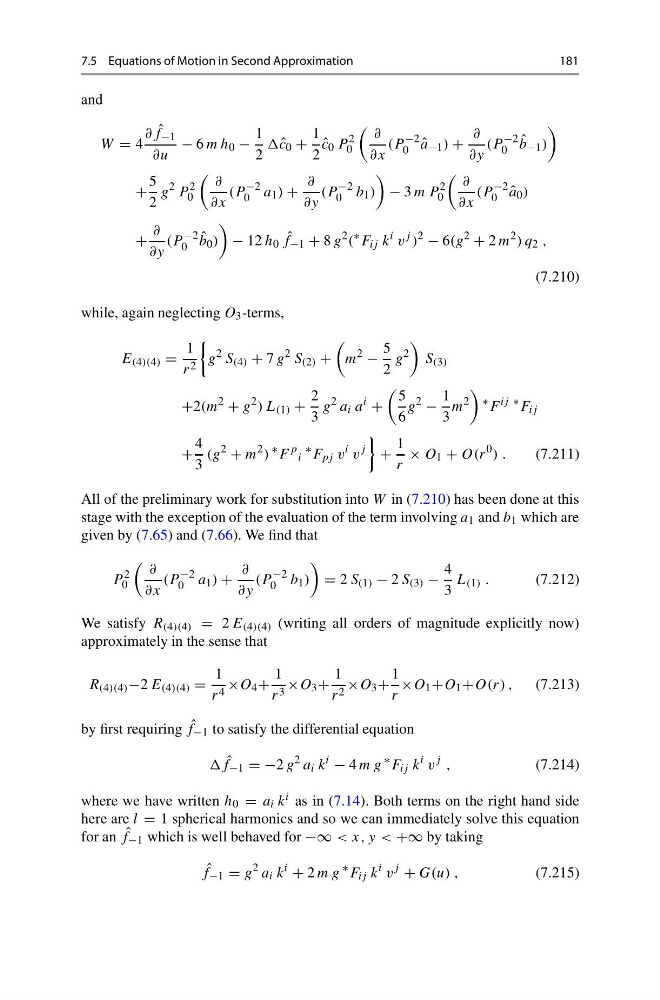
All of the preliminary work for substitution into W in (7.210) has been done at this
stage with the exception of the evaluation of the term involving a 1 and b 1 which are
given by (7.65) and (7.66). We find that
P
2
0
∂
∂x
(P
−2
0 a 1 ) +
∂
∂y
(P
−2
0 b 1 )
= 2 S (1) − 2 S (3) −
4
3
L (1) .
(7.212)
We satisfy R (4)(4) = 2 E (4)(4) (writing all orders of magnitude explicitly now)
approximately in the sense that
R (4)(4) −2 E (4)(4) =
1
r 4 ×O 4 +
1
r 3 ×O 3 +
1
r 2 ×O 3 +
1
r
×O 1 +O 1 +O(r) ,
(7.213)
by first requiring ˆ
f −1 to satisfy the differential equation
ˆ
f −1 = −2 g
2 a i k
i
− 4 m g
∗ F ij k
i v
j ,
(7.214)
where we have written h 0 = a i k i as in (7.14). Both terms on the right hand side
here are l = 1 spherical harmonics and so we can immediately solve this equation
for an ˆ
f −1 which is well behaved for −∞ < x, y < +∞ by taking
ˆ
f −1 = g
2 a i k
i
+ 2 m g
∗ F ij k
i v
j
+ G(u) ,
(7.215)
181
and
W = 4
∂ ˆ
f −1
∂u
− 6 m h 0 −
1
2
ˆ
c 0 +
1
2
ˆ
c 0 P
2
0
∂
∂x
(P
−2
0 ˆ
a −1 ) +
∂
∂y
(P
−2
0
ˆ
b −1 )
+
5
2
g
2 P
2
0
∂
∂x
(P
−2
0 a 1 ) +
∂
∂y
(P
−2
0 b 1 )
− 3 m P
2
0
∂
∂x
(P
−2
0 ˆ
a 0 )
+
∂
∂y
(P
−2
0
ˆ
b 0 )
− 12 h 0 ˆ
f −1 + 8 g
2 (
∗ F ij k
i v
j )
2
− 6(g
2
+ 2 m
2 ) q 2 ,
(7.210)
while, again neglecting O 3 -terms,
E (4)(4) =
1
r 2
g
2 S (4) + 7 g
2 S (2) +
m
2
−
5
2
g
2
S (3)
+2(m
2
+ g
2 ) L (1) +
2
3
g
2 a i a
i
+
5
6
g
2
−
1
3
m
2
∗ F
ij ∗ F ij
+
4
3
(g
2
+ m
2 )
∗ F
p
i
∗ F pj v
i v
j
+
1
r
× O 1 + O(r
0 ) .
(7.211)
All of the preliminary work for substitution into W in (7.210) has been done at this
stage with the exception of the evaluation of the term involving a 1 and b 1 which are
given by (7.65) and (7.66). We find that
P
2
0
∂
∂x
(P
−2
0 a 1 ) +
∂
∂y
(P
−2
0 b 1 )
= 2 S (1) − 2 S (3) −
4
3
L (1) .
(7.212)
We satisfy R (4)(4) = 2 E (4)(4) (writing all orders of magnitude explicitly now)
approximately in the sense that
R (4)(4) −2 E (4)(4) =
1
r 4 ×O 4 +
1
r 3 ×O 3 +
1
r 2 ×O 3 +
1
r
×O 1 +O 1 +O(r) ,
(7.213)
by first requiring ˆ
f −1 to satisfy the differential equation
ˆ
f −1 = −2 g
2 a i k
i
− 4 m g
∗ F ij k
i v
j ,
(7.214)
where we have written h 0 = a i k i as in (7.14). Both terms on the right hand side
here are l = 1 spherical harmonics and so we can immediately solve this equation
for an ˆ
f −1 which is well behaved for −∞ < x, y < +∞ by taking
ˆ
f −1 = g
2 a i k
i
+ 2 m g
∗ F ij k
i v
j
+ G(u) ,
(7.215)