

7.5 Equations of Motion in Second Approximation
175
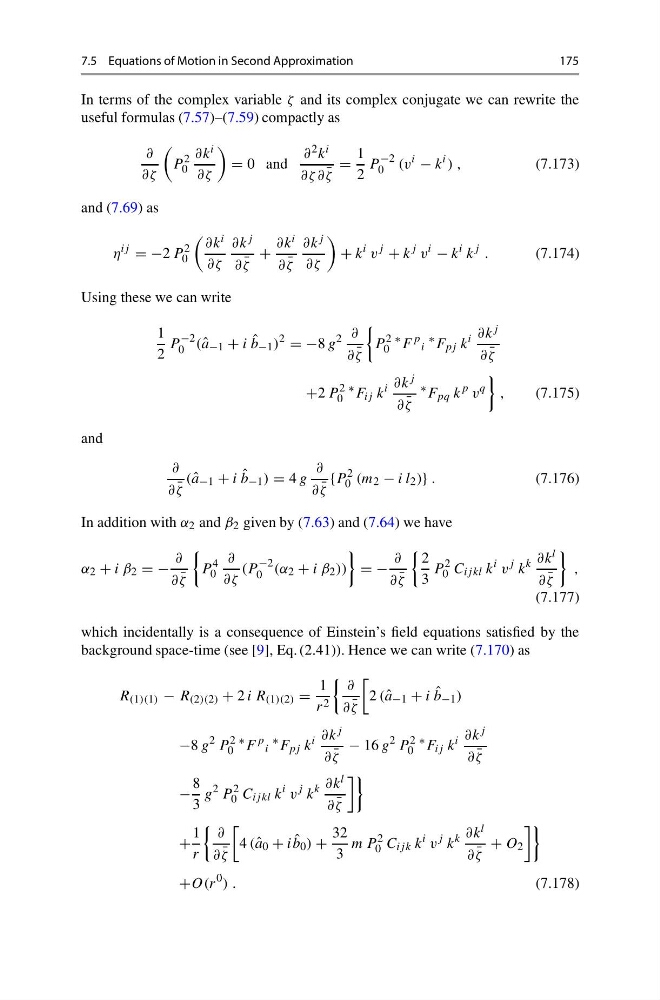
In terms of the complex variable ζ and its complex conjugate we can rewrite the
useful formulas (7.57)–(7.59) compactly as
∂
∂ζ
P
2
0
∂k i
∂ζ
= 0 and
∂ 2 k i
∂ζ ∂ ¯
ζ
=
1
2
P
−2
0 (v
i
− k
i ) ,
(7.173)
and (7.69) as
η
ij
= −2 P
2
0
∂k i
∂ζ
∂k j
∂ ¯
ζ
+
∂k i
∂ ¯
ζ
∂k j
∂ζ
+ k
i v
j
+ k
j v
i
− k
i k
j .
(7.174)
Using these we can write
1
2
P
−2
0 ( ˆ
a −1 + i ˆ
b −1 )
2
= −8 g
2 ∂
∂ ¯
ζ
P
2
0
∗ F
p
i
∗ F pj k
i ∂k j
∂ ¯
ζ
+2 P
2
0
∗ F ij k
i ∂k j
∂ ¯
ζ
∗ F pq k
p v
q
,
(7.175)
and
∂
∂ ¯
ζ
( ˆ
a −1 + i ˆ
b −1 ) = 4 g
∂
∂ ¯
ζ
{P
2
0 (m 2 − i l 2 )} .
(7.176)
In addition with α 2 and β 2 given by (7.63) and (7.64) we have
α 2 + i β 2 = −
∂
∂ ¯
ζ
P
4
0
∂
∂ζ
(P
−2
0 (α 2 + i β 2 ))
= −
∂
∂ ¯
ζ
2
3
P
2
0 C ij kl k
i v
j k
k ∂k l
∂ ¯
ζ
,
(7.177)
which incidentally is a consequence of Einstein’s field equations satisfied by the
background space-time (see [9], Eq. (2.41)). Hence we can write (7.170) as
R (1)(1) − R (2)(2) + 2 i R (1)(2) =
1
r 2
∂
∂ ¯
ζ
2 ( ˆ
a −1 + i ˆ
b −1 )
−8 g
2 P
2
0
∗ F
p
i
∗ F pj k
i ∂k j
∂ ¯
ζ
− 16 g
2 P
2
0
∗ F ij k
i ∂k j
∂ ¯
ζ
−
8
3
g
2 P
2
0 C ij kl k
i v
j k
k ∂k l
∂ ¯
ζ
+
1
r
∂
∂ ¯
ζ
4 ( ˆ
a 0 + i ˆ
b 0 ) +
32
3
m P
2
0 C ij k k
i v
j k
k ∂k l
∂ ¯
ζ
+ O 2
+O(r
0 ) .
(7.178)
175
In terms of the complex variable ζ and its complex conjugate we can rewrite the
useful formulas (7.57)–(7.59) compactly as
∂
∂ζ
P
2
0
∂k i
∂ζ
= 0 and
∂ 2 k i
∂ζ ∂ ¯
ζ
=
1
2
P
−2
0 (v
i
− k
i ) ,
(7.173)
and (7.69) as
η
ij
= −2 P
2
0
∂k i
∂ζ
∂k j
∂ ¯
ζ
+
∂k i
∂ ¯
ζ
∂k j
∂ζ
+ k
i v
j
+ k
j v
i
− k
i k
j .
(7.174)
Using these we can write
1
2
P
−2
0 ( ˆ
a −1 + i ˆ
b −1 )
2
= −8 g
2 ∂
∂ ¯
ζ
P
2
0
∗ F
p
i
∗ F pj k
i ∂k j
∂ ¯
ζ
+2 P
2
0
∗ F ij k
i ∂k j
∂ ¯
ζ
∗ F pq k
p v
q
,
(7.175)
and
∂
∂ ¯
ζ
( ˆ
a −1 + i ˆ
b −1 ) = 4 g
∂
∂ ¯
ζ
{P
2
0 (m 2 − i l 2 )} .
(7.176)
In addition with α 2 and β 2 given by (7.63) and (7.64) we have
α 2 + i β 2 = −
∂
∂ ¯
ζ
P
4
0
∂
∂ζ
(P
−2
0 (α 2 + i β 2 ))
= −
∂
∂ ¯
ζ
2
3
P
2
0 C ij kl k
i v
j k
k ∂k l
∂ ¯
ζ
,
(7.177)
which incidentally is a consequence of Einstein’s field equations satisfied by the
background space-time (see [9], Eq. (2.41)). Hence we can write (7.170) as
R (1)(1) − R (2)(2) + 2 i R (1)(2) =
1
r 2
∂
∂ ¯
ζ
2 ( ˆ
a −1 + i ˆ
b −1 )
−8 g
2 P
2
0
∗ F
p
i
∗ F pj k
i ∂k j
∂ ¯
ζ
− 16 g
2 P
2
0
∗ F ij k
i ∂k j
∂ ¯
ζ
−
8
3
g
2 P
2
0 C ij kl k
i v
j k
k ∂k l
∂ ¯
ζ
+
1
r
∂
∂ ¯
ζ
4 ( ˆ
a 0 + i ˆ
b 0 ) +
32
3
m P
2
0 C ij k k
i v
j k
k ∂k l
∂ ¯
ζ
+ O 2
+O(r
0 ) .
(7.178)