

174
7 Small Magnetic Black Hole
R (1)(1) − R (2)(2) =
1
r 2
∂ ˆ
a −1
∂x
−
∂ ˆ
b −1
∂y
+
1
2
P
−2
0 ( ˆ
a
2
−1 − ˆ
b
2
−1 ) + 4 g
2 α 2
+
1
r
2
∂ ˆ
a 0
∂x
−
∂ ˆ
b 0
∂y
− 16 m α 2 + O 2
+ O(r
0 ) ,
(7.167)
and
R (A)(A) = −
2 g 2
r 4 +
2
r 2
− 1 + ˆ
c 0 − ((Q 2 + 2 Q 2 ) +
1
4
P
−2
0 ( ˆ
a
2
−1 + ˆ
b
2
−1 )
+
3
2
P
2
0
∂
∂x
(P
−2
0 ˆ
a −1 ) +
∂
∂y
(P
−2
0
ˆ
b −1 )
+
4
r
ˆ
c 1 + 2 h 0
+P
2
0
∂
∂x
(P
−2
0 ˆ
a 0 ) +
∂
∂y
(P
−2
0
ˆ
b 0 )
+ O 2
+ O(r
0 ) .
(7.168)
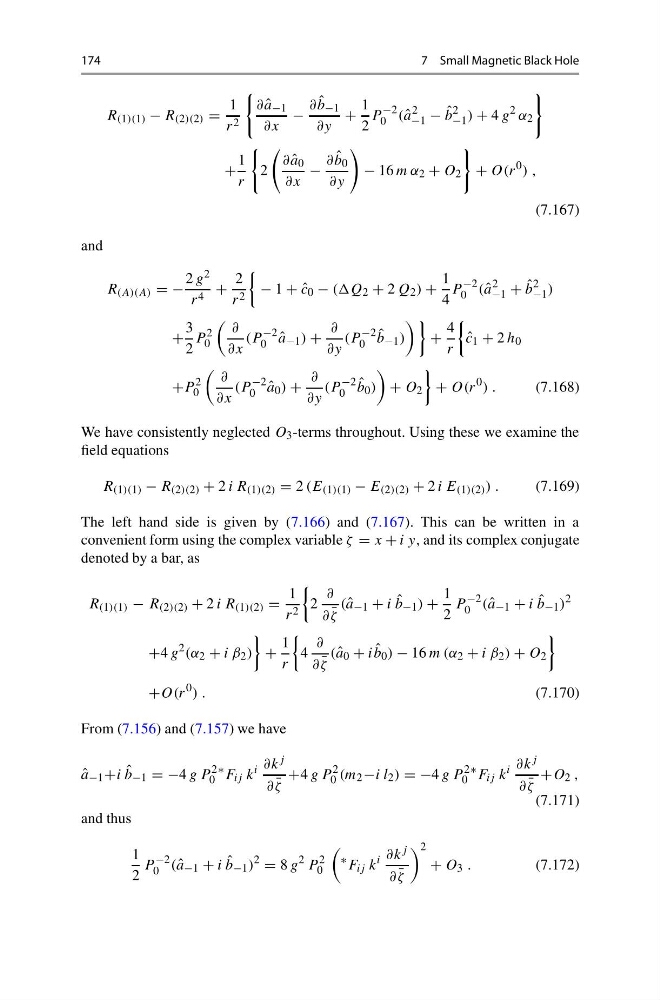
We have consistently neglected O 3 -terms throughout. Using these we examine the
field equations
R (1)(1) − R (2)(2) + 2 i R (1)(2) = 2 (E (1)(1) − E (2)(2) + 2 i E (1)(2) ) .
(7.169)
The left hand side is given by (7.166) and (7.167). This can be written in a
convenient form using the complex variable ζ = x + i y, and its complex conjugate
denoted by a bar, as
R (1)(1) − R (2)(2) + 2 i R (1)(2) =
1
r 2
2
∂
∂ ¯
ζ
( ˆ
a −1 + i ˆ
b −1 ) +
1
2
P
−2
0 ( ˆ
a −1 + i ˆ
b −1 )
2
+4 g
2 (α 2 + i β 2 )
+
1
r
4
∂
∂ ¯
ζ
( ˆ
a 0 + i ˆ
b 0 ) − 16 m (α 2 + i β 2 ) + O 2
+O(r
0 ) .
(7.170)
From (7.156) and (7.157) we have
ˆ
a −1 +i ˆ
b −1 = −4 g P
2
0
∗ F ij k
i ∂k j
∂ ¯
ζ
+4 g P
2
0 (m 2 −i l 2 ) = −4 g P
2
0
∗ F ij k
i ∂k j
∂ ¯
ζ
+O 2 ,
(7.171)
and thus
1
2
P
−2
0 ( ˆ
a −1 + i ˆ
b −1 )
2
= 8 g
2 P
2
0
∗ F ij k
i ∂k j
∂ ¯
ζ
2
+ O 3 .
(7.172)
7 Small Magnetic Black Hole
R (1)(1) − R (2)(2) =
1
r 2
∂ ˆ
a −1
∂x
−
∂ ˆ
b −1
∂y
+
1
2
P
−2
0 ( ˆ
a
2
−1 − ˆ
b
2
−1 ) + 4 g
2 α 2
+
1
r
2
∂ ˆ
a 0
∂x
−
∂ ˆ
b 0
∂y
− 16 m α 2 + O 2
+ O(r
0 ) ,
(7.167)
and
R (A)(A) = −
2 g 2
r 4 +
2
r 2
− 1 + ˆ
c 0 − ((Q 2 + 2 Q 2 ) +
1
4
P
−2
0 ( ˆ
a
2
−1 + ˆ
b
2
−1 )
+
3
2
P
2
0
∂
∂x
(P
−2
0 ˆ
a −1 ) +
∂
∂y
(P
−2
0
ˆ
b −1 )
+
4
r
ˆ
c 1 + 2 h 0
+P
2
0
∂
∂x
(P
−2
0 ˆ
a 0 ) +
∂
∂y
(P
−2
0
ˆ
b 0 )
+ O 2
+ O(r
0 ) .
(7.168)
We have consistently neglected O 3 -terms throughout. Using these we examine the
field equations
R (1)(1) − R (2)(2) + 2 i R (1)(2) = 2 (E (1)(1) − E (2)(2) + 2 i E (1)(2) ) .
(7.169)
The left hand side is given by (7.166) and (7.167). This can be written in a
convenient form using the complex variable ζ = x + i y, and its complex conjugate
denoted by a bar, as
R (1)(1) − R (2)(2) + 2 i R (1)(2) =
1
r 2
2
∂
∂ ¯
ζ
( ˆ
a −1 + i ˆ
b −1 ) +
1
2
P
−2
0 ( ˆ
a −1 + i ˆ
b −1 )
2
+4 g
2 (α 2 + i β 2 )
+
1
r
4
∂
∂ ¯
ζ
( ˆ
a 0 + i ˆ
b 0 ) − 16 m (α 2 + i β 2 ) + O 2
+O(r
0 ) .
(7.170)
From (7.156) and (7.157) we have
ˆ
a −1 +i ˆ
b −1 = −4 g P
2
0
∗ F ij k
i ∂k j
∂ ¯
ζ
+4 g P
2
0 (m 2 −i l 2 ) = −4 g P
2
0
∗ F ij k
i ∂k j
∂ ¯
ζ
+O 2 ,
(7.171)
and thus
1
2
P
−2
0 ( ˆ
a −1 + i ˆ
b −1 )
2
= 8 g
2 P
2
0
∗ F ij k
i ∂k j
∂ ¯
ζ
2
+ O 3 .
(7.172)