

1.1 Time-Like Conguences
7
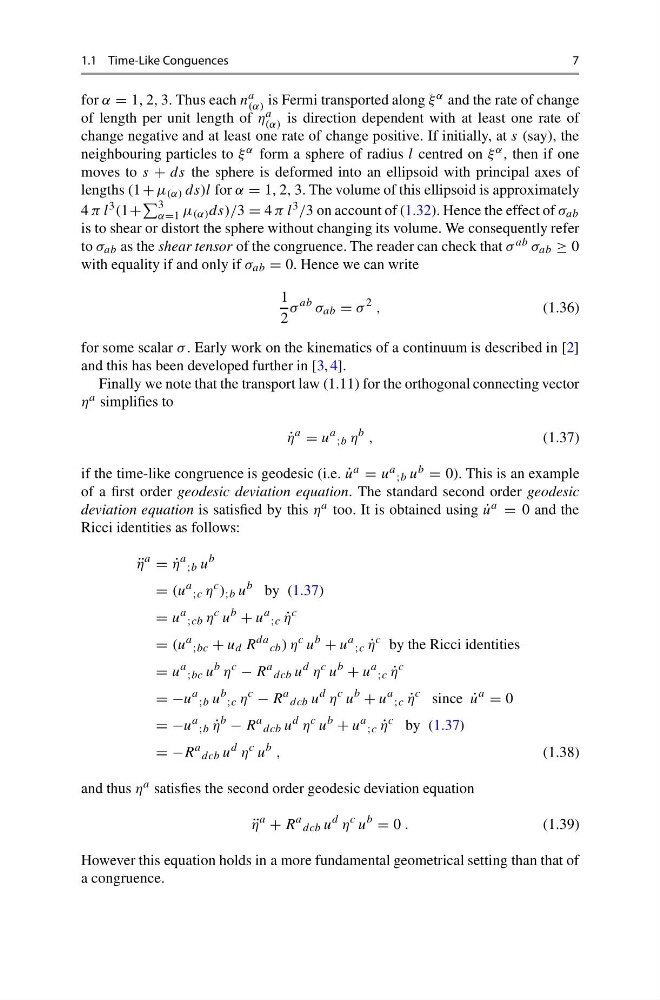
for α = 1, 2, 3. Thus each n a
(α) is Fermi transported along ξ α and the rate of change
of length per unit length of η a
(α) is direction dependent with at least one rate of
change negative and at least one rate of change positive. If initially, at s (say), the
neighbouring particles to ξ α form a sphere of radius l centred on ξ α , then if one
moves to s + ds the sphere is deformed into an ellipsoid with principal axes of
lengths (1 + μ (α) ds)l for α = 1, 2, 3. The volume of this ellipsoid is approximately
4 π l 3 (1+
3
α=1 μ (α) ds)/3 = 4 π l 3 /3 on account of (1.32). Hence the effect of σ ab
is to shear or distort the sphere without changing its volume. We consequently refer
to σ ab as the shear tensor of the congruence. The reader can check that σ ab σ ab ≥ 0
with equality if and only if σ ab = 0. Hence we can write
1
2
σ
ab σ ab = σ
2 ,
(1.36)
for some scalar σ . Early work on the kinematics of a continuum is described in [2]
and this has been developed further in [3, 4].
Finally we note that the transport law (1.11) for the orthogonal connecting vector
η a simplifies to
˙
η
a
= u
a ;b η
b ,
(1.37)
if the time-like congruence is geodesic (i.e. ˙
u a = u a ;b u b = 0). This is an example
of a first order geodesic deviation equation. The standard second order geodesic
deviation equation is satisfied by this η a too. It is obtained using ˙
u a = 0 and the
Ricci identities as follows:
¨
η
a
= ˙
η
a ;b u
b
= (u
a ;c η
c ) ;b u
b by (1.37)
= u
a ;cb η
c u
b
+ u
a ;c ˙
η
c
= (u
a ;bc + u d R
da
cb ) η
c u
b
+ u
a ;c ˙
η
c by the Ricci identities
= u
a ;bc u
b η
c
− R
a
dcb u
d η
c u
b
+ u
a ;c ˙
η
c
= −u
a ;b u
b ;c η
c
− R
a
dcb u
d η
c u
b
+ u
a ;c ˙
η
c since ˙
u
a
= 0
= −u
a ;b ˙
η
b
− R
a
dcb u
d η
c u
b
+ u
a ;c ˙
η
c by (1.37)
= −R
a
dcb u
d η
c u
b ,
(1.38)
and thus η a satisfies the second order geodesic deviation equation
¨
η
a
+ R
a
dcb u
d η
c u
b
= 0 .
(1.39)
However this equation holds in a more fundamental geometrical setting than that of
a congruence.
7
for α = 1, 2, 3. Thus each n a
(α) is Fermi transported along ξ α and the rate of change
of length per unit length of η a
(α) is direction dependent with at least one rate of
change negative and at least one rate of change positive. If initially, at s (say), the
neighbouring particles to ξ α form a sphere of radius l centred on ξ α , then if one
moves to s + ds the sphere is deformed into an ellipsoid with principal axes of
lengths (1 + μ (α) ds)l for α = 1, 2, 3. The volume of this ellipsoid is approximately
4 π l 3 (1+
3
α=1 μ (α) ds)/3 = 4 π l 3 /3 on account of (1.32). Hence the effect of σ ab
is to shear or distort the sphere without changing its volume. We consequently refer
to σ ab as the shear tensor of the congruence. The reader can check that σ ab σ ab ≥ 0
with equality if and only if σ ab = 0. Hence we can write
1
2
σ
ab σ ab = σ
2 ,
(1.36)
for some scalar σ . Early work on the kinematics of a continuum is described in [2]
and this has been developed further in [3, 4].
Finally we note that the transport law (1.11) for the orthogonal connecting vector
η a simplifies to
˙
η
a
= u
a ;b η
b ,
(1.37)
if the time-like congruence is geodesic (i.e. ˙
u a = u a ;b u b = 0). This is an example
of a first order geodesic deviation equation. The standard second order geodesic
deviation equation is satisfied by this η a too. It is obtained using ˙
u a = 0 and the
Ricci identities as follows:
¨
η
a
= ˙
η
a ;b u
b
= (u
a ;c η
c ) ;b u
b by (1.37)
= u
a ;cb η
c u
b
+ u
a ;c ˙
η
c
= (u
a ;bc + u d R
da
cb ) η
c u
b
+ u
a ;c ˙
η
c by the Ricci identities
= u
a ;bc u
b η
c
− R
a
dcb u
d η
c u
b
+ u
a ;c ˙
η
c
= −u
a ;b u
b ;c η
c
− R
a
dcb u
d η
c u
b
+ u
a ;c ˙
η
c since ˙
u
a
= 0
= −u
a ;b ˙
η
b
− R
a
dcb u
d η
c u
b
+ u
a ;c ˙
η
c by (1.37)
= −R
a
dcb u
d η
c u
b ,
(1.38)
and thus η a satisfies the second order geodesic deviation equation
¨
η
a
+ R
a
dcb u
d η
c u
b
= 0 .
(1.39)
However this equation holds in a more fundamental geometrical setting than that of
a congruence.