

7.5 Equations of Motion in Second Approximation
171
7.5
Equations of Motion in Second Approximation
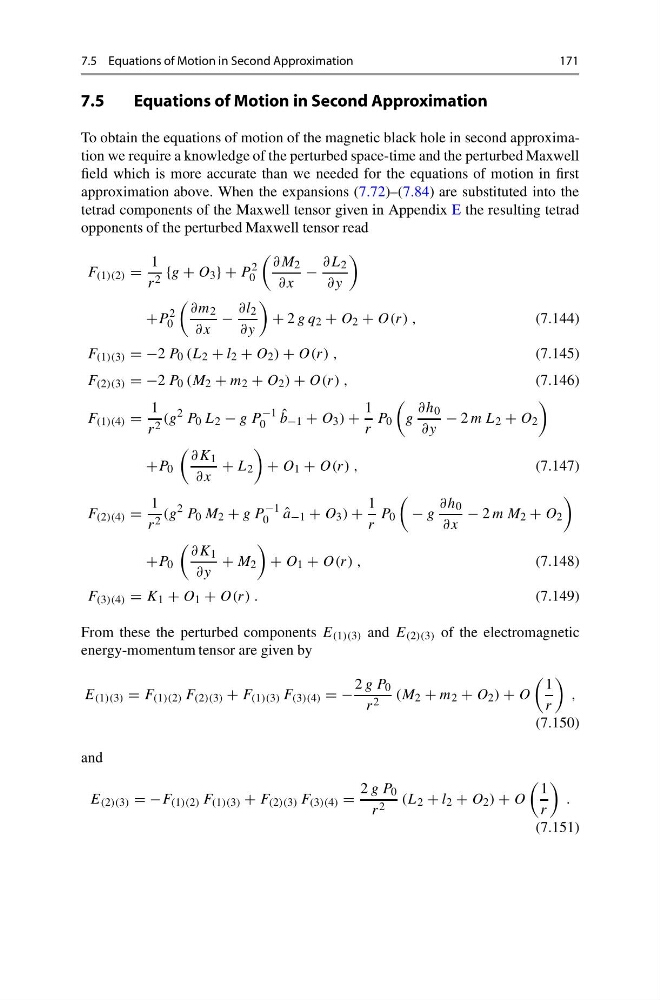
To obtain the equations of motion of the magnetic black hole in second approximation we require a knowledge of the perturbed space-time and the perturbed Maxwell
field which is more accurate than we needed for the equations of motion in first
approximation above. When the expansions (7.72)–(7.84) are substituted into the
tetrad components of the Maxwell tensor given in Appendix E the resulting tetrad
opponents of the perturbed Maxwell tensor read
F (1)(2) =
1
r 2 {g + O 3 } + P
2
0
∂M 2
∂x
−
∂L 2
∂y
+P
2
0
∂m 2
∂x
−
∂l 2
∂y
+ 2 g q 2 + O 2 + O(r) ,
(7.144)
F (1)(3) = −2 P 0 (L 2 + l 2 + O 2 ) + O(r) ,
(7.145)
F (2)(3) = −2 P 0 (M 2 + m 2 + O 2 ) + O(r) ,
(7.146)
F (1)(4) =
1
r 2 (g
2 P 0 L 2 − g P
−1
0
ˆ
b −1 + O 3 ) +
1
r
P 0
g
∂h 0
∂y
− 2 m L 2 + O 2
+P 0
∂K 1
∂x
+ L 2
+ O 1 + O(r) ,
(7.147)
F (2)(4) =
1
r 2 (g
2 P 0 M 2 + g P
−1
0 ˆ
a −1 + O 3 ) +
1
r
P 0
− g
∂h 0
∂x
− 2 m M 2 + O 2
+P 0
∂K 1
∂y
+ M 2
+ O 1 + O(r) ,
(7.148)
F (3)(4) = K 1 + O 1 + O(r) .
(7.149)
From these the perturbed components E (1)(3) and E (2)(3) of the electromagnetic
energy-momentum tensor are given by
E (1)(3) = F (1)(2) F (2)(3) + F (1)(3) F (3)(4) = −
2 g P 0
r 2 (M 2 + m 2 + O 2 ) + O
1
r
,
(7.150)
and
E (2)(3) = −F (1)(2) F (1)(3) + F (2)(3) F (3)(4) =
2 g P 0
r 2 (L 2 + l 2 + O 2 ) + O
1
r
.
(7.151)
171
7.5
Equations of Motion in Second Approximation
To obtain the equations of motion of the magnetic black hole in second approximation we require a knowledge of the perturbed space-time and the perturbed Maxwell
field which is more accurate than we needed for the equations of motion in first
approximation above. When the expansions (7.72)–(7.84) are substituted into the
tetrad components of the Maxwell tensor given in Appendix E the resulting tetrad
opponents of the perturbed Maxwell tensor read
F (1)(2) =
1
r 2 {g + O 3 } + P
2
0
∂M 2
∂x
−
∂L 2
∂y
+P
2
0
∂m 2
∂x
−
∂l 2
∂y
+ 2 g q 2 + O 2 + O(r) ,
(7.144)
F (1)(3) = −2 P 0 (L 2 + l 2 + O 2 ) + O(r) ,
(7.145)
F (2)(3) = −2 P 0 (M 2 + m 2 + O 2 ) + O(r) ,
(7.146)
F (1)(4) =
1
r 2 (g
2 P 0 L 2 − g P
−1
0
ˆ
b −1 + O 3 ) +
1
r
P 0
g
∂h 0
∂y
− 2 m L 2 + O 2
+P 0
∂K 1
∂x
+ L 2
+ O 1 + O(r) ,
(7.147)
F (2)(4) =
1
r 2 (g
2 P 0 M 2 + g P
−1
0 ˆ
a −1 + O 3 ) +
1
r
P 0
− g
∂h 0
∂x
− 2 m M 2 + O 2
+P 0
∂K 1
∂y
+ M 2
+ O 1 + O(r) ,
(7.148)
F (3)(4) = K 1 + O 1 + O(r) .
(7.149)
From these the perturbed components E (1)(3) and E (2)(3) of the electromagnetic
energy-momentum tensor are given by
E (1)(3) = F (1)(2) F (2)(3) + F (1)(3) F (3)(4) = −
2 g P 0
r 2 (M 2 + m 2 + O 2 ) + O
1
r
,
(7.150)
and
E (2)(3) = −F (1)(2) F (1)(3) + F (2)(3) F (3)(4) =
2 g P 0
r 2 (L 2 + l 2 + O 2 ) + O
1
r
.
(7.151)