

170
7 Small Magnetic Black Hole
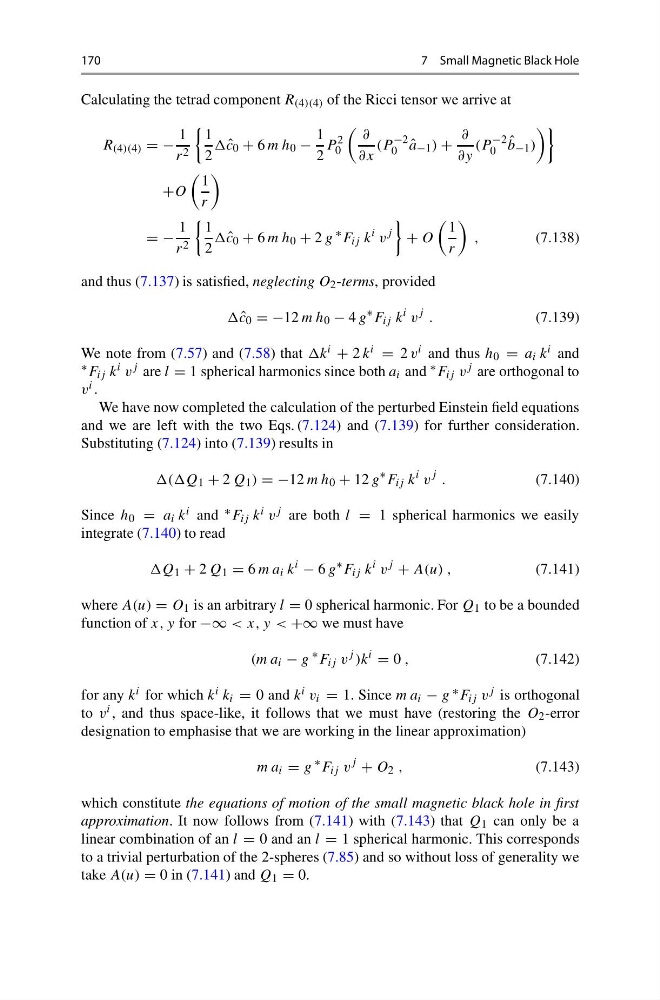
Calculating the tetrad component R (4)(4) of the Ricci tensor we arrive at
R (4)(4) = −
1
r 2
1
2
ˆ
c 0 + 6 m h 0 −
1
2
P
2
0
∂
∂x
(P
−2
0 ˆ
a −1 ) +
∂
∂y
(P
−2
0
ˆ
b −1 )
+O
1
r
= −
1
r 2
1
2
ˆ
c 0 + 6 m h 0 + 2 g
∗ F ij k
i v
j
+ O
1
r
,
(7.138)
and thus (7.137) is satisfied, neglecting O 2 -terms, provided
ˆ
c 0 = −12 m h 0 − 4 g
∗ F ij k
i v
j .
(7.139)
We note from (7.57) and (7.58) that i + 2 k i = 2 v i and thus h 0 = a i k i and
∗ F ij k i v j are l = 1 spherical harmonics since both a i and ∗ F ij v j are orthogonal to
v i .
We have now completed the calculation of the perturbed Einstein field equations
and we are left with the two Eqs. (7.124) and (7.139) for further consideration.
Substituting (7.124) into (7.139) results in
1 + 2 Q 1 ) = −12 m h 0 + 12 g
∗ F ij k
i v
j .
(7.140)
Since h 0 = a i k i and ∗ F ij k i v j are both l = 1 spherical harmonics we easily
integrate (7.140) to read
1 + 2 Q 1 = 6 m a i k
i
− 6 g
∗ F ij k
i v
j
+ A(u) ,
(7.141)
where A(u) = O 1 is an arbitrary l = 0 spherical harmonic. For Q 1 to be a bounded
function of x, y for −∞ < x, y < +∞ we must have
(m a i − g
∗ F ij v
j )k
i
= 0 ,
(7.142)
for any k i for which k i k i = 0 and k i v i = 1. Since m a i − g ∗ F ij v j is orthogonal
to v i , and thus space-like, it follows that we must have (restoring the O 2 -error
designation to emphasise that we are working in the linear approximation)
m a i = g
∗ F ij v
j
+ O 2 ,
(7.143)
which constitute the equations of motion of the small magnetic black hole in first
approximation. It now follows from (7.141) with (7.143) that Q 1 can only be a
linear combination of an l = 0 and an l = 1 spherical harmonic. This corresponds
to a trivial perturbation of the 2-spheres (7.85) and so without loss of generality we
take A(u) = 0 in (7.141) and Q 1 = 0.
7 Small Magnetic Black Hole
Calculating the tetrad component R (4)(4) of the Ricci tensor we arrive at
R (4)(4) = −
1
r 2
1
2
ˆ
c 0 + 6 m h 0 −
1
2
P
2
0
∂
∂x
(P
−2
0 ˆ
a −1 ) +
∂
∂y
(P
−2
0
ˆ
b −1 )
+O
1
r
= −
1
r 2
1
2
ˆ
c 0 + 6 m h 0 + 2 g
∗ F ij k
i v
j
+ O
1
r
,
(7.138)
and thus (7.137) is satisfied, neglecting O 2 -terms, provided
ˆ
c 0 = −12 m h 0 − 4 g
∗ F ij k
i v
j .
(7.139)
We note from (7.57) and (7.58) that i + 2 k i = 2 v i and thus h 0 = a i k i and
∗ F ij k i v j are l = 1 spherical harmonics since both a i and ∗ F ij v j are orthogonal to
v i .
We have now completed the calculation of the perturbed Einstein field equations
and we are left with the two Eqs. (7.124) and (7.139) for further consideration.
Substituting (7.124) into (7.139) results in
1 + 2 Q 1 ) = −12 m h 0 + 12 g
∗ F ij k
i v
j .
(7.140)
Since h 0 = a i k i and ∗ F ij k i v j are both l = 1 spherical harmonics we easily
integrate (7.140) to read
1 + 2 Q 1 = 6 m a i k
i
− 6 g
∗ F ij k
i v
j
+ A(u) ,
(7.141)
where A(u) = O 1 is an arbitrary l = 0 spherical harmonic. For Q 1 to be a bounded
function of x, y for −∞ < x, y < +∞ we must have
(m a i − g
∗ F ij v
j )k
i
= 0 ,
(7.142)
for any k i for which k i k i = 0 and k i v i = 1. Since m a i − g ∗ F ij v j is orthogonal
to v i , and thus space-like, it follows that we must have (restoring the O 2 -error
designation to emphasise that we are working in the linear approximation)
m a i = g
∗ F ij v
j
+ O 2 ,
(7.143)
which constitute the equations of motion of the small magnetic black hole in first
approximation. It now follows from (7.141) with (7.143) that Q 1 can only be a
linear combination of an l = 0 and an l = 1 spherical harmonic. This corresponds
to a trivial perturbation of the 2-spheres (7.85) and so without loss of generality we
take A(u) = 0 in (7.141) and Q 1 = 0.