

6.6 Post Collision Physical Properties
151
If in the metric tensor components here we replace u, v by u + = u ϑ(u), v + =
v ϑ(v) we obtain in a single line element the expressions (6.134) and (6.136) for the
pre-collision regions and (6.164) for the post collision region. In particular this will
enable us to calculate the physical properties of the boundaries v = 0 , u ≥ 0 and
u = 0 , v ≥ 0 of the post collision region.
6.6
Post Collision Physical Properties
The Ricci tensor components of the space-time are given by
R ab = 6 k l ϑ(u) ϑ(v) g ab +
2 k l u + (k 2 u 2
+ − 3)
1 − k 2 u 2
+
δ(v) δ
3
a δ
3
b
+
2 k l v + (l 2 v 2
+ − 3)
1 − l 2 v 2
+
δ(u) δ
4
a δ
4
b .
(6.165)
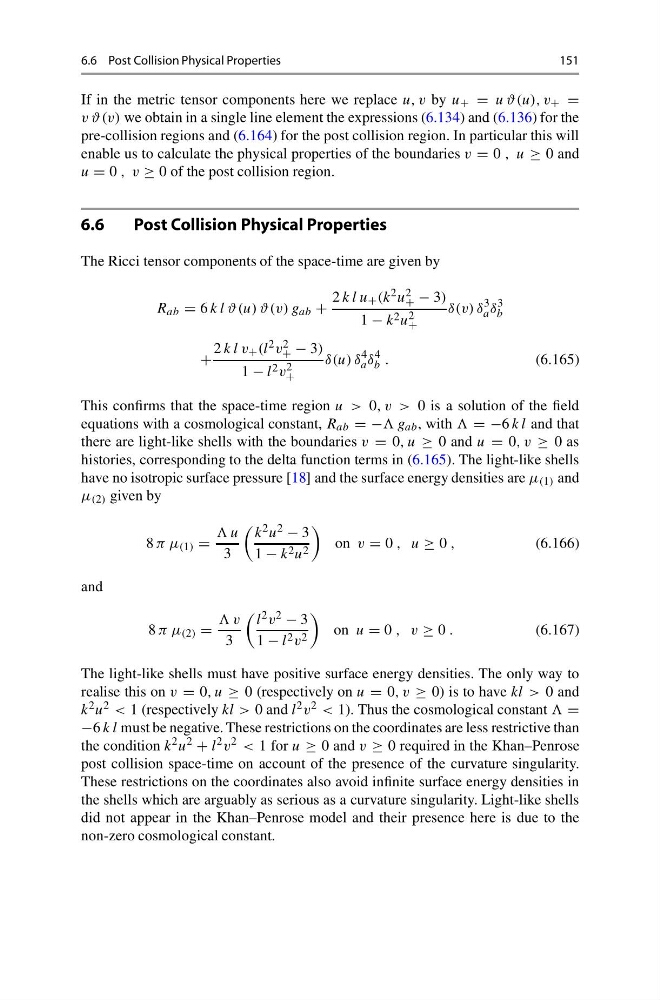
This confirms that the space-time region u > 0, v > 0 is a solution of the field
equations with a cosmological constant, R ab = − g ab , with = −6 k l and that
there are light-like shells with the boundaries v = 0, u ≥ 0 and u = 0, v ≥ 0 as
histories, corresponding to the delta function terms in (6.165). The light-like shells
have no isotropic surface pressure [18] and the surface energy densities are μ (1) and
μ (2) given by
8 π μ (1) =
u
3
k 2 u 2 − 3
1 − k 2 u 2
on v = 0 , u ≥ 0 ,
(6.166)
and
8 π μ (2) =
v
3
l 2 v 2 − 3
1 − l 2 v 2
on u = 0 , v ≥ 0 .
(6.167)
The light-like shells must have positive surface energy densities. The only way to
realise this on v = 0, u ≥ 0 (respectively on u = 0, v ≥ 0) is to have kl > 0 and
k 2 u 2 < 1 (respectively kl > 0 and l 2 v 2 < 1). Thus the cosmological constant =
−6 k l must be negative. These restrictions on the coordinates are less restrictive than
the condition k 2 u 2 + l 2 v 2 < 1 for u ≥ 0 and v ≥ 0 required in the Khan–Penrose
post collision space-time on account of the presence of the curvature singularity.
These restrictions on the coordinates also avoid infinite surface energy densities in
the shells which are arguably as serious as a curvature singularity. Light-like shells
did not appear in the Khan–Penrose model and their presence here is due to the
non-zero cosmological constant.
151
If in the metric tensor components here we replace u, v by u + = u ϑ(u), v + =
v ϑ(v) we obtain in a single line element the expressions (6.134) and (6.136) for the
pre-collision regions and (6.164) for the post collision region. In particular this will
enable us to calculate the physical properties of the boundaries v = 0 , u ≥ 0 and
u = 0 , v ≥ 0 of the post collision region.
6.6
Post Collision Physical Properties
The Ricci tensor components of the space-time are given by
R ab = 6 k l ϑ(u) ϑ(v) g ab +
2 k l u + (k 2 u 2
+ − 3)
1 − k 2 u 2
+
δ(v) δ
3
a δ
3
b
+
2 k l v + (l 2 v 2
+ − 3)
1 − l 2 v 2
+
δ(u) δ
4
a δ
4
b .
(6.165)
This confirms that the space-time region u > 0, v > 0 is a solution of the field
equations with a cosmological constant, R ab = − g ab , with = −6 k l and that
there are light-like shells with the boundaries v = 0, u ≥ 0 and u = 0, v ≥ 0 as
histories, corresponding to the delta function terms in (6.165). The light-like shells
have no isotropic surface pressure [18] and the surface energy densities are μ (1) and
μ (2) given by
8 π μ (1) =
u
3
k 2 u 2 − 3
1 − k 2 u 2
on v = 0 , u ≥ 0 ,
(6.166)
and
8 π μ (2) =
v
3
l 2 v 2 − 3
1 − l 2 v 2
on u = 0 , v ≥ 0 .
(6.167)
The light-like shells must have positive surface energy densities. The only way to
realise this on v = 0, u ≥ 0 (respectively on u = 0, v ≥ 0) is to have kl > 0 and
k 2 u 2 < 1 (respectively kl > 0 and l 2 v 2 < 1). Thus the cosmological constant =
−6 k l must be negative. These restrictions on the coordinates are less restrictive than
the condition k 2 u 2 + l 2 v 2 < 1 for u ≥ 0 and v ≥ 0 required in the Khan–Penrose
post collision space-time on account of the presence of the curvature singularity.
These restrictions on the coordinates also avoid infinite surface energy densities in
the shells which are arguably as serious as a curvature singularity. Light-like shells
did not appear in the Khan–Penrose model and their presence here is due to the
non-zero cosmological constant.