

6.2 Intersecting Null Hyperplanes
135
and ˙
q = ∂q/∂u. If we now introduce the coordinate r via the equation
z − t =
1 +
6
m (z − t)
q r ,
(6.53)
the line element (6.49) takes the general Ozsváth–Robinson–Rózga [4] form
ds
2
= 2 p
−2 dζ d ¯
ζ + 2 p
−2 q
2 du{dr + (q
−1
˙
q r +
1
2
κ r
2 ) du} ,
(6.54)
with p, q given by (6.46) and (6.52) respectively. When m = 0(⇒ α = 0) this
reduces to (6.28). The construction given here illustrates an origin for the arbitrary
functions α(u), β(u) appearing in (6.54) via (6.51) and (6.52).
6.2
Intersecting Null Hyperplanes
The equations of the null hyperplanes u(t, x, y, z) = constant, are given implicitly
by (6.5) with b = 0 and by (6.6) with (6.29) holding. These are easy to visualise in
Minkowskian space-time and so it is clear that the null hyperplanes given by (6.5)
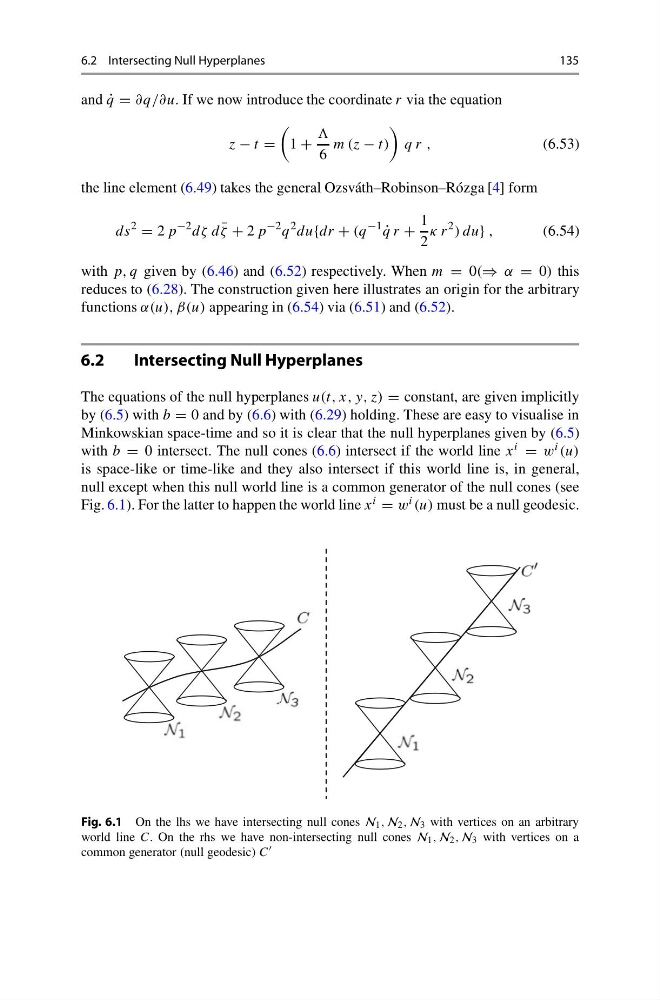
with b = 0 intersect. The null cones (6.6) intersect if the world line x i = w i (u)
is space-like or time-like and they also intersect if this world line is, in general,
null except when this null world line is a common generator of the null cones (see
Fig. 6.1). For the latter to happen the world line x i = w i (u) must be a null geodesic.
Fig. 6.1 On the lhs we have intersecting null cones N 1 , N 2 , N 3 with vertices on an arbitrary
world line C. On the rhs we have non-intersecting null cones N 1 , N 2 , N 3 with vertices on a
common generator (null geodesic) C
135
and ˙
q = ∂q/∂u. If we now introduce the coordinate r via the equation
z − t =
1 +
6
m (z − t)
q r ,
(6.53)
the line element (6.49) takes the general Ozsváth–Robinson–Rózga [4] form
ds
2
= 2 p
−2 dζ d ¯
ζ + 2 p
−2 q
2 du{dr + (q
−1
˙
q r +
1
2
κ r
2 ) du} ,
(6.54)
with p, q given by (6.46) and (6.52) respectively. When m = 0(⇒ α = 0) this
reduces to (6.28). The construction given here illustrates an origin for the arbitrary
functions α(u), β(u) appearing in (6.54) via (6.51) and (6.52).
6.2
Intersecting Null Hyperplanes
The equations of the null hyperplanes u(t, x, y, z) = constant, are given implicitly
by (6.5) with b = 0 and by (6.6) with (6.29) holding. These are easy to visualise in
Minkowskian space-time and so it is clear that the null hyperplanes given by (6.5)
with b = 0 intersect. The null cones (6.6) intersect if the world line x i = w i (u)
is space-like or time-like and they also intersect if this world line is, in general,
null except when this null world line is a common generator of the null cones (see
Fig. 6.1). For the latter to happen the world line x i = w i (u) must be a null geodesic.
Fig. 6.1 On the lhs we have intersecting null cones N 1 , N 2 , N 3 with vertices on an arbitrary
world line C. On the rhs we have non-intersecting null cones N 1 , N 2 , N 3 with vertices on a
common generator (null geodesic) C