

6.1 Null Hyperplanes in Space-Times of Constant Curvature
133
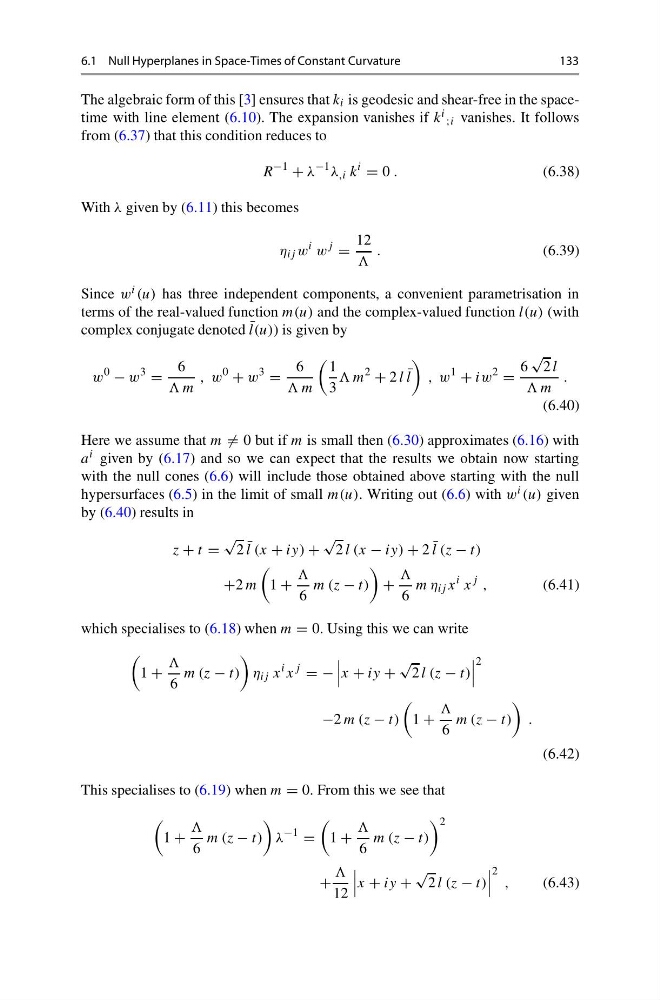
The algebraic form of this [3] ensures that k i is geodesic and shear-free in the spacetime with line element (6.10). The expansion vanishes if k i ;i vanishes. It follows
from (6.37) that this condition reduces to
R
−1
+ λ
−1 λ ,i k
i
= 0 .
(6.38)
With λ given by (6.11) this becomes
η ij w
i w
j
=
12
.
(6.39)
Since w i (u) has three independent components, a convenient parametrisation in
terms of the real-valued function m(u) and the complex-valued function l(u) (with
complex conjugate denoted ¯
l(u)) is given by
w
0
− w
3
=
6
m
, w
0
+ w
3
=
6
m
1
3
m
2
+ 2 l ¯
l
, w
1
+ iw
2
=
6
√
2 l
m
.
(6.40)
Here we assume that m = 0 but if m is small then (6.30) approximates (6.16) with
a i given by (6.17) and so we can expect that the results we obtain now starting
with the null cones (6.6) will include those obtained above starting with the null
hypersurfaces (6.5) in the limit of small m(u). Writing out (6.6) with w i (u) given
by (6.40) results in
z + t =
√
2 ¯
l (x + iy) +
√
2 l (x − iy) + 2 ¯
l (z − t)
+2 m
1 +
6
m (z − t)
+
6
m η ij x
i x
j ,
(6.41)
which specialises to (6.18) when m = 0. Using this we can write
1 +
6
m (z − t)
η ij x
i x
j
= −
x + iy +
√
2 l (z − t)
2
−2 m (z − t)
1 +
6
m (z − t)
.
(6.42)
This specialises to (6.19) when m = 0. From this we see that
1 +
6
m (z − t)
λ
−1
=
1 +
6
m (z − t)
2
+
12
x + iy +
√
2 l (z − t)
2
,
(6.43)
133
The algebraic form of this [3] ensures that k i is geodesic and shear-free in the spacetime with line element (6.10). The expansion vanishes if k i ;i vanishes. It follows
from (6.37) that this condition reduces to
R
−1
+ λ
−1 λ ,i k
i
= 0 .
(6.38)
With λ given by (6.11) this becomes
η ij w
i w
j
=
12
.
(6.39)
Since w i (u) has three independent components, a convenient parametrisation in
terms of the real-valued function m(u) and the complex-valued function l(u) (with
complex conjugate denoted ¯
l(u)) is given by
w
0
− w
3
=
6
m
, w
0
+ w
3
=
6
m
1
3
m
2
+ 2 l ¯
l
, w
1
+ iw
2
=
6
√
2 l
m
.
(6.40)
Here we assume that m = 0 but if m is small then (6.30) approximates (6.16) with
a i given by (6.17) and so we can expect that the results we obtain now starting
with the null cones (6.6) will include those obtained above starting with the null
hypersurfaces (6.5) in the limit of small m(u). Writing out (6.6) with w i (u) given
by (6.40) results in
z + t =
√
2 ¯
l (x + iy) +
√
2 l (x − iy) + 2 ¯
l (z − t)
+2 m
1 +
6
m (z − t)
+
6
m η ij x
i x
j ,
(6.41)
which specialises to (6.18) when m = 0. Using this we can write
1 +
6
m (z − t)
η ij x
i x
j
= −
x + iy +
√
2 l (z − t)
2
−2 m (z − t)
1 +
6
m (z − t)
.
(6.42)
This specialises to (6.19) when m = 0. From this we see that
1 +
6
m (z − t)
λ
−1
=
1 +
6
m (z − t)
2
+
12
x + iy +
√
2 l (z − t)
2
,
(6.43)