

5.3 Field Determination by Means of Clocks
111
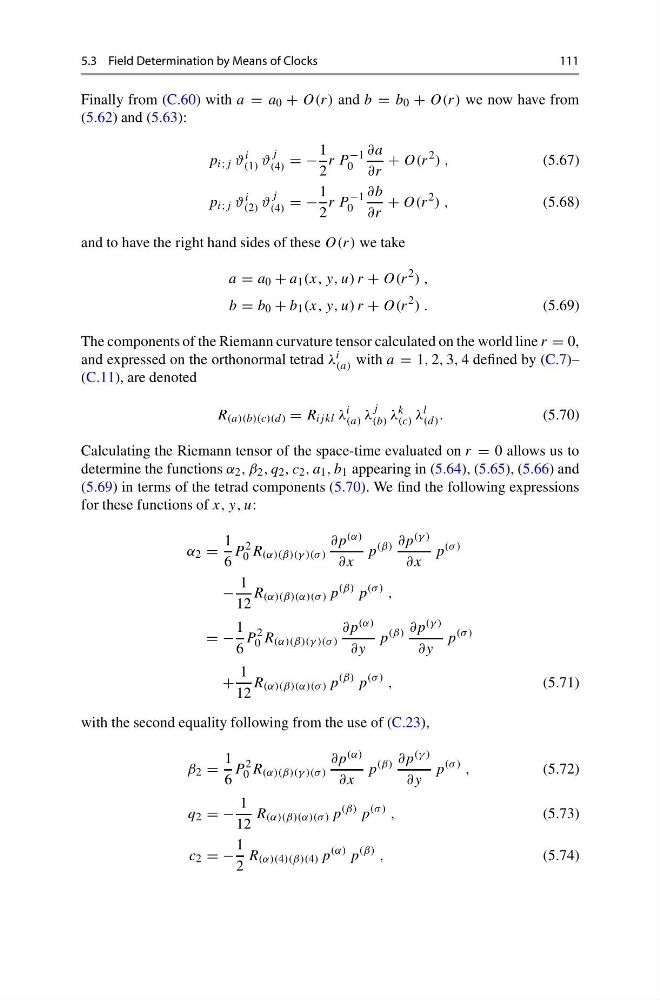
Finally from (C.60) with a = a 0 + O(r) and b = b 0 + O(r) we now have from
(5.62) and (5.63):
p i;j ϑ
i
(1) ϑ
j
(4) = −
1
2
r P
−1
0
∂a
∂r
+ O(r
2 ) ,
(5.67)
p i;j ϑ
i
(2) ϑ
j
(4) = −
1
2
r P
−1
0
∂b
∂r
+ O(r
2 ) ,
(5.68)
and to have the right hand sides of these O(r) we take
a = a 0 + a 1 (x, y, u) r + O(r
2 ) ,
b = b 0 + b 1 (x, y, u) r + O(r
2 ) .
(5.69)
The components of the Riemann curvature tensor calculated on the world line r = 0,
and expressed on the orthonormal tetrad λ
i
(a) with a = 1, 2, 3, 4 defined by (C.7)–
(C.11), are denoted
R (a)(b)(c)(d) = R ij kl λ
i
(a) λ
j
(b) λ
k
(c) λ
l
(d) .
(5.70)
Calculating the Riemann tensor of the space-time evaluated on r = 0 allows us to
determine the functions α 2 , β 2 , q 2 , c 2 , a 1 , b 1 appearing in (5.64), (5.65), (5.66) and
(5.69) in terms of the tetrad components (5.70). We find the following expressions
for these functions of x, y, u:
α 2 =
1
6
P
2
0 R (α)(β)(γ )(σ )
∂p (α)
∂x
p
(β) ∂p (γ )
∂x
p
(σ )
−
1
12
R (α)(β)(α)(σ ) p
(β) p
(σ ) ,
= −
1
6
P
2
0 R (α)(β)(γ )(σ )
∂p (α)
∂y
p
(β) ∂p (γ )
∂y
p
(σ )
+
1
12
R (α)(β)(α)(σ ) p
(β) p
(σ ) ,
(5.71)
with the second equality following from the use of (C.23),
β 2 =
1
6
P
2
0 R (α)(β)(γ )(σ )
∂p (α)
∂x
p
(β) ∂p (γ )
∂y
p
(σ ) ,
(5.72)
q 2 = −
1
12
R (α)(β)(α)(σ ) p
(β) p
(σ ) ,
(5.73)
c 2 = −
1
2
R (α)(4)(β)(4) p
(α) p
(β) ,
(5.74)
111
Finally from (C.60) with a = a 0 + O(r) and b = b 0 + O(r) we now have from
(5.62) and (5.63):
p i;j ϑ
i
(1) ϑ
j
(4) = −
1
2
r P
−1
0
∂a
∂r
+ O(r
2 ) ,
(5.67)
p i;j ϑ
i
(2) ϑ
j
(4) = −
1
2
r P
−1
0
∂b
∂r
+ O(r
2 ) ,
(5.68)
and to have the right hand sides of these O(r) we take
a = a 0 + a 1 (x, y, u) r + O(r
2 ) ,
b = b 0 + b 1 (x, y, u) r + O(r
2 ) .
(5.69)
The components of the Riemann curvature tensor calculated on the world line r = 0,
and expressed on the orthonormal tetrad λ
i
(a) with a = 1, 2, 3, 4 defined by (C.7)–
(C.11), are denoted
R (a)(b)(c)(d) = R ij kl λ
i
(a) λ
j
(b) λ
k
(c) λ
l
(d) .
(5.70)
Calculating the Riemann tensor of the space-time evaluated on r = 0 allows us to
determine the functions α 2 , β 2 , q 2 , c 2 , a 1 , b 1 appearing in (5.64), (5.65), (5.66) and
(5.69) in terms of the tetrad components (5.70). We find the following expressions
for these functions of x, y, u:
α 2 =
1
6
P
2
0 R (α)(β)(γ )(σ )
∂p (α)
∂x
p
(β) ∂p (γ )
∂x
p
(σ )
−
1
12
R (α)(β)(α)(σ ) p
(β) p
(σ ) ,
= −
1
6
P
2
0 R (α)(β)(γ )(σ )
∂p (α)
∂y
p
(β) ∂p (γ )
∂y
p
(σ )
+
1
12
R (α)(β)(α)(σ ) p
(β) p
(σ ) ,
(5.71)
with the second equality following from the use of (C.23),
β 2 =
1
6
P
2
0 R (α)(β)(γ )(σ )
∂p (α)
∂x
p
(β) ∂p (γ )
∂y
p
(σ ) ,
(5.72)
q 2 = −
1
12
R (α)(β)(α)(σ ) p
(β) p
(σ ) ,
(5.73)
c 2 = −
1
2
R (α)(4)(β)(4) p
(α) p
(β) ,
(5.74)