

110
5 Gravitational (Clock) Compass
ϑ
i
(4) = c
−1
− e
−α
{a cosh β − b sinh β},
e
α
{a sinh β − b cosh β}, 0, 1
,
(5.57)
and thus
p i;j ϑ
i
(1) ϑ
j
(1) − p i;j ϑ
i
(2) ϑ
j
(2) = −2
∂α
∂r
cosh 2 β ,
(5.58)
p i;j ϑ
i
(1) ϑ
j
(2) = −
∂β
∂r
,
(5.59)
p i;j ϑ
i
(1) ϑ
j
(1) + p i;j ϑ
i
(2) ϑ
j
(2) = −2
∂
∂r
log(r P
−1 ) ,
(5.60)
p i;j ϑ
i
(4) ϑ
j
(4) =
∂
∂r
log c ,
(5.61)
p i;j ϑ
i
(1) ϑ
j
(4) =
1
2
r (P c)
−1
−
∂a
∂r
+ (a cosh 2 β
−b sinh 2 β)
∂α
∂r
+ b
∂β
∂r
,
(5.62)
p i;j ϑ
i
(2) ϑ
j
(4) =
1
2
r (P c)
−1
−
∂b
∂r
+ (a sinh 2 β
−b cosh 2 β)
∂α
∂r
+ a
∂β
∂r
.
(5.63)
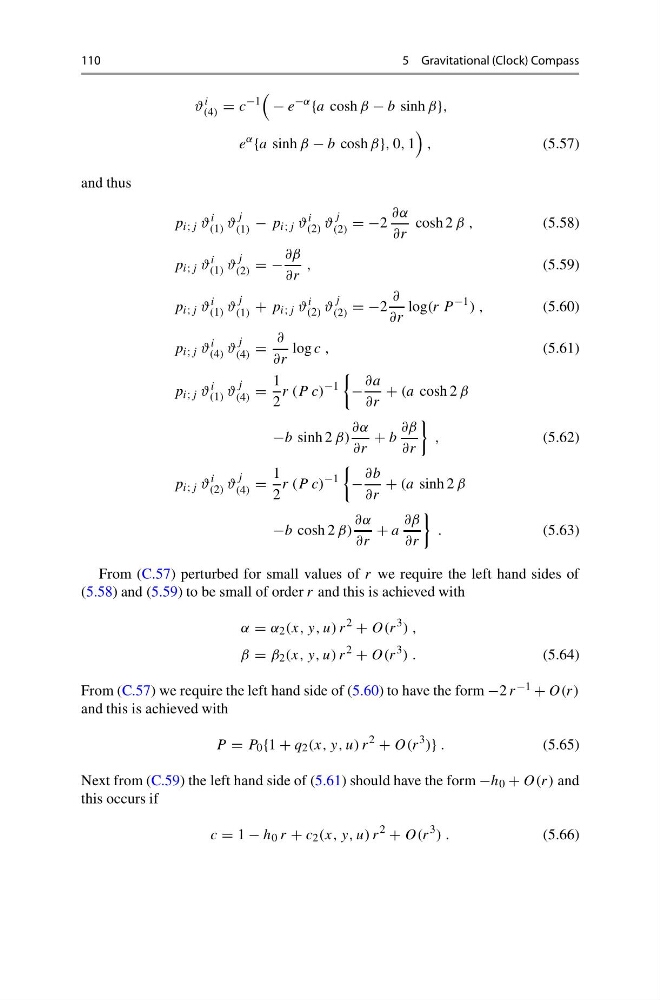
From (C.57) perturbed for small values of r we require the left hand sides of
(5.58) and (5.59) to be small of order r and this is achieved with
α = α 2 (x, y, u) r
2
+ O(r
3 ) ,
β = β 2 (x, y, u) r
2
+ O(r
3 ) .
(5.64)
From (C.57) we require the left hand side of (5.60) to have the form −2 r −1 + O(r)
and this is achieved with
P = P 0 {1 + q 2 (x, y, u) r
2
+ O(r
3 )} .
(5.65)
Next from (C.59) the left hand side of (5.61) should have the form −h 0 + O(r) and
this occurs if
c = 1 − h 0 r + c 2 (x, y, u) r
2
+ O(r
3 ) .
(5.66)
5 Gravitational (Clock) Compass
ϑ
i
(4) = c
−1
− e
−α
{a cosh β − b sinh β},
e
α
{a sinh β − b cosh β}, 0, 1
,
(5.57)
and thus
p i;j ϑ
i
(1) ϑ
j
(1) − p i;j ϑ
i
(2) ϑ
j
(2) = −2
∂α
∂r
cosh 2 β ,
(5.58)
p i;j ϑ
i
(1) ϑ
j
(2) = −
∂β
∂r
,
(5.59)
p i;j ϑ
i
(1) ϑ
j
(1) + p i;j ϑ
i
(2) ϑ
j
(2) = −2
∂
∂r
log(r P
−1 ) ,
(5.60)
p i;j ϑ
i
(4) ϑ
j
(4) =
∂
∂r
log c ,
(5.61)
p i;j ϑ
i
(1) ϑ
j
(4) =
1
2
r (P c)
−1
−
∂a
∂r
+ (a cosh 2 β
−b sinh 2 β)
∂α
∂r
+ b
∂β
∂r
,
(5.62)
p i;j ϑ
i
(2) ϑ
j
(4) =
1
2
r (P c)
−1
−
∂b
∂r
+ (a sinh 2 β
−b cosh 2 β)
∂α
∂r
+ a
∂β
∂r
.
(5.63)
From (C.57) perturbed for small values of r we require the left hand sides of
(5.58) and (5.59) to be small of order r and this is achieved with
α = α 2 (x, y, u) r
2
+ O(r
3 ) ,
β = β 2 (x, y, u) r
2
+ O(r
3 ) .
(5.64)
From (C.57) we require the left hand side of (5.60) to have the form −2 r −1 + O(r)
and this is achieved with
P = P 0 {1 + q 2 (x, y, u) r
2
+ O(r
3 )} .
(5.65)
Next from (C.59) the left hand side of (5.61) should have the form −h 0 + O(r) and
this occurs if
c = 1 − h 0 r + c 2 (x, y, u) r
2
+ O(r
3 ) .
(5.66)