

106
5 Gravitational (Clock) Compass
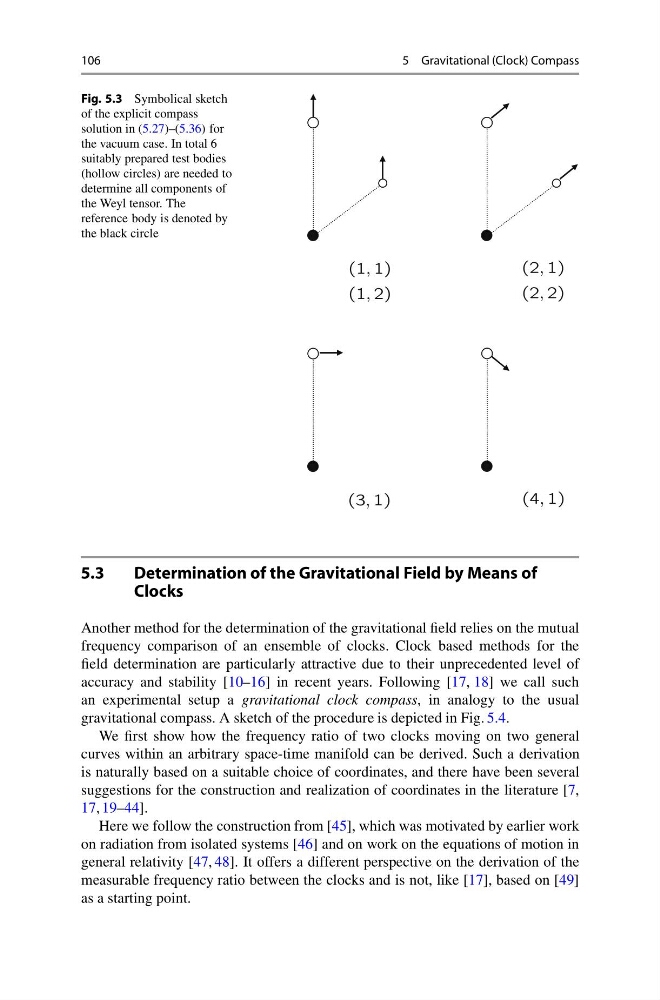
Fig. 5.3 Symbolical sketch
of the explicit compass
solution in (5.27)–(5.36) for
the vacuum case. In total 6
suitably prepared test bodies
(hollow circles) are needed to
determine all components of
the Weyl tensor. The
reference body is denoted by
the black circle
5.3
Determination of the Gravitational Field by Means of
Clocks
Another method for the determination of the gravitational field relies on the mutual
frequency comparison of an ensemble of clocks. Clock based methods for the
field determination are particularly attractive due to their unprecedented level of
accuracy and stability [10–16] in recent years. Following [17, 18] we call such
an experimental setup a gravitational clock compass, in analogy to the usual
gravitational compass. A sketch of the procedure is depicted in Fig. 5.4.
We first show how the frequency ratio of two clocks moving on two general
curves within an arbitrary space-time manifold can be derived. Such a derivation
is naturally based on a suitable choice of coordinates, and there have been several
suggestions for the construction and realization of coordinates in the literature [7,
17, 19–44].
Here we follow the construction from [45], which was motivated by earlier work
on radiation from isolated systems [46] and on work on the equations of motion in
general relativity [47, 48]. It offers a different perspective on the derivation of the
measurable frequency ratio between the clocks and is not, like [17], based on [49]
as a starting point.
5 Gravitational (Clock) Compass
Fig. 5.3 Symbolical sketch
of the explicit compass
solution in (5.27)–(5.36) for
the vacuum case. In total 6
suitably prepared test bodies
(hollow circles) are needed to
determine all components of
the Weyl tensor. The
reference body is denoted by
the black circle
5.3
Determination of the Gravitational Field by Means of
Clocks
Another method for the determination of the gravitational field relies on the mutual
frequency comparison of an ensemble of clocks. Clock based methods for the
field determination are particularly attractive due to their unprecedented level of
accuracy and stability [10–16] in recent years. Following [17, 18] we call such
an experimental setup a gravitational clock compass, in analogy to the usual
gravitational compass. A sketch of the procedure is depicted in Fig. 5.4.
We first show how the frequency ratio of two clocks moving on two general
curves within an arbitrary space-time manifold can be derived. Such a derivation
is naturally based on a suitable choice of coordinates, and there have been several
suggestions for the construction and realization of coordinates in the literature [7,
17, 19–44].
Here we follow the construction from [45], which was motivated by earlier work
on radiation from isolated systems [46] and on work on the equations of motion in
general relativity [47, 48]. It offers a different perspective on the derivation of the
measurable frequency ratio between the clocks and is not, like [17], based on [49]
as a starting point.