

5.2 Gravitational Compass
105
04 : C 2020 =
3
4
(1,2) A 2 c
−2
10 ,
(5.30)
05 : C 3020 =
3
4
(1,2) A 3 c
−2
10 ,
(5.31)
06 : C 2110 =
3
4
(2,1) A 2 c
−1
21 c
−1
20 − C 2010 c
−1
21 c 20 ,
(5.32)
07 : C 3110 =
3
4
(2,1) A 3 c
−1
21 c
−1
20 − C 3010 c
−1
21 c 20 ,
(5.33)
08 : C 0212 =
3
4
(3,1) A 0 c
−2
32 + C 2010 c
−1
32 c 30 ,
(5.34)
09 : C 0231 =
1
4
(4,1) A 2 c
−1
40 c
−1
43 −
1
4
(2,2) A 3 c
−1
20 c
−1
21
+
1
3
C 3020
c 20 c
−1
21 + c 21 c
−1
20
−
1
3
C 2010
c 40 c
−1
43 + c 43 c
−1
40
,
(5.35)
10 : C 0312 =
1
4
(4,1) A 2 c
−1
40 c
−1
42 +
1
2
(2,2) A 3 c
−1
20 c
−1
21
−
2
3
C 3020
c 20 c
−1
21 + c 21 c
−1
20
+
1
3
C 2010
c 40 c
−1
43 + c 43 c
−1
40
.
(5.36)
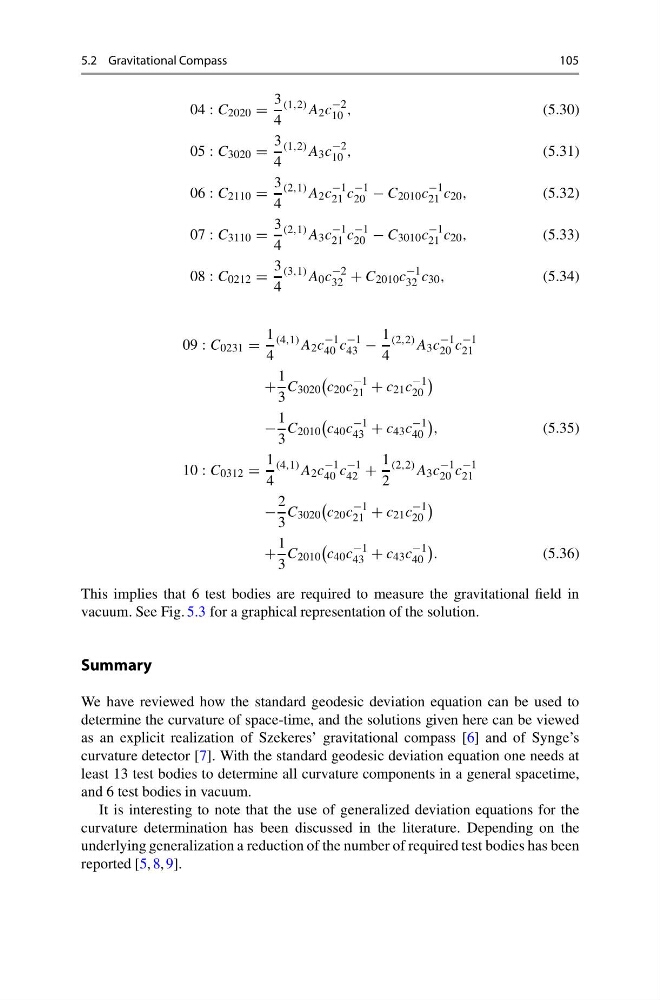
This implies that 6 test bodies are required to measure the gravitational field in
vacuum. See Fig. 5.3 for a graphical representation of the solution.
Summary
We have reviewed how the standard geodesic deviation equation can be used to
determine the curvature of space-time, and the solutions given here can be viewed
as an explicit realization of Szekeres’ gravitational compass [6] and of Synge’s
curvature detector [7]. With the standard geodesic deviation equation one needs at
least 13 test bodies to determine all curvature components in a general spacetime,
and 6 test bodies in vacuum.
It is interesting to note that the use of generalized deviation equations for the
curvature determination has been discussed in the literature. Depending on the
underlying generalization a reduction of the number of required test bodies has been
reported [5, 8, 9].
105
04 : C 2020 =
3
4
(1,2) A 2 c
−2
10 ,
(5.30)
05 : C 3020 =
3
4
(1,2) A 3 c
−2
10 ,
(5.31)
06 : C 2110 =
3
4
(2,1) A 2 c
−1
21 c
−1
20 − C 2010 c
−1
21 c 20 ,
(5.32)
07 : C 3110 =
3
4
(2,1) A 3 c
−1
21 c
−1
20 − C 3010 c
−1
21 c 20 ,
(5.33)
08 : C 0212 =
3
4
(3,1) A 0 c
−2
32 + C 2010 c
−1
32 c 30 ,
(5.34)
09 : C 0231 =
1
4
(4,1) A 2 c
−1
40 c
−1
43 −
1
4
(2,2) A 3 c
−1
20 c
−1
21
+
1
3
C 3020
c 20 c
−1
21 + c 21 c
−1
20
−
1
3
C 2010
c 40 c
−1
43 + c 43 c
−1
40
,
(5.35)
10 : C 0312 =
1
4
(4,1) A 2 c
−1
40 c
−1
42 +
1
2
(2,2) A 3 c
−1
20 c
−1
21
−
2
3
C 3020
c 20 c
−1
21 + c 21 c
−1
20
+
1
3
C 2010
c 40 c
−1
43 + c 43 c
−1
40
.
(5.36)
This implies that 6 test bodies are required to measure the gravitational field in
vacuum. See Fig. 5.3 for a graphical representation of the solution.
Summary
We have reviewed how the standard geodesic deviation equation can be used to
determine the curvature of space-time, and the solutions given here can be viewed
as an explicit realization of Szekeres’ gravitational compass [6] and of Synge’s
curvature detector [7]. With the standard geodesic deviation equation one needs at
least 13 test bodies to determine all curvature components in a general spacetime,
and 6 test bodies in vacuum.
It is interesting to note that the use of generalized deviation equations for the
curvature determination has been discussed in the literature. Depending on the
underlying generalization a reduction of the number of required test bodies has been
reported [5, 8, 9].