

100
5 Gravitational (Clock) Compass
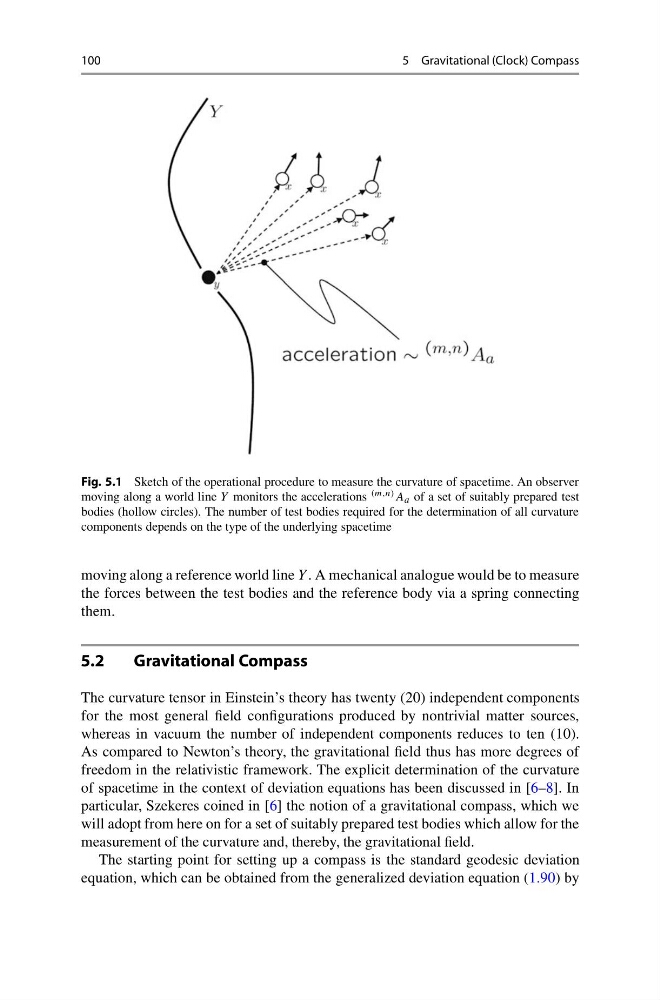
Fig. 5.1 Sketch of the operational procedure to measure the curvature of spacetime. An observer
moving along a world line Y monitors the accelerations (m,n) A a of a set of suitably prepared test
bodies (hollow circles). The number of test bodies required for the determination of all curvature
components depends on the type of the underlying spacetime
moving along a reference world line Y . A mechanical analogue would be to measure
the forces between the test bodies and the reference body via a spring connecting
them.
5.2
Gravitational Compass
The curvature tensor in Einstein’s theory has twenty (20) independent components
for the most general field configurations produced by nontrivial matter sources,
whereas in vacuum the number of independent components reduces to ten (10).
As compared to Newton’s theory, the gravitational field thus has more degrees of
freedom in the relativistic framework. The explicit determination of the curvature
of spacetime in the context of deviation equations has been discussed in [6–8]. In
particular, Szekeres coined in [6] the notion of a gravitational compass, which we
will adopt from here on for a set of suitably prepared test bodies which allow for the
measurement of the curvature and, thereby, the gravitational field.
The starting point for setting up a compass is the standard geodesic deviation
equation, which can be obtained from the generalized deviation equation (1.90) by
5 Gravitational (Clock) Compass
Fig. 5.1 Sketch of the operational procedure to measure the curvature of spacetime. An observer
moving along a world line Y monitors the accelerations (m,n) A a of a set of suitably prepared test
bodies (hollow circles). The number of test bodies required for the determination of all curvature
components depends on the type of the underlying spacetime
moving along a reference world line Y . A mechanical analogue would be to measure
the forces between the test bodies and the reference body via a spring connecting
them.
5.2
Gravitational Compass
The curvature tensor in Einstein’s theory has twenty (20) independent components
for the most general field configurations produced by nontrivial matter sources,
whereas in vacuum the number of independent components reduces to ten (10).
As compared to Newton’s theory, the gravitational field thus has more degrees of
freedom in the relativistic framework. The explicit determination of the curvature
of spacetime in the context of deviation equations has been discussed in [6–8]. In
particular, Szekeres coined in [6] the notion of a gravitational compass, which we
will adopt from here on for a set of suitably prepared test bodies which allow for the
measurement of the curvature and, thereby, the gravitational field.
The starting point for setting up a compass is the standard geodesic deviation
equation, which can be obtained from the generalized deviation equation (1.90) by