

86
3 Physical Theory of RFID System Physical Anti-Collision
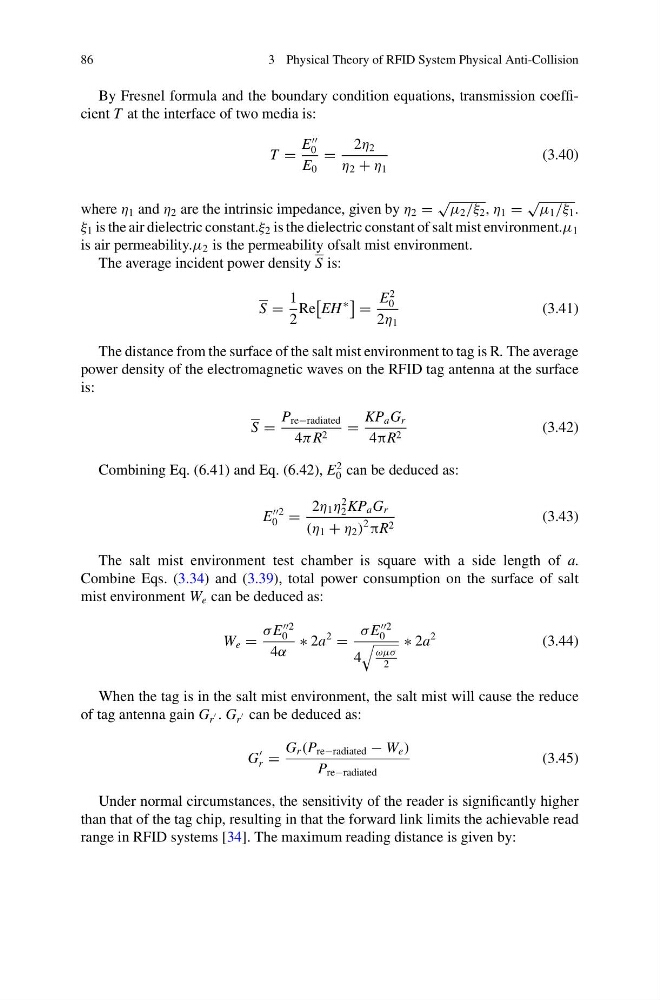
By Fresnel formula and the boundary condition equations, transmission coefficient T at the interface of two media is:
T =
E
0
E 0
=
2η 2
η 2 + η 1
(3.40)
where η 1 and η 2 are the intrinsic impedance, given by η 2 =
√ μ 2 /ξ 2 , η 1 =
√ μ 1 /ξ 1 .
ξ 1 is the air dielectric constant.ξ 2 is the dielectric constant of salt mist environment.μ 1
is air permeability.μ 2 is the permeability ofsalt mist environment.
The average incident power density S is:
S =
1
2
Re
EH
∗
=
E
2
0
2η 1
(3.41)
The distance from the surface of the salt mist environment to tag is R. The average
power density of the electromagnetic waves on the RFID tag antenna at the surface
is:
S =
P re−radiated
4π R 2 =
KP a G r
4πR 2
(3.42)
Combining Eq. (6.41) and Eq. (6.42), E
2
0 can be deduced as:
E
2
0 =
2η 1 η
2
2 KP a G r
(η 1 + η 2 )
2
πR 2
(3.43)
The salt mist environment test chamber is square with a side length of a.
Combine Eqs. (3.34) and (3.39), total power consumption on the surface of salt
mist environment W e can be deduced as:
W e =
σ E
2
0
4α
∗ 2a
2
=
σ E
2
0
4
ωμσ
2
∗ 2a
2
(3.44)
When the tag is in the salt mist environment, the salt mist will cause the reduce
of tag antenna gain G r
. G r
can be deduced as:
G
r =
G r (P re−radiated − W e )
P re−radiated
(3.45)
Under normal circumstances, the sensitivity of the reader is significantly higher
than that of the tag chip, resulting in that the forward link limits the achievable read
range in RFID systems [34]. The maximum reading distance is given by:
3 Physical Theory of RFID System Physical Anti-Collision
By Fresnel formula and the boundary condition equations, transmission coefficient T at the interface of two media is:
T =
E
0
E 0
=
2η 2
η 2 + η 1
(3.40)
where η 1 and η 2 are the intrinsic impedance, given by η 2 =
√ μ 2 /ξ 2 , η 1 =
√ μ 1 /ξ 1 .
ξ 1 is the air dielectric constant.ξ 2 is the dielectric constant of salt mist environment.μ 1
is air permeability.μ 2 is the permeability ofsalt mist environment.
The average incident power density S is:
S =
1
2
Re
EH
∗
=
E
2
0
2η 1
(3.41)
The distance from the surface of the salt mist environment to tag is R. The average
power density of the electromagnetic waves on the RFID tag antenna at the surface
is:
S =
P re−radiated
4π R 2 =
KP a G r
4πR 2
(3.42)
Combining Eq. (6.41) and Eq. (6.42), E
2
0 can be deduced as:
E
2
0 =
2η 1 η
2
2 KP a G r
(η 1 + η 2 )
2
πR 2
(3.43)
The salt mist environment test chamber is square with a side length of a.
Combine Eqs. (3.34) and (3.39), total power consumption on the surface of salt
mist environment W e can be deduced as:
W e =
σ E
2
0
4α
∗ 2a
2
=
σ E
2
0
4
ωμσ
2
∗ 2a
2
(3.44)
When the tag is in the salt mist environment, the salt mist will cause the reduce
of tag antenna gain G r
. G r
can be deduced as:
G
r =
G r (P re−radiated − W e )
P re−radiated
(3.45)
Under normal circumstances, the sensitivity of the reader is significantly higher
than that of the tag chip, resulting in that the forward link limits the achievable read
range in RFID systems [34]. The maximum reading distance is given by: