

3.2 Electromagnetism Analysis of Physical Anti-Collision …
75
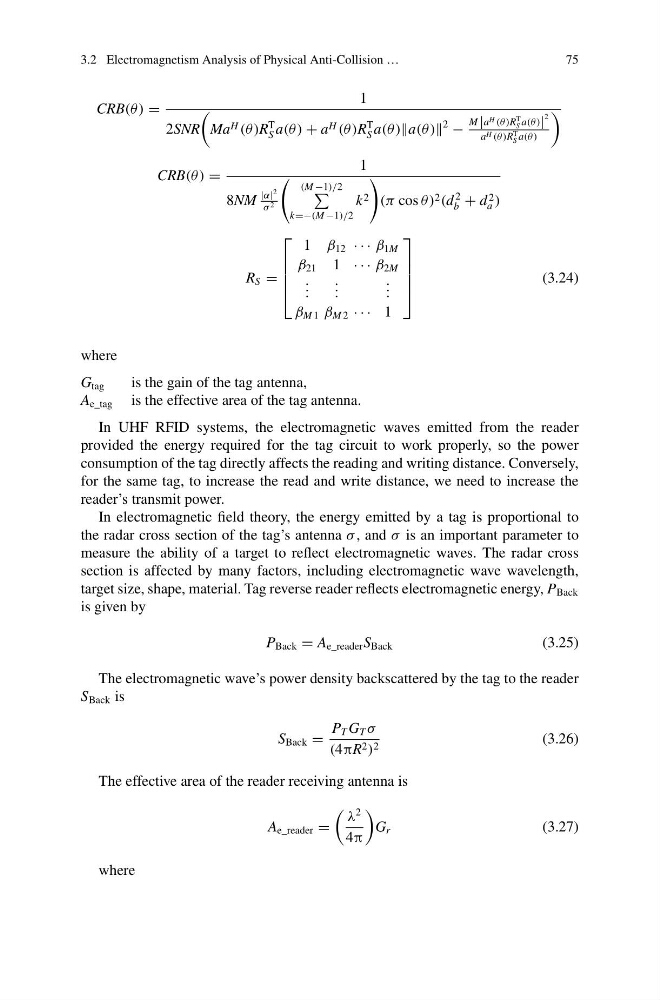
CRB(θ ) =
1
2SNR
Ma H (θ )R
T
S a(θ ) + a H (θ )R
T
S a(θ )a(θ )
2
−
M |a
H (θ)R
T
S a(θ)|
2
a H (θ)R
T
S a(θ)
CRB(θ ) =
1
8NM
|α|
2
σ 2
(M −1)/2
k=−(M −1)/2
k 2
(π cos θ) 2 (d
2
b + d 2
a )
R S =
⎡
⎢
⎢
⎢
⎣
1 β 12 · · · β 1M
β 21 1 · · · β 2M
. . .
. . .
. . .
β M 1 β M 2 · · · 1
⎤
⎥
⎥
⎥
⎦
(3.24)
where
G tag
is the gain of the tag antenna,
A e_tag is the effective area of the tag antenna.
In UHF RFID systems, the electromagnetic waves emitted from the reader
provided the energy required for the tag circuit to work properly, so the power
consumption of the tag directly affects the reading and writing distance. Conversely,
for the same tag, to increase the read and write distance, we need to increase the
reader’s transmit power.
In electromagnetic field theory, the energy emitted by a tag is proportional to
the radar cross section of the tag’s antenna σ , and σ is an important parameter to
measure the ability of a target to reflect electromagnetic waves. The radar cross
section is affected by many factors, including electromagnetic wave wavelength,
target size, shape, material. Tag reverse reader reflects electromagnetic energy, P Back
is given by
P Back = A e_reader S Back
(3.25)
The electromagnetic wave’s power density backscattered by the tag to the reader
S Back is
S Back =
P T G T σ
(4πR 2 ) 2
(3.26)
The effective area of the reader receiving antenna is
A e_reader =
λ
2
4π
G r
(3.27)
where
75
CRB(θ ) =
1
2SNR
Ma H (θ )R
T
S a(θ ) + a H (θ )R
T
S a(θ )a(θ )
2
−
M |a
H (θ)R
T
S a(θ)|
2
a H (θ)R
T
S a(θ)
CRB(θ ) =
1
8NM
|α|
2
σ 2
(M −1)/2
k=−(M −1)/2
k 2
(π cos θ) 2 (d
2
b + d 2
a )
R S =
⎡
⎢
⎢
⎢
⎣
1 β 12 · · · β 1M
β 21 1 · · · β 2M
. . .
. . .
. . .
β M 1 β M 2 · · · 1
⎤
⎥
⎥
⎥
⎦
(3.24)
where
G tag
is the gain of the tag antenna,
A e_tag is the effective area of the tag antenna.
In UHF RFID systems, the electromagnetic waves emitted from the reader
provided the energy required for the tag circuit to work properly, so the power
consumption of the tag directly affects the reading and writing distance. Conversely,
for the same tag, to increase the read and write distance, we need to increase the
reader’s transmit power.
In electromagnetic field theory, the energy emitted by a tag is proportional to
the radar cross section of the tag’s antenna σ , and σ is an important parameter to
measure the ability of a target to reflect electromagnetic waves. The radar cross
section is affected by many factors, including electromagnetic wave wavelength,
target size, shape, material. Tag reverse reader reflects electromagnetic energy, P Back
is given by
P Back = A e_reader S Back
(3.25)
The electromagnetic wave’s power density backscattered by the tag to the reader
S Back is
S Back =
P T G T σ
(4πR 2 ) 2
(3.26)
The effective area of the reader receiving antenna is
A e_reader =
λ
2
4π
G r
(3.27)
where