

232
6 Deep Learning and RFID System Physical Anti-Collision
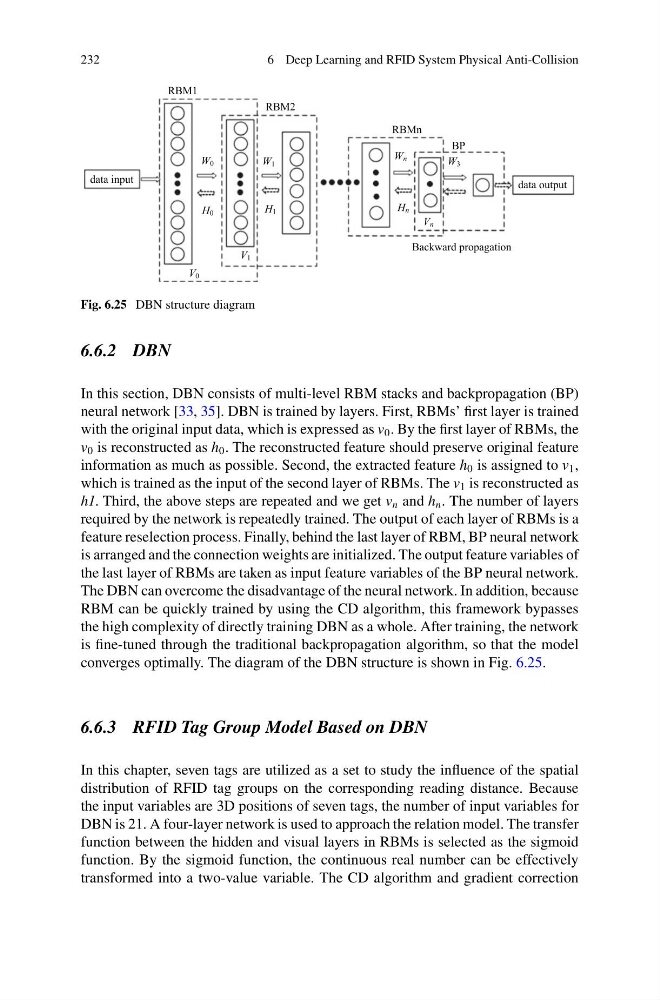
Fig. 6.25 DBN structure diagram
6.6.2 DBN
In this section, DBN consists of multi-level RBM stacks and backpropagation (BP)
neural network [33, 35]. DBN is trained by layers. First, RBMs’ first layer is trained
with the original input data, which is expressed as v 0 . By the first layer of RBMs, the
v 0 is reconstructed as h 0 . The reconstructed feature should preserve original feature
information as much as possible. Second, the extracted feature h 0 is assigned to v 1 ,
which is trained as the input of the second layer of RBMs. The v 1 is reconstructed as
h1. Third, the above steps are repeated and we get v n and h n . The number of layers
required by the network is repeatedly trained. The output of each layer of RBMs is a
feature reselection process. Finally, behind the last layer of RBM, BP neural network
is arranged and the connection weights are initialized. The output feature variables of
the last layer of RBMs are taken as input feature variables of the BP neural network.
The DBN can overcome the disadvantage of the neural network. In addition, because
RBM can be quickly trained by using the CD algorithm, this framework bypasses
the high complexity of directly training DBN as a whole. After training, the network
is fine-tuned through the traditional backpropagation algorithm, so that the model
converges optimally. The diagram of the DBN structure is shown in Fig. 6.25.
6.6.3 RFID Tag Group Model Based on DBN
In this chapter, seven tags are utilized as a set to study the influence of the spatial
distribution of RFID tag groups on the corresponding reading distance. Because
the input variables are 3D positions of seven tags, the number of input variables for
DBN is 21. A four-layer network is used to approach the relation model. The transfer
function between the hidden and visual layers in RBMs is selected as the sigmoid
function. By the sigmoid function, the continuous real number can be effectively
transformed into a two-value variable. The CD algorithm and gradient correction
6 Deep Learning and RFID System Physical Anti-Collision
Fig. 6.25 DBN structure diagram
6.6.2 DBN
In this section, DBN consists of multi-level RBM stacks and backpropagation (BP)
neural network [33, 35]. DBN is trained by layers. First, RBMs’ first layer is trained
with the original input data, which is expressed as v 0 . By the first layer of RBMs, the
v 0 is reconstructed as h 0 . The reconstructed feature should preserve original feature
information as much as possible. Second, the extracted feature h 0 is assigned to v 1 ,
which is trained as the input of the second layer of RBMs. The v 1 is reconstructed as
h1. Third, the above steps are repeated and we get v n and h n . The number of layers
required by the network is repeatedly trained. The output of each layer of RBMs is a
feature reselection process. Finally, behind the last layer of RBM, BP neural network
is arranged and the connection weights are initialized. The output feature variables of
the last layer of RBMs are taken as input feature variables of the BP neural network.
The DBN can overcome the disadvantage of the neural network. In addition, because
RBM can be quickly trained by using the CD algorithm, this framework bypasses
the high complexity of directly training DBN as a whole. After training, the network
is fine-tuned through the traditional backpropagation algorithm, so that the model
converges optimally. The diagram of the DBN structure is shown in Fig. 6.25.
6.6.3 RFID Tag Group Model Based on DBN
In this chapter, seven tags are utilized as a set to study the influence of the spatial
distribution of RFID tag groups on the corresponding reading distance. Because
the input variables are 3D positions of seven tags, the number of input variables for
DBN is 21. A four-layer network is used to approach the relation model. The transfer
function between the hidden and visual layers in RBMs is selected as the sigmoid
function. By the sigmoid function, the continuous real number can be effectively
transformed into a two-value variable. The CD algorithm and gradient correction